
Barricades and patrols in Ceuta to push out the migrants who resist returning to Morocco: ‘There are still some left’
Many young arrivals are being driven out of neighborhoods by residents and soldiers, and hiding in an area of water reservoirs and woodland
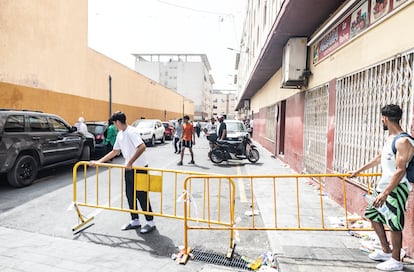

Four men stand guard at the entrance to a street in the Los Rosales neighborhood of Ceuta, where they have erected a yellow construction fence to block access. They set up their own “border” on Thursday, the same day more than 60,000 people entered the Spanish exclave city from Morocco, fearing that migrants would end up in their homes.
Given the scale of the arrivals relative to Ceuta’s population of 83,000, many residents assumed it would not be long before the newcomers reached their neighborhood, as indeed happened. By Saturday at midday, when the vast majority of those who had entered the city en masse through the breakwater at the El Tarajal border crossing had returned to Morocco of their own accord, shepherded back by the army, the residents were still maintaining their security cordon.
Few migrants could be seen in the city center, but groups of young men remained scattered through residential neighborhoods. According to the autonomous city government, there were still “several thousand” of them, wandering through the streets, sleeping in the shade, or trying to buy water, cigarettes, or something to eat. One resident of Los Rosales had set out an armchair and joked that those keeping watch in the shade were “living in luxury.” Wary of being filmed, the men pointed out other makeshift barricades that had sprung up around the area.
“My sister woke up to find they had stolen her work clothes,” one of them said. “We try to be as fair as possible; here in our neighborhood nothing has happened, everything is under control,” another insisted, though his hurried account soon expanded to include incidents reported in other districts such as Hadú, La Reina, and El Príncipe. “That man over there, he’s sick, they just slapped him,” they say.
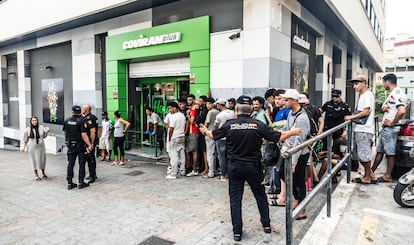
The resident, a man in his sixties, about 1.70 meters tall and very thin, sits on the marble doorstep of a house, nursing his injuries. He has two red marks on his cheekbone and is distraught.
“I have cancer, and look what they did to me for asking for a cigarette I didn’t have. They hit me! The boys there went after them, but they didn’t catch them. I’ve lived here all my life. To hell with everything!” he says, alternating between insults and phrases in dariya, the Arabic dialect spoken in Ceuta.
On the same street, one of the young migrants who has overheard his outburst voices his own frustration. “These bastards,” he says, referring to those who assault residents or commit crimes, “are stealing our future.”
Not far away, in an apartment complex in an area known as La Reina, “things are tense.” Mohamed, a 17-year-old from El Príncipe, shows a video of a Ceuta resident being stabbed on Friday around midday. “Many were driven out of El Príncipe and came here, which is home to one of the largest mosques in Ceuta, hoping for food,” he explains.
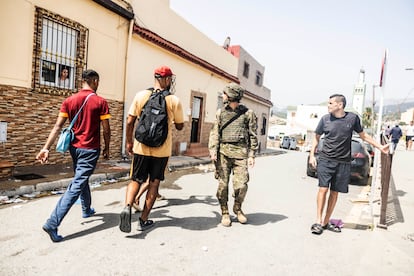
During a half-hour walk through the area, one of the young men who crossed from Morocco asks for directions to a shelter for unaccompanied minors. Nearby, two soldiers who are trying to guide migrants back toward the border stop another pair of youths from crossing, until one of them reveals a bleeding head wound. The soldiers then allow them to continue on to the university hospital.
After the city began to reopen, some establishments such as bakeries and grocery stores resumed business on Saturday. Dolores, a proud caballa (the nickname for people from Ceuta, derived from the abundance of mackerel in the Strait), has lived for 47 years in the neighborhood of La Pantera (The Panther), where she raised her two sons, now 46 and 38 years old, “without ever having a single problem.”
La Reina acquired its nickname because its apartment blocks were painted pink. With its many entry and exit points, it too filled with migrants over the past few days.
“There are still more than 300 people,” says Dolores. “We drove them out because you couldn’t walk. People from three or four neighborhoods came together, threatening them with sticks to make them leave. Yesterday we did it and this afternoon again. We’ve gone three days without bread. Let’s hope this ends once and for all, but there are still some left.” With her hair clipped back, she was carrying a bag containing four loaves of bread. In her hand, she held a knife wrapped in a napkin.
Standing near the neighborhood’s public parking lot, where her son-in-law works as a security guard, the woman describes the fear of recent days. “I had to go to the pharmacy because my husband is sick and I left with this,” she says, pointing to the knife.
“The fear that they’re here, and thinking, ‘What if they do something to me?’ Maybe they won’t do anything to you, but the fear is still there,” her son-in-law adds.
“You have to be very alert. They broke into homes with people inside and went out through windows. Now they’re hiding everywhere and when they see the soldiers they slip away underneath,” Dolores describes before leaving to make lunch.
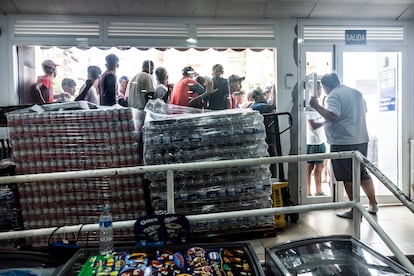
On Romero de Córdoba Street, in the densely populated neighborhood of Hadú, about 20 migrants were waiting for a bakery-grocery store to open, its shutter only slightly raised. Standing beside them were three local residents, two women and a man, all around 60 years old.
“Yesterday and today, thank God, there haven’t been any incidents in this area that I know of,” says the man, Francisco. “It’s logical for them to ask us for help, but how can you give it if you don’t have enough for yourself?”
He continues: “They’re in the same situation we’ve been in these past few days [with the businesses being closed]. Most of them have returned voluntarily because they’ve seen what the situation is like. In Los Rosales and El Príncipe, they’ve been beaten, but it’s not as though that’s happening everywhere. No one has accosted me at all. You shouldn’t go out onto the street and attack them,” he reflects.
“If it happened to me, I’d defend myself,” he adds. “In Spain, we were emigrants and you have to think about what our parents went through. You should remember and put yourself in the other person’s shoes. We’re all human beings.”
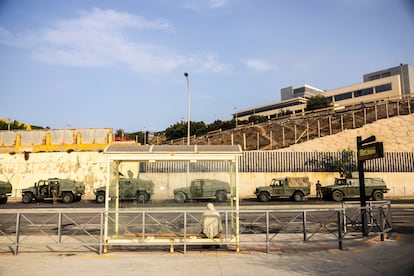
On Sunday afternoon, a few migrants still roamed the streets of these neighborhoods. Most moved cautiously when they saw the soldiers, who prevented them from entering the residential area.
The young men gradually made their way toward Benítez Beach, an area that taxi drivers consider “dangerous” simply because of the presence of the young migrants, but on Sunday, people from Ceuta were swimming there as usual.
Otma, a 20-year-old from Casablanca, watched them from the seafront promenade with friends who had arrived before Thursday, the day of the mass influx. Dressed in black shorts and a Real Madrid shirt covered in sand, he says they spend their nights hiding in nearby wooded areas and that he and the three friends who crossed with him intend to remain in the city until things calm down.
“The soldiers tell us to leave, to give up the dream of coming to Spain,” he says.
Sign up for our weekly newsletter to get more English-language news coverage from EL PAÍS USA Edition









































