Spain’s high-speed train control center: state-of-the-art software and tremendous pressure
Following the second major crash in under a year, unions are blasting working conditions at the epicenter of Adif’s network management
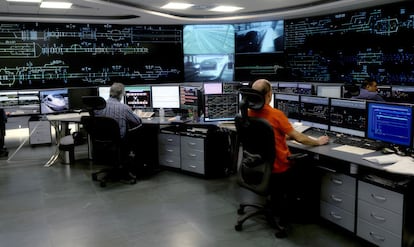
Staff shortages and intense pressure on operators during peak traffic hours. These are two recurring complaints from unions about the Command Post and Regulation and Control Center (CRC) that Spain’s rail infrastructure manager Adif operates next to Madrid’s Atocha station.
Around a hundred people work there using Da Vinci, one of the most advanced rail network monitoring systems in Europe. From its screens, workers monitor centralized traffic control, fixed and GSM-R communications, signalling, safety systems, traffic planning and regulation systems, video surveillance and station control.
Until now this place was a source of pride for Adif, the state-owned railway infrastructure manager that is dependent on the Ministry of Transportation. But it is also here that a chain of disjointed orders were issued on Wednesday morning, resulting in tragedy when two trains collided in the town of Urda, Toledo, killing at least 69 people.
The representation of the rail lines that stitch the country from top to bottom is visible on the screens via the videographic system, showing trains in real time, signals and their status, and also interlockings. Each of the orders the operator gave to the drivers affected by the LZB safety-system outage in Urda is known as a telefonema. The instructions are read from Adif’s manual, with a reference number, and are copied down by the drivers on board the trains.
Like Atocha’s, there are three other similar control centers in Antequera, Albacete and Zaragoza dedicated to high-speed rail traffic. With 18 duty positions, the Madrid center manages the Madrid–South and Northwest corridors, and also provides backup to the centers in Albacete and Antequera.
In total, Adif has about 3,700 people working on traffic management across some 20 CRCs nationwide, including conventional lines and mobile teams. In response to union complaints, an Adif spokesperson says that roughly 500 positions have been created since 2018 to reinforce train traffic control.
CSIF union spokesman Pedro Poves says the number of operator positions is the same as in 2019, before the liberalization of rail transportation — in Madrid, 18 people. “The pressure to have trains arrive on time is brutal. And it’s not easy because service isn’t interrupted when works are carried out,” he says.
Antonio Tobal, the UGT union’s state-sector rail traffic safety manager at Adif, argues that the operator blamed for the human error that triggered the collision between a Renfe train and an Iryo train in Urda had sufficient training to perform the role, if limited experience. Each operator must take charge of two to four stations, about 200 kilometers (124 miles) of track.
One of the problems at this traffic nerve center is staff leaving for other positions within Adif because of the demands of the job. The CRC is open 24 hours, seven days a week, with night and holiday shifts. Unions complain that schedules are announced with little notice, “which prevents employees from organizing vacations and causes very high turnover and low experience.” These sources say salaries range from €2,000 to €3,000 per month on average.
A CRC work shift lasts eight hours, which may be extended by the time required for handovers. The morning shift starts at 7.00am and 10 minutes of rest are allowed every two-and-a-half hours, provided a substitute can be found.
The Atocha CRC is run by a room chief, who oversees two supervisors: one for the northeast area and another for the south. They, in turn, are supported by technicians or assistants, and the team is completed by 18 front-line operators, also called circulation managers or traffic controllers.
Human factor
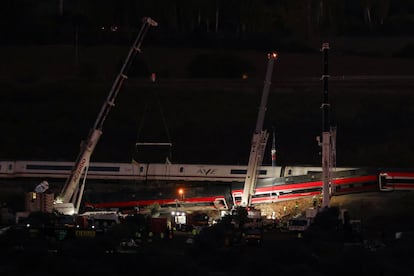
One of the assistants went over to support the operator who at 8.30 a.m. had to manage the failure of the LZB safety system across 63 kilometers (39 miles) of the Madrid–Seville line, in the Urda and Los Yébenes (Toledo) area. Under the operator’s supervision, with assistance from the aide and oversight from the supervisor, six trains were halted, including the AVE and the Iryo that crashed 23 minutes later. The controller communicated with them via two satellite phones and a third line to speak with the stations.
“The human factor is the last cog in the machinery. Before that you have to review work planning, training processes and organizational conditions,” says Pedro Poves of CSIF. His union has issued a statement saying that “public employees always give their best when a tragedy occurs.” “The workers of Renfe and Adif are devastated and we will not allow them to be left holding the blame,” he added. In addition to demanding the resignation of Minister Puente for pointing to the error of an Adif worker, CSIF stresses that it already warned in September about “excessively long working days at Adif and staff shortages.”
Adif employees themselves argue that the LZB system is safe and robust, but that its availability becomes intermittent when it coincides with the installation by Hitachi of the more modern ERTMS system.
Like the state railway company Renfe, the public operator Adif has been dealing with an aging workforce when the financial crisis collapsed the replacement rate for retiring staff. Between 2008 and 2020, new hires were insufficient to ensure the coexistence of long-serving workers with the younger staff. For the unions, the rail traffic operator has lost human capital in recent decades.
New operators who go to work at centers like Atocha’s receive a specific one-year training course, undergo a medical examination and a certification process. After passing the course, they still must complete about six months of trial period. The flagship training center is Delicias 61 in Madrid. Traffic operators hold a general certification, may qualify for a station certification and, finally, for a command center certification. Within the company, Antonio Tobal of UGT says there is a lack of ongoing, specific crisis-management training.
Sign up for our weekly newsletter to get more English-language news coverage from EL PAÍS USA Edition