Cooperatives to buy homes at cost: A forgotten formula for easing Spain’s housing crisis?
The sector, which has been responsible for building 2.5 million houses since 1957, is calling for more public land, lower taxes and faster planning procedures
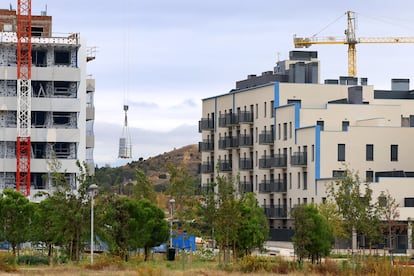

Just 18 days after the end of the Spanish Civil War, on April 19, 1939, the National Housing Institute was created to address the severe housing shortage and the destruction of the country’s housing stock caused by the conflict. One of the mechanisms it relied on was housing cooperatives, which have enabled the construction of more than 2.5 million homes since 1957, representing around 10% of Spain’s housing stock, according to the Spanish Confederation of Housing and Rehabilitation Cooperatives (Concovi).
Today, cooperatives may no longer wield the same influence, but they remain highly active: they develop everything from affordable housing for young people to high-end residential projects in some of Spain’s most sought-after areas. Around 30,000 market-rate and subsidized homes are currently being promoted through cooperatives across Spain, giving them an average 30% market share. Cooperatives affiliated with Concovi alone ended 2025 with 11,805 homes under development through 227 cooperative societies, representing a combined investment of €3.7 billion ($4.2 billion).
“They are driving development in some of the most important urban expansion areas in Spain’s provincial capitals, and in some regions their market share is even higher, as is the case in Madrid, Valencia and the Basque Country,” says Juan Casares, president of the confederation.
However, both cooperatives and project managers believe their current output falls far short of its potential. “We could build three times as many homes. Bringing supply into balance with demand would ease price pressures,” says Juan José Perucho, president of the Association of Housing Developers and Managers (AGV) and chief executive of Grupo Ibosa. In his view, “if we do not rapidly produce large quantities of affordable housing, the problem will reach an unsustainable level.”
Housing cooperatives eliminate the developer’s profit margin: their members are both the buyers and the parties driving the project. This allows homes to be allocated at cost price. Galivivienda, a nationwide cooperative that has developed more than 1,000 homes in Spain, estimates that cooperative members can save around 20% compared with buying in a conventional development.
That does not mean, however, that they are insulated from the sharp rise in land and construction costs. The pressure is reflected in prices: according to Concovi, the average allocation cost of a market-rate home developed by a cooperative now stands at €312,022 ($356,000), equivalent to about €3,120 ($3,560) per square meter of built area.
In Madrid, where land prices have risen particularly steeply, the figures are significantly higher. Perucho estimates that in developments such as Los Berrocales, Los Cerros and Los Ahijones, in southeastern Madrid, recent land transactions mean homes will need to be marketed at around €5,000 ($5,700) per square meter of built area to offset rising costs. “These are high prices, accessible to fewer and fewer people,” he acknowledges.
For that very reason, cooperatives and project managers agree that the main obstacles are the shortage of available land, the slow pace of urban development projects and lengthy licensing procedures. There are numerous examples of developments that have accumulated years, and in some cases decades, of delays. La Amarguilla, a cooperative in the new Jarama neighborhood of Coslada that was established in 2011, is a textbook example of the ordeal members can sometimes face. The same is true of the five major developments in southeastern Madrid, which have experienced delays of up to 26 years.
“Many municipal administrations have refused to designate or develop enough new buildable land to meet the significant population increase of recent years,” says Perucho. In his view, Spain needs a new national land law to speed up urban development projects and shorten approval timelines.
Alongside the shortage of new land zoned for development, the cooperative sector is also focusing attention on the use of publicly owned land. Juan Casares argues for closer cooperation between public authorities and social-economy organizations to boost the supply of affordable housing, and criticizes the way the protected-land market operates.
“I have spent many years denouncing the speculation surrounding land designated for protected housing by both the public and private sectors, preventing it from fulfilling the social purpose for which it was intended,” he says.
Casares, who is calling on public authorities to listen to the sector, believes that greater availability of public land, combined with a lower tax burden on housing developments and a simplification of planning procedures, would help increase the construction of affordable homes.
Galivivienda notes that Spain’s Cooperatives Act (Law 27/1999) allows public land to be allocated directly to housing cooperatives. However, it argues that most public authorities choose instead to auction these plots to the highest bidder, a practice that drives up land costs and limits the development of new affordable housing projects.
Madrid, the stronghold of housing cooperatives
The Madrid region has become the leading champion of this model. According to Perucho, housing cooperatives account for between 30% and 40% of the homes being developed in new urban expansion areas such as Los Berrocales, Los Ahijones, Los Cerros and Valdecarros. In new neighborhoods in municipalities such as Pozuelo de Alarcón, cooperatives have already allocated and are managing almost 50% of homes before urbanization work has even begun. In Brunete and San Sebastián de los Reyes, the figure stands at around 40%.
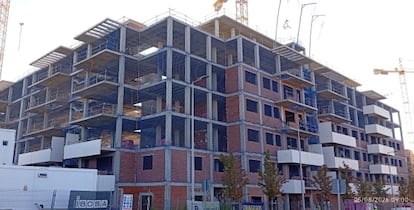
By Perucho’s rough estimate, 95% of the subsidized for-sale housing currently being developed in the Madrid region is being promoted through cooperatives. Many developments do not even require major marketing campaigns and are filled through waiting lists maintained by cooperative management companies. “They are mostly lists of young people who cannot access market-rate housing,” he says.
Grupo Ibosa alone currently manages more than 1,800 subsidized homes across nearly 20 cooperatives in Madrid. The AGV, which brings together 18 companies, currently oversees 16,992 homes at various stages of development and delivers around 4,072 homes a year, a figure equivalent to roughly one-third of all homes completed in the region in 2025.
The picture is different nationwide. Most of the developments overseen by Concovi now consist of market-rate housing. According to the organization, only 35% of the 11,805 homes currently under development are subject to any form of housing protection scheme, reflecting the transformation of Spain’s housing cooperative sector over recent decades.
Industry representatives believe that past failures, such as PSV, the housing cooperative collapse of the early 1990s that affected tens of thousands of members and tarnished the sector’s reputation, have been overcome. During the collapse of Spain’s housing bubble, several cooperatives entered bankruptcy proceedings and projects were halted.
“Today there are many mechanisms to avoid these situations,” says Perucho. “Financial institutions as well as traditional developers and cooperatives have done their homework, become highly professionalized and security is very high.”
Sign up for our weekly newsletter to get more English-language news coverage from EL PAÍS USA Edition