
Spain’s secret luxury housing market: ‘Prices start at $1.75 million, with sales reaching up to $14 and $16 million’
Off-market transactions privately executed outside of traditional channels gain in popularity, powered by the elite’s desire for privacy
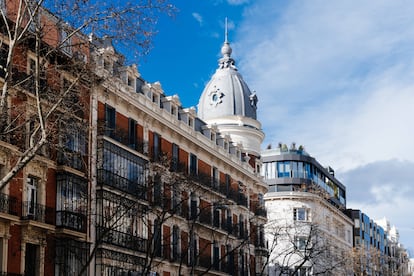

A few weeks ago in the Almagro neighborhood, in the middle of the Madrid district of Chamberí, a 5,400-square-foot home was sold for $4.6 million. Its owner was a celebrity figure, “a very well-known person in the world of culture and television,” says Manuel Garzón, director of the large accounts department at the luxury real estate agency Gilmar, without providing further details. The sale was confidential. The house was never announced on real estate platforms, and anonymity of both seller and buyer was guaranteed in the contract.
This is the real estate off-market, a restricted exchange comprised of properties that require very selective marketing. “[The seller] opted for an off-market sale directed exclusively at pre-selected buyers who had an actual capacity to buy. This allowed for a minimum of visits, avoiding the curious and protecting the privacy of the seller throughout the process,” says Garzón.
Properties sold in this manner dodge mass channels because their owners are international impresarios, executives, holding companies, professional athletes and public figures looking to avoid any media exposure. Nor do they wish to reveal the exact location of their home and much less for its images to circulate widely. “We’re talking about HNWI (high net worth individual) clients and UHNWI (ultra high net worth individuals),” says Álvaro González de La-Hoz, CEO of Spain Sotheby’s International Realty.
This way of selling, closely tied to luxury, has grown in popularity in recent years. “In our case, we estimate that between 20% and 30% of high-value transactions in 2025 closed without being published on real-estate platforms. Five years ago, off-market was a much more limited practice restricted to a certain kind of profile,” says González de La Hoz.
The phenomenon is linked to a growing demand for privacy and confidentiality. Plus, the rise of private assets, international mobility and the lack of prime products in certain locations. The other face of the coin is that in off-market real estate transactions, the number of potential buyers is reduced, and owners could miss out on receiving competitive offers. Still “in many cases, peace of mind carries as much value as the economic result of the sale itself,” says González de La-Hoz.
Paloma Pérez Bravo, CEO of the luxury firm Dils Lucas Fox, says that “the more unique the home and the higher the public profile of its owner, the more likely it is that it will be marketed privately.” At her agency, around half of all sales take place at some point away from public channels. Pérez Bravo says that this modality has always existed in the high-range market, but that it has evolved from a network of personal contacts into a professionalized structure, with filtered databases and a more rigorous control of information. A rise in international demand has also contributed to its expansion. “In countries like the United Kingdom, off market is the norm, and clients expect to have that same way of working when they buy in Spain,” she says.
What such properties have in common is an elevated price, though that is not the primary criteria for being sold in this format. “Properties are often priced beginning around $1.75 million, with sales reaching up to $14 and $16 million,” says Juan Luis Sáez, director general of The Avenue Select Real Estate, an agency specializing in the luxury and investment sectors, where 35% of operations are conducted off market. Of course, when it comes to ultra-luxe housing, from $11.5 to $23 million, private sales “are often the norm rather than the exception,” says Pérez Bravo.
Some of these homes are unique, like large seaside villas, historic farms, exceptional penthouses, entire buildings, properties with significant cultural heritage and homes owned by business leaders, well-known families and international clients. There are also holdings with works of art, collections or elements that the owner does not wish to expose, as well as the best apartments in branded residences tied to luxury hotel chains or fashion designers, which are initially presented to a select list of private clients.
The practice is most popular in cities and areas with a high concentration of luxury and super-luxury housing. Such is the case in Madrid — particularly in neighborhoods like Salamanca, Chamberí and Justicia — and in Spain’s Marbella and Costa del Sol, in addition to “areas like Milla de Oro, Sierra Blanca, Puerto Banús, La Zagaleta and Sotogrande,” says Garzón. At Gilmar, he says off market sales are growing every year, in parallel with the development of the luxury housing sector. It went from 8% of their total sales in 2025 to 10% this year, with an average home price around $5.7 million.
For off market sales, agencies work with a reduced base of pre-selected buyers. “We analyze their financial capacity, the origin of their wealth when appropriate, their actual interest in the holding, the expected purchase period and the extent to which the property meets their needs. This significantly reduces unnecessary processes, and protects the confidentiality of both parties,” says Sáez.
No photos or addresses
The key is not to hide the property — but rather to provide its information in phases. Pérez Bravo tells of the sale of a singular property in a coastal destination that she publicized among an international network of clients and holding companies. “The first phase is carried out through a blind teaser, without an exact address or any images that allow the property to be located. Only once we verify the profile, capacity and current interest of possible buyers do we grant access to the complete dossier.”
Subsequent meetings typically involve the real estate advisor, the owner, the buyer and — depending on the transaction — lawyers, tax advisors, private bankers, architects, technical experts and wealth managers. “In many cases, viewings are organized under prior confidentiality agreements and are limited to buyers whose financial capacity has already been verified,” says González de La-Hoz. In particularly sensitive transactions, the use of cell phones and photography during visits are restricted, with a log maintained of each person accessing its every document, adds Pérez Bravo.
There is no premium for operating outside traditional channels. Value continues to be determined by the property’s location, quality and uniqueness.
Sign up for our weekly newsletter to get more English-language news coverage from EL PAÍS USA Edition









































