
A country divided on migrant rights: Some US states expand protections while others restrict them
The Trump administration’s immigration crackdown has split the nation: while California and Illinois are broadening support, Republican-led Texas and Tennessee are introducing more restrictions
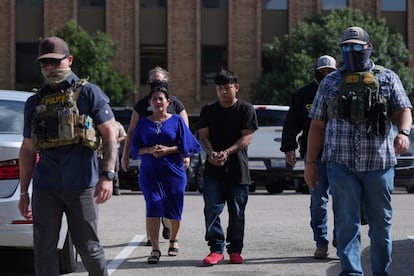

Starting January 1, local and federal agents detaining migrants in California are prohibited from hiding behind masks that conceal their faces, as they have done until now. This is mandated by one of the many laws that have taken effect at the beginning of the year and will impact the migrant community.
The Trump administration’s crusade against immigration has divided the nation and, on the legislative front, has led to the passage of new regulations in local and state laws that will come into force in 2026. Some, in states governed by Democrats such as California and Illinois, expand protections for migrants; in other states like Texas and Tennessee, governed by Republicans, the objective is to facilitate the work of federal agents in their race against time to increase the number of detainees and deportees.
California’s law SB 627, which makes it a crime for law enforcement officers to wear a mask or a face covering while on duty, has been challenged in court by the federal government. The Trump administration argues that anonymity for employees of Immigration and Customs Enforcement (ICE) is a protective measure for agents. The Department of Homeland Security (DHS) has reported that attacks on agents have increased by more than 1,000%. The lawsuit argues that the mask ban is unconstitutional because states do not have the power to regulate federal agencies. Several states have introduced measures prohibiting immigration agents from wearing face coverings, but California was the first to enact such a ban into law.
Democratic Senator Scott Wiener, the bill’s author, criticizes the fear and helplessness migrants feel when they cannot identify those who detain them. “When law enforcement wears ski masks in communities that terrorize communities, it reduces trust in law enforcement,” he stated in a video posted on social media. Migrants and organizations that support migrant rights say that concealing officers’ faces and allowing them to remain anonymous has made it easier for abuses of force to occur during arrests, including by people who are not law enforcement officers
Another new rule aimed at addressing this problem requires federal agents to visibly wear their identification with their name, badge number and agency, and prohibits bounty hunters from participating in arrests.
Another law signed by Democratic Governor Gavin Newsom that will have a broad impact on the immigrant community is AB 495, also known as the Family Preparedness Plan Act of 2025. Its purpose is to help families prepare for deportation. The new legislation expands the number of relatives up to the fifth degree (such as great-aunts and cousins) who can become temporary guardians of children, allowing them to make decisions about medical care and school enrollment. Since the start of immigration raids, one of the biggest concerns in the immigrant community has been who will care for children if their parents are detained or deported. In addition, the new law will prohibit daycare centers from collecting immigration information about a child or their parents.
With the goal of protecting minors, California has also enacted a law requiring the state to provide legal counsel to young people to defend their immigration cases. The Trump administration has targeted unaccompanied minors arriving in the United States on several fronts, drastically cutting funding to organizations that assist them and eliminating their right to legal representation — a measure that is being challenged in court. This lack of protection has led to scenes as surreal as children under the age of five being forced to argue their asylum cases alone before an immigration judge. Another of the Trump administration’s most controversial actions against minors, later blocked by a judge, was an attempt to deport more than 300 Guatemalan children without any removal order or giving them the opportunity to defend themselves.
Restoring “sensitive” locations
One of Trump’s first actions upon returning to the White House was to eliminate the protections afforded to so-called “sensitive” locations (hospitals, schools, and places of worship), which effectively barred immigration agents from these facilities. Since January, California’s SB 81 law has sought to restore such protections by designating health care facilities as safe spaces, barring immigration agents from accessing them, and classifying a patient’s immigration data as protected medical information.
Illinois, another state heavily affected by federal immigration raids, has also moved to strengthen protections for patients’ immigration status in hospitals. The new legislation, approved this fall amid an escalation of federal operations under Operation Midway Blitz in Chicago, also bans civil arrests in and around Illinois courthouses and allows anyone wrongly arrested in or near a courthouse to seek compensation of up to $10,000. The Trump administration has turned the routine court appearances that migrants are required to attend into ambushes designed to detain them.
Agents will also be barred from entering schools without a warrant, and certain decisions based on immigration status are restricted. State-licensed daycare centers must now display information about immigrants’ rights at each facility, tighten the conditions for sharing documentation with law enforcement, and develop action plans in case immigration agents appear.
Greater cooperation with ICE
For migrants living in Republican-controlled states, however, the new year brings little cause for optimism. In Texas, a law has taken effect requiring sheriffs to sign cooperation agreements — known as 287(g) agreements — with ICE. Under SB 8, local jail officials must share detainees’ immigration information with federal agents.
Groups such as the American Civil Liberties Union of Texas warn that the legislation could lead to over-policing and racial discrimination. Under these agreements, local jails may hold residents without legal status who would otherwise be released after a minor offense or after posting bail, until ICE arrives to arrest them. “Local police officers become secretaries for ICE — doing paperwork and helping process people for deportations,” the ACLU said.
In Tennessee, another Republican-led state, the new year also brings a new form of discriminatory documentation for foreign residents. Legal residents will be issued temporary driver’s licenses or identification cards that explicitly state they are not full citizens. Republican Senator Bo Watson introduced the bill as a measure to safeguard election integrity.
Another law that will take effect in 2026 prohibits Tennessee from recognizing driver’s licenses or identification cards issued by other states to undocumented migrants.
Loss of health care
In recent months, a recurring line of attack by the government against irregular immigration has been the claim that undocumented migrants take advantage of federal resources — an argument that is false, since undocumented migrants are not eligible for any federal benefits. In response, some states have established programs to provide them with basic services, such as access to education or health care.
Residents of Minnesota are beginning the year by losing part of those benefits. The state, whose legislature has a very slim Democratic majority, passed a law in early summer last year that withdraws health coverage for undocumented migrants over the age of 18. About 17,000 people who were enrolled in the MinnesotaCare program will lose their health coverage with the arrival of 2026.
Sign up for our weekly newsletter to get more English-language news coverage from EL PAÍS USA Edition









































