
What we know about Midway Blitz, the federal immigration operation in Chicago
Immigrant rights advocates and activists have been protesting outside ICE facilities since last week
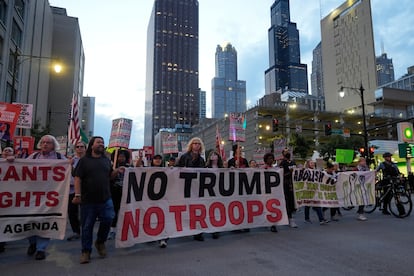

After weeks of threats, the Trump administration launched “Operation Midway Blitz” on Monday, in which federal agents will intensify immigration control measures in Chicago, Illinois. The city, considered a “sanctuary” due to its policies on the treatment of undocumented immigrants, has reaffirmed that it will not cooperate with the operation and will seek to protect communities that may be at risk.
Midway Blitz
According to the Department, “Operation Midway Blitz” is being carried out “in honor” of Katie Abraham, who died in a car accident caused by Julio Cucul-Bol, an immigrant from Guatemala who was allegedly intoxicated.
The operation targets immigrants “who moved to Chicago and Illinois because they knew that Governor Jay Robert Pritzker and his sanctuary policies would protect them and allow them to roam free on American streets.” The department alleges that under these policies, members of the Venezuelan gang Tren de Aragua, rapists, kidnappers, and drug traffickers were released onto the streets of Chicago, turning the city into a “magnet for criminals.” However, critics and advocacy groups deny that this is happening in California and cite official city figures as proof.
The figures
Data from the Chicago Police Department show that its criminal homicide figures between June and August were the lowest in 60 years, while violent crime as a whole is at its lowest point in four decades. This year has seen a 21.5% decline in violent crime since 2024. This decline is part of a national trend.
An analysis by the Chicago Tribune found that although there has been an increase in migrant arrests in Chicago since the busing of asylum seekers from Florida and Texas began in August 2022, the vast majority of these incidents are for non-violent crimes, such as traffic violations and theft.
Chicago’s response
As operations began in Chicago, Mayor Brandon Johnson stated that the city received “no notice of any enhanced immigration enforcement” prior to the operation. “Once again, this is not about fighting crime. That requires support and coordination, yet we have experienced nothing like that over the past several weeks.”
He recently signed an executive order reinforcing the city’s sanctuary policies and prohibiting police from collaborating with federal immigration agents, as well as requiring Chicago officers to wear uniforms without masks to distinguish them. “We will not have our police officers who are working hard every single day to drive down crime deputized to do traffic stops and checkpoints for the president.”
The Johnson administration has emphasized that measures taken to reduce violent crime in Chicago include improving police leadership under Superintendent Larry Snelling and strengthening a program in which reformed criminals serve as mediators in neighborhood disputes and connect at-risk individuals with social services. Investments in summer jobs for young people, affordable housing, and public education have also been promoted.
Help for migrants
In response to the federal operation against migration, the city of Chicago offers guides called “Know Your Rights” in both Spanish and English.
Immigrant rights advocates and activists in Chicago have been protesting since last week outside ICE facilities in the suburbs, and more protests are planned for this week. The Illinois Coalition for Immigrant and Refugee Rights has been handing out informational cards to help keep families safe.
Although various reports mention that so far there have only been a few arrests of people suspected of being gang members, the Department of Homeland Security said it has arrested suspects accused of sexual assault against a family member, rape, armed robbery, and domestic violence.
Sign up for our weekly newsletter to get more English-language news coverage from EL PAÍS USA Edition









































