
No more masked ICE agents: Democrats want to ban immigration officials from hiding their faces
The image of an immigration officer carrying out an arrest with his face covered has become a symbol of Trump’s immigration policy. Several initiatives seek to curb the practice
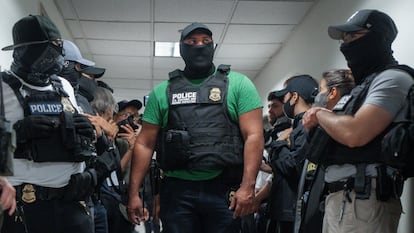

A dozen federal agents, half of them masked, struggle with two men in a narrow hallway of a Manhattan courthouse. They end up arresting both individuals: an immigrant and a New York City elected official who tried to protect him. In California, the Los Angeles police rush downtown after reports of an ongoing kidnapping, only to find Immigration and Customs Enforcement (ICE) agents, also masked, arresting a woman.
Scenes like these happen daily across the U.S. as part of the Trump administration’s immigration crackdown: arrests made by federal agents, who hide their faces behind masks or balaclavas, wear civilian clothes, and move in unmarked vehicles. This reality has prompted Democratic legislators and state and local officials to push for laws that prohibit law enforcement officers from concealing their identities in public spaces while conducting immigration enforcement operations.
In Congress, two Democratic senators introduced a bill last Tuesday that would require immigration officers to clearly display their agency’s name or acronym, as well as their name or badge number, without tactical gear or clothing hiding them. The initiative, called the VISIBLE Act, was proposed by legislators Alex Padilla of California and Cory Booker of New Jersey. It would also prohibit the use of non-medical face coverings, such as masks or balaclavas, that conceal the agent’s identity. The legislation would apply to all agents of the Department of Homeland Security, from ICE to Customs and Border Protection (CBP), as well as federal officers and state or local forces assigned to immigration operations.
“For weeks, Americans have watched federal agents with no visible identification detain people off the streets and instill fear in communities across the country,” Senator Booker said in a statement announcing the bill. “The lack of visible identification and uniform standards for immigration enforcement officers has created confusion, stoked fear, and undermined public trust in law enforcement.”
“Immigration agents should be required to display their agency and name or badge number — just like police and other local law enforcement agencies,” Senator Padilla added. Padilla, the first and only Latino senator from California, was briefly detained and handcuffed last month after confronting Homeland Security Secretary Kristi Noem at a press conference to question the federal government’s response to mass protests in Los Angeles against Trump’s immigration policies.
Padilla and 13 other Democratic senators also sent a letter to ICE Acting Director Todd Lyons demanding information on the agency’s policy regarding mask and uniform use.
The letter, sent July 7, reads: “Storming courthouses, grabbing students off the street, raiding places of work, and sweeping through restaurants at prime dining hours are in and of themselves tactics clearly designed to engender fear and sow chaos in the population. Doing so in plainclothes, with no identification of their name or agency, while wearing a mask designed to obscure the agent’s face, represents a clear attempt to compound that fear and chaos — and to avoid accountability for agents’ actions.”
The VISIBLE Act is unlikely to pass, since Republicans control both chambers of Congress. Back in late June, two other Democrats from New York, Adriano Espaillat and Dan Goldman, introduced a similar proposal in the House of Representatives — the No Secret Police Act — which also failed. Nevertheless, both measures reflect the growing discontent with the way Trump is implementing his mass deportation agenda. This discontent is not only felt by Democrats, but by a majority of Americans: 47% of the population view the government’s immigration policy negatively, compared to 42% who support it, according to a recent Pew survey.
The Republican administration, for its part, argues that agents cover their faces for protection. According to the Department of Homeland Security, its agents have been victims of doxing — the act of having their personal information shared online and on social media. The federal agency claims that ICE agents are “facing a 500% increase in assaults against them while carrying out immigration enforcement operations.”
“People are out there taking photos of the names and their faces and posting them online with death threats to their family and themselves,” Lyons, the acting director of ICE, said in a press conference in June. “So I’m sorry if people are offended by them wearing masks but I’m not going to let my officers and agents go out there and put their lives on the line and their family on the line because people don’t like what immigration enforcement is.”
State initiatives
Outside the Capitol, there have also been initiatives against immigration agents concealing their identities. This week, state and city officials in New York introduced a bill that would ban law enforcement officers from wearing masks in public spaces throughout the state. The proposed legislation makes exceptions for medical-grade face coverings and those designed to protect against exposure to wildfire smoke or biological or chemical agents.
“When police wear masks, democracy loses its face,” said Democratic State Assemblymember Tony Simone as he introduced the measure. Also present at the announcement was Brad Lander, the current comptroller of New York City and until recently a Democratic candidate for mayor, who was detained earlier last month in an immigration court while protecting an immigrant man from federal agents, who have been conducting hundreds of arrests not only in the city’s courts but across the country.
If the New York bill is passed, violating it would constitute a misdemeanor. In California, a similar proposal was introduced in the state legislature in early June, but has not yet been approved. That bill would prohibit local, state, and federal law enforcement officers from wearing “any kind of mask or personal disguise” while on duty, except in specific circumstances such as during an undercover operation.
Sign up for our weekly newsletter to get more English-language news coverage from EL PAÍS USA Edition









































