
Trump’s immigration policy is choking business: ‘There’s nobody to work’
Activists and lawmakers say Americans are feeling the effects of the ‘ICE tax’: higher prices for goods and services caused by a labor shortage


In recent months, the Donald Trump administration has been proudly releasing statistics on migrant arrests. Nearly 51,000 detentions were recorded in August, setting a new record that surpassed July’s 50,208, according to Department of Homeland Security (DHS) data. But while the administration celebrates increased operations by Immigration and Customs Enforcement (ICE), business owners lament the effects on the labor market. “I’ve already lost several employees. There’s nobody to work,” says Carlos Raba, a chef of Mexican descent.
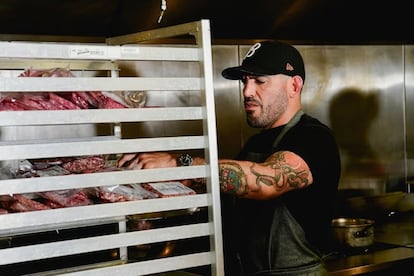
His restaurant Clavel in Baltimore, Maryland, has been operating successfully for 11 years thanks to the work of nearly 50 employees from various nationalities. Since Trump returned to the White House and launched his campaign against immigration, however, he has struggled to fill positions. His sous chef, or second-in-command in the kitchen, self-deported seven months ago after seven years working with him. She was from Honduras and held a work permit that became worthless when the government ended that country’s Temporary Protected Status (TPS), leaving her vulnerable to being taken to an ICE detention center. She chose to leave behind everything she had built over those years and return with her two U.S.-born children to the country she had fled. Shortly after, Raba lost another worker, also Honduran, who was driven away by the fear spread by immigration agents.
“They are here legally, seeking political asylum, with a work permit. They’ve spent years doing things legally. Now they go to court, their permits are revoked, they’re denied asylum and put in jail. What kind of treatment is that for someone who has been socially and economically contributing to the country?” he asks.
“The government needs to understand that kitchens and restaurants have skill positions,” he says, switching between Spanish and English, “like being a bartender, like our cooks — these are workers who need experience.” Raba grew up in Culiacán, Mexico, and came to the United States 26 years ago at age 17. He explains that each employee is an investment because they must be taught and trained, and that takes a lot of time.
No staff in restaurants
In Texas, for example, 36% of restaurants have lost employees and 26% have seen a drop in customer traffic because of immigration enforcement activity this year. Fewer than half of such businesses in Texas say they have enough staff to operate successfully, according to a second-quarter 2026 report from the Texas Restaurant Association.
This week Raba joined a group of activists and members of Congress who demonstrated a few feet from the Capitol in Washington to call for immigration reform granting permanent residency and work rights to foreigners who have lived in the country for years. The Trump administration has ended work permits issued through TPS for 13 countries, and activists fear El Salvador could be next. The program that protected 170,000 Salvadorans from deportation expired on September 9, 2026, and it is still unclear what will happen to them.
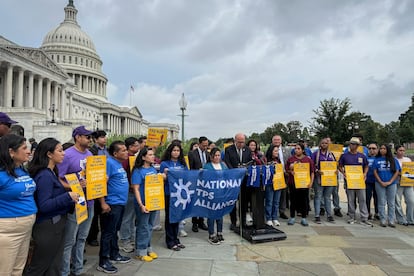
The national coalition Seat The Table, which brings together leaders in the food service industry and represents all links in the food supply chain—from farms and ranches to restaurants and hospitality businesses—denounced in front of the Capitol the consequences of ending TPS for a sector in which migrants make up 20% of the workforce and 36% of owners. According to their data, more than half of restaurant operators nationwide have been harmed by immigration policies.
“Do the math and you’ll see what’s coming”
“TPS beneficiaries have been here for years, working and living the same dream as any parent; they deserve our respect and support. People aren’t showing up to work because they’re scared. The dominoes are about to fall. I’ve seen businesses in my area change their business hours simply because they don’t have enough staff. I’ve seen hotels take rooms out of service because they can’t staff them. People are terrified, even though all their paperwork is in order,” said Bill Lay, a Florida businessman of Cuban origin.
Lay owns five restaurants in a tourism-dependent area. “Key West has a population of 25,000. Our Haitian community represents 20% of the population and more than 60% of the workforce. Think about those numbers. This will have a huge impact. We serve 3.5 million tourists a year. Do the math and you’ll see what’s coming,” he warns.
Backed by the Supreme Court in July, the government canceled Haiti’s TPS this year, leaving nearly 350,000 Haitians without the program that had protected them from deportation. Deportation flights to a country mired in violence began immediately. Two of the sectors most affected by the departure of Haitians are healthcare and personal care assistance. Some 22% of Haitian workers are employed in the healthcare sector, compared with 10% of other migrant workers, according to the Migration Policy Institute (MPI). Thirteen percent work in caregiving — a share three times that of migrants from other nationalities employed in that role.
“Many Haitians work in elder care: in nursing homes, helping older people with daily tasks like getting out of bed, dressing, rising from the toilet, bathing or maintaining personal hygiene. And now those caregivers are gone. These are skilled workers doing very demanding, often physical work. That means nursing homes have longer waiting lists for admission; remaining staff suffer burnout; we see specific units — such as those for patients with memory problems — closed simply for lack of staff; and overtime costs rise,” explains Rebecca Shi, CEO of the Association of Immigrant Entrepreneurs (ABIC), in an interview with EL PAÍS.
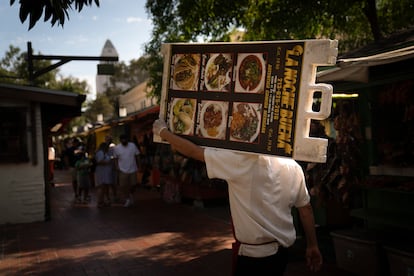
Since the crackdown on migrants began, Shi has advocated in Washington for legislation granting permanent resident and work permits to undocumented migrants who have lived and worked in the U.S. for years. She also warns of the impact the Trump agenda is having on sectors such as construction. “Nearly 40% of construction labor is composed of immigrants, and in certain areas of the country like South Texas or Florida, that figure reaches 70%. ICE operations have reduced staff and delayed projects — some by eight to twelve months — which leads to higher financing and operational costs that ultimately fall on consumers,” she says.
Visas only Amazon can afford
In addition to ending TPS — which had provided legal residence to more than one million people in the United States — the Republican administration has imposed restrictions on the issuance of work visas. One change is a $103,000 fee to bring in highly skilled labor on H-1B visas. “If you’re Amazon or Microsoft, maybe you can pay it; but you can’t if you’re a small family restaurant, a construction company or a small rural community health clinic: you simply can’t afford it, and that will end up affecting the entire business sector,” he says.
Agriculture, livestock and landscaping are other sectors heavily affected by visa limits. “For your Caesar salad you need lettuce. That comes from California — and who’s cutting the lettuce? Hispanics,” Raba emphasizes. The price of lettuce jumped 32% in the 12 months before June 2026. That figure, supplied by America’s Voice, is representative of the effect detentions and deportations have on prices.
The so-called ICE tax reflects how the labor shortage caused by the immigration agenda harms consumers. According to the organization, while core prices (excluding fuel and food) rose 2.6% in June, canned fruit rose 7.9%; fresh citrus, 6.3%; home healthcare, 10.7%; landscaping services, 10.8%; and whole milk, 9%.
“A cruel and costly agenda”
Latino Democratic members of Congress and leaders of America’s Voice raised their voices this Thursday outside the Capitol to denounce the effects the ICE tax will have on families. “Trump’s deportation agenda is not only cruel, inhuman and evil, it’s also costly,” said Hispanic caucus chair Adriano Espaillat. “We are seeing what’s happening to our economy. We are seeing what happened this week with interest rates,” he said, referring to the Federal Reserve’s decision to raise interest rates by a quarter point to fight inflation.
The lack of workers is not only the result of deportations. The fear caused in the immigrant community — especially among Latinos — by aggressive ICE raids has driven job absenteeism. “Every time ICE scares a worker away from their workplace, the economy suffers,” Espaillat added.
A recent Brookings study found that in cities where arrests increased the most, employment falls below projections after raids and shows no signs of recovery a year later. The Metro Surge operation targeting immigration in the Minneapolis–St. Paul area earlier this year led to a 2.8% drop in employment, a 1.9% reduction in hours worked and a 1.7% decline in the number of open businesses, equivalent to an estimated $106 million loss in wages.
“Whether one agreed with the previous administration is irrelevant. It happened. At this point, it’s up to us to find a reasonable way to fix it,” said Lay, who identifies as a Republican.
Sign up for our weekly newsletter to get more English-language news coverage from EL PAÍS USA Edition









































