
End of Salvadoran TPS adds to Trump’s campaign against other countries
Around 170,000 Salvadorans will lose protection from deportation on September 9
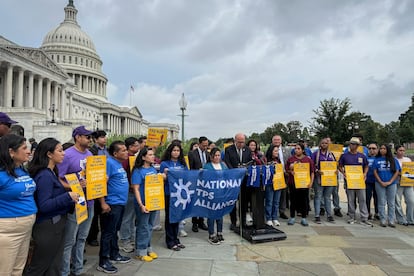

The Temporary Protected Status (TPS) that allowed 170,000 Salvadorans to live and work legally in the United States for more than two decades ends on September 9, 2026. The Department of Homeland Security (DHS) has kept that date as the program’s termination day and has not announced a new extension so far.
El Salvador was the first country to receive TPS, a humanitarian program that temporarily allows citizens of countries affected by war, extreme violence, or natural disasters to live and work legally in the United States. Protection for Salvadorans was first established in 1990 because of the devastation caused by the country’s civil war. It expired in 1992 and was not renewed until 2001, after two devastating earthquakes and a civil war that had left the country mired in poverty, violence, and instability and prompted the exodus of hundreds of thousands of people. Since then, it has been systematically extended.
Twenty-five years later, many of those who arrived under that protection have built lives in the United States: they have raised families, bought homes, started businesses and put down roots in their communities. In July, a Democratic congressman sent a letter signed by 80 members of his party to DHS Secretary Markwayne Mullin asking him to preserve the program. They have not received a response so far.
El Salvador’s case comes amid a broader push by the Trump administration against TPS. Since the start of the Republican’s second term, the administration has worked to terminate designations for several countries, a strategy that has put the protection of hundreds of thousands of immigrants at risk. Pew Research Center estimates that roughly one million of the 1.3 million TPS beneficiaries who existed in March 2025 have lost protection.
At the start of September 2026, only Lebanon, Sudan, and Ukraine still had active designations, although the status of other countries remains subject to court proceedings. In June 2026, the U.S. Supreme Court allowed the Trump administration to move forward with ending TPS designations for Haiti and Syria.
Venezuela’s case also highlights the legal disputes that have accompanied much of this campaign. In February 2025, then–DHS secretary Kristi Noem ended the 2023 TPS designation for Venezuelans. That decision was initially blocked by a federal court, but the Supreme Court later allowed the administration to carry out the termination while litigation continued.
The Trump administration, which in 2018 tried to end TPS for El Salvador but was prevented from doing so by federal litigation, argues that the terminations respond to changed conditions that originally justified the designations and that affected countries now offer sufficient conditions for their citizens to return. The administration has also insisted that TPS was conceived as a temporary protection and has questioned why some designations have been extended for years or even decades.
Immigrant advocates, by contrast, say security, economic and social conditions remain adverse in several of the affected countries and that ending TPS after so many years ignores the deep ties beneficiaries have developed in the United States. Migration organizations have also questioned the consequences of terminations for families who have lived in the country for decades.
Below, EL PAÍS examines the myths and facts about the program’s end and the migration options now available to those who lose protection.
“El Salvador no longer faces any problems”
Salvadoran TPS was originally created after the 2001 earthquakes. In January 2025, DHS justified its most recent extension by saying conditions related to the environmental disaster persisted, including problems with access to water and the effects of recent weather events. Added to these circumstances are concerns from international bodies and human rights organizations about allegations of abuses under President Nayib Bukele’s government, including arbitrary detentions, due process violations, and mistreatment of people detained under the state of emergency implemented in 2022.
“On September 10 all Salvadorans with TPS will be deported”
The end of TPS does not mean that everyone protected by the program will be automatically deported the next day. What ends is the specific immigration protection granted by TPS. People who hold another status, a pending asylum application, or an immigration procedure that grants them independent protection may be in a different situation. The concrete consequence for each person will depend on their particular immigration circumstances.
“Work authorization becomes invalid immediately when TPS ends”
U.S. Citizenship and Immigration Services (USCIS) has issued specific rules for employment authorization documents tied to TPS. As of September 10, 2026, an employment authorization whose only basis was Salvadoran TPS will no longer be valid, even if the physical card shows a later or different expiration date. But if a person has, for example, a work authorization based on a pending asylum application, DACA, a pending adjustment of status, or another independent immigration category, that authorization remains valid according to the rules of that category.
USCIS can grant automatic extensions of employment authorization cards to TPS beneficiaries in certain circumstances, but those extensions are linked to TPS itself and to DHS rules.
“The end of TPS means there are no longer any migration options”
Some TPS beneficiaries may have other legal options or pending procedures that allow them to remain in the country, such as a residency application based on a family petition, marriage to a U.S. citizen, an asylum process, or another form of protection or immigration status.
However, the end of TPS could have significant consequences for those without other protections. Once the program ends on September 9, people who remain in the United States without another status could begin to accrue unlawful presence (penalties begin once 180 exact days have passed from the expiration of the I-94, the entry and exit record), reducing their chances of obtaining a new status.
Beneficiaries who believe they have a pathway to remain legally in the United States should consult an immigration lawyer as soon as possible to determine whether they can apply for another status or protection, and which deadlines apply to their case.
Sign up for our weekly newsletter to get more English-language news coverage from EL PAÍS USA Edition









































