
Supreme Court to weigh Trump’s attempt to eliminate TPS for over one million people
Justices will hear arguments for the cancellation of the humanitarian program for Haitians and Syrians. Its decision will affect Venezuelans, Salvadorans, and citizens of more than a dozen other countries
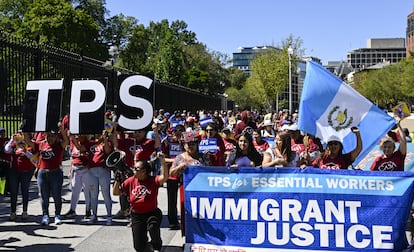

Several organizations and hundreds of people are expected to gather this Wednesday in front of the imposing Supreme Court building in Washington, D.C., to show their support for migrants. Inside, the justices will hold a hearing whose outcome will affect more than a million people. The court will debate Temporary Protected Status (TPS), on which hundreds of thousands of Haitian and Syrian citizens depend. A ruling against the program would open the door to the deportation of citizens from not just these two countries, but also others such as Venezuela and El Salvador, whose only protection against expulsion is TPS, the program that the Trump Administration has been gradually dismantling.
“The court’s decision will determine whether more than 350,000 members of the Haitian community and 6,000 members of the Syrian community will immediately lose their legal status and potentially be detained and forced back into a dangerous situation. The decision could also determine the future of TPS for 1.3 million people from the 17 countries designated for the program, given that the Administration is asking the Supreme Court to declare that TPS decisions are not subject to judicial review,” explains Megan Hauptman, an attorney with the International Refugee Assistance Project (IRAP), which is representing the Syrians.
The TPS program, enacted in 1990 under President George H.W. Bush, was created to temporarily protect citizens of countries experiencing crises such as armed conflict or natural disasters. Unlike asylum and refugee status—which are evaluated on a case-by-case basis and can take years to obtain—TPS can be activated quickly and cover many people simultaneously. It is valid for six to 18 months but is subject to renewal.
Haiti was first designated for TPS by the Obama administration in 2010, following a devastating earthquake that affected nearly a third of its population. The Biden administration extended the program several times due to the economic, health, and political crises that arose after the assassination of its president in 2021.
In the case of Syria, Obama granted TPS because of the crisis the country suffered with the repression enforced by former Syrian President Bashar al-Assad against anti-government protests in what ended up being a bloody civil war lasting more than a decade.
Last year, then-Homeland Security Secretary Kristi Noem ended TPS for those two countries and 11 others. The Supreme Court will hear arguments in the cases of Mullin v. Dahlia Doe and Trump v. Miot. The former involves a Syrian citizen who uses that pseudonym. Dahlia, who is not yet 30, received TPS in 2021. She works as a research director and lives in the Bronx, New York, where she cares for her father, who has Parkinson’s disease. Her parents are legal permanent residents, and her sister is a U.S. citizen. She is a Syrian citizen, although she was born in another Middle Eastern country and has never lived in Syria, where she could now be deported. District Judge Katherine Polk Failla ruled in November that the termination of TPS for Syrians was motivated by “undue political influence.”
In the Haiti case, District Judge Ana Reyes ruled in February that Noem’s decision was motivated by “anti-Black and anti-Haitian” animosity, citing Trump’s statements in which he called Haiti a “shithole country” and accused its citizens living in Springfield, Ohio, of eating pets. The Trump administration requested a Supreme Court review after successive appeals courts refused to stay the rulings in favor of the migrants.
The plaintiffs’ lawyers have said that the Administration is inconsistent in determining that those countries no longer have the situations for which they were granted TPS while simultaneously advising Americans against traveling to those countries because of kidnappings, terrorist activity, and instability.
A similar situation has occurred with Venezuela, El Salvador, and Afghanistan, and it’s part of the Administration’s project to remove migrants from the country. To this end, it has attacked several programs that protect them, such as asylum, refugee status, and DACA (Deferred Action for Childhood Arrivals). “They are fighting to revoke their TPS, not because the conditions that led them to seek refuge have changed in the slightest. In some cases, those conditions have even worsened; and this, paradoxically, seems to fit the intention of this program, since what they are seeking is to fit into this Administration’s vision of who deserves to be an American and who has the right to remain in this country,” denounced Delia Ramírez, Democratic representative from Illinois, in a virtual press conference. The House approved the extension of TPS for Haitian citizens this month thanks to the votes of three Republicans, although it has little chance of passing the Senate.
According to a report published this week by FWD.US, TPS beneficiaries contribute more than $29 billion annually to the U.S. economy and pay nearly $8 billion in taxes.
“From day one, we have worked hard not only to survive, but also to contribute and give back,” said Cecilia González, a TPS recipient and co-founder of the Venezuelan American Caucus. “I paid for my university studies by working; I often had to juggle several jobs at once and managed to graduate with honors. Today I work full-time as a voting rights advocate,” she added. For González, the case now before the Supreme Court is not just about two countries. “It’s about a broader effort to eliminate protections and legal status for immigrants in order to make us deportable; it sends the message that even when you follow the rules, even when you build your life here, your status can be taken away overnight,” she stated.
Sign up for our weekly newsletter to get more English-language news coverage from EL PAÍS USA Edition









































