
Canada dares to stand up to Trump
The country has rallied behind Prime Minister Mark Carney after he broke off trade talks with the US. Despite the upcoming economic pain, most Canadians believe giving in would have been worse

If no picky official causes problems at the border, it takes only half an hour to go from Detroit airport to Drew Dilkens’s office. The mayor of Windsor, a Canadian city bordering to the United States, greets the newcomer in a room at City Hall from which, across the Detroit River, you can see Michigan’s Art Decó skyscrapers. The host offers his broadest smile but does not conceal his concern. “No matter how crazy his statements may seem to us, no matter how unusual his style, we cannot take lightly what the president of the United States says. And since he returned to power, Donald Trump has not stopped attacking Canada,” he says with a grave expression.
Below, on a facade of City Hall in this city of 230,000 that’s on the front lines of the trade war between the two countries, five words from the national anthem appear in capital letters: “True North. Strong and Free.” They serve, in case it wasn’t clear, as a warning to anyone wishing to play with the sovereignty of the maple-leaf country. Another warning: the giant Canadian flag that flies as soon as you exit the tunnel that connects the two riverbanks.
According to the country’s Chamber of Commerce, Windsor is the city with the most to lose in a clash with Washington. The auto industry reigns supreme here, fully integrated with the one on the other side of the border. Tariffs would mean ruin. Mayor Dilkens is a good example of how the border for many here was as if it did not exist. It used to be that if he wanted to go out to dinner, he’d get in the car and be at his favorite Thai place in Detroit in nine minutes. Used to be. Because now, like many other Canadians interviewed for this story, he prefers to buy local and not give money away to someone that nobody considers a friend anymore.
“I’m surprised and disappointed. We’ve always known we were different, but we believed the United States was a partner we could trust. Now we see it isn’t. It’s painful. Like when you stop talking to a brother. But they left us no other choice,” says Peter Frise, a professor of automotive engineering at the University of Windsor, speaking at a restaurant near City Hall.
Like this professor, many Canadians remain stunned after these 20 frantic months of Trump in the White House. Even before taking office, the Republican leader had circulated the idea that the country was destined to be absorbed into the United States as the 51st state. Since then, the clashes have been countless — whether over fires that Washington said Canada was not doing enough to fight, or over a Government of Ontario video about a speech against tariffs by President Ronald Reagan that infuriated Trump.
“At war”
It was raining, but it was not yet a deluge. Not until August 21. That day, Prime Minister Mark Carney did something that few Western leaders have dared: he said no to Trump. His attitude was light years away from the European Union’s Ursula von der Leyen, who posed with a forced smile and giving a thumbs-up with Trump after signing a highly contested trade deal. Instead, Canada’s Liberal leader walked out on negotiations with Washington. The next day he addressed the nation.
“Last spring, I warned that America is trying to break us so that they can own us. And I promised: ‘That will never, ever happen.’ We are keeping that promise,” he declared in a 22-minute televised speech that echoed words he had used in Davos last January, when he warned that the old world order was dead and buried.
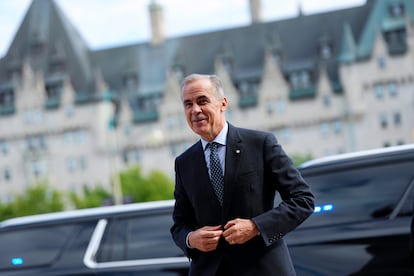
Surrounded by Canadian flags and alternating between English and French, Carney sounded tough and combative: “We cannot accept what they’ve offered, and we will not give what they’ve asked. […] We were not prepared to compromise our sovereignty or undermine key industries.” At the end, a reporter asked about his sombre tone. Carney then used the word “war.” He was not referring to any international terrorist group, but to the country alongside which Canada fought in both world wars, in Korea and Afghanistan (though not in Iraq or Vietnam), and which opened its skies during the jihadist attacks of 9/11 — a date that will soon mark 25 years.
“You are at war when you are attacked. And we have been attacked,” he said. The country swallowed hard.
The move carries obvious risks. Because if nothing else prevents the conflict, both countries will suffer, and Canada holds the worse hand. Two-thirds of its exports go to the United States. One in eight jobs depends on imports from its large southern neighbor. And the weight of the two economies is incomparable. This week the U.S. Treasury secretary referred to that weakness in a meeting with G-20 counterparts. “I don’t think you can be in a tit-for-tat with someone who’s 13 times larger than you are,” said Scott Bessent, who called it “unfortunate” that Carney had turned trade talks “into a political shouting match.”
Canadians are aware that, absent a last-minute deal, a confrontation with the United States will mean more unemployment, higher prices and less wealth. But in times of crisis people must unite. And the country has rallied around the prime minister’s bold move.
“We face a reborn protectionism that will prevent our products from reaching our key market. It’s impossible to quantify the impact, but it will be very large,” predicts Andrew DiCapua, chief economist at the Chamber of Commerce.
“State of panic”
On the University of Toronto campus in the city center, it looks as if nothing bad could happen. On Thursday, groups of students took advantage of the beautiful day to work on their laptops in the sun while a squirrel watched. But the idyllic scene does not hide the “state of panic” that, according to political science professor Arnd Jurgensen, citizens are experiencing.
Polls show majority support for Carney’s stand against Trump: between 60% and 80% approve of the prime minister’s handling of the matter, according to various studies. On August 31, a week after his speech, Carney’s Liberals won three by-elections in Quebec, Ontario and British Columbia, strengthening their parliamentary majority.
Some conservative politicians who long ago flirted with becoming Canada’s Trump are now competing to see who can shout the loudest at him. Like Ontario Premier Doug Ford, who called the Republican a “dictator” and told him: “You can kiss my ass.” After several members of the Trump administration laughed at Canada’s military weakness, Carney asked them to “stop doing memes, stop throwing shade and stop trying to be tough, and start being serious about having those discussions.”
Several of the dozens of people interviewed for this report agree that Trump’s strategy can only be understood within the framework of his goal to make Canada the 51st state — a point the vice president J. D. Vance has recently joked about again. “They want to create uncertainty, scare off international investment, fuel separatism in Alberta… All of it to undermine the country and make it easier to take over. That’s the only explanation,” says Professor Jurgensen. Faced with “this existential threat,” he adds, people are willing to make sacrifices.
Carney, 61, has played a fundamental role in uniting the country. No one can dispute the merits of his résumé. He is the only person to have led the central banks of two major countries, Canada and the United Kingdom. “In these difficult times, I cannot imagine a better leader,” says Professor Frise, who admits he had never voted Liberal until Carney showed up.
Some voices criticize the man who inherited power from a beleaguered Justin Trudeau for pushing his party to the right on issues such as defense spending or climate change. But he has no serious competitor inside or outside the party. That is another key to his move. Right now he is a strong leader. And he sees Trump as weak—unpopular, mired in a war in Iran he does not know how to extricate himself from, and with U.S. elections around the corner in which he could lose one or both chambers of Congress.
In Ottawa they believe this moment should be used to return to the negotiating table stronger, perhaps after the U.S. elections. The challenge then will be how to cool the public’s warlike fervor. Chief negotiator Janice Charette has said the government is willing to sit down again when necessary. She sums up the approach in one phrase: “We have withdrawn the pens, but the doors remain open.”
The breakdown in talks was surprising because days earlier Trump had assumed the deal was done. Each side blames the other for imposing last-minute, unacceptable conditions. But Canadians insist Washington demanded they reduce protections for the French language and that future trade deals with other regions comply with U.S. regulations. Those were two unacceptable conditions affecting their sovereignty. That was when they broke off the talks.
The consequence is that on Tuesday, Canadian tariffs of 50% on U.S. goods worth $20 billion will take effect, as retaliation for a similar measure by the neighbor. It is, as Carney said, a “dollar for dollar” response.
New alliances
This upheaval may pass. Maybe the Democrats will win in 2028 and someone more reasonable will reach the White House. Maybe the new leader will try to heal the wounds. But in Canada there is a growing sense that the old days will not return. “We are at an inflection point. We have been good allies in trade, security and defense. But that has changed,” says Peter Boehm, now a senator—a post in Canada appointed directly by the prime minister—with a long career as a diplomat and senior official under various governments.
Boehm criticizes “this administration’s very limited view of bilateral relations,” but he does not believe everything would change drastically under the Democrats. “At least,” he concedes, “there would be more respect and a greater willingness to negotiate.”
Confidence in the United States has been lost. They know dependence on their southern neighbor must be reduced. Carney has already set to work. He is seeking trade deals around the world, whether in large Asian markets such as China and India or in the EU. It is no coincidence that on September 16, the prime minister will participate in a plenary session of the European Parliament in Strasbourg.
The game of shifting alliances is already underway in a world that no longer operates by the parameters of the second half of the 20th century. Analysts in both countries agree this battle will be won by neither the United States nor Canada. The victor will be China.
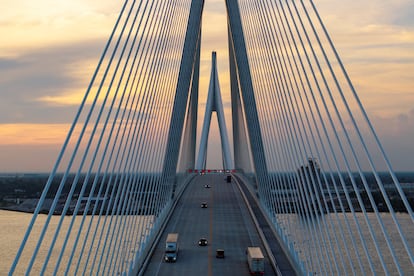
Back in Windsor, people still talk about the inauguration less than two months ago of the majestic Gordie Howe Bridge that links the two countries. It is ironic that it happened just as they are most divided. “That bridge speaks more about our future relations than our current ones. It took 25 years to make it real, it will be there for hundreds of years and Trump only has two left,” says Mayor Dilkens, referring to a project that cost C$6.4 billion (about $4.6 billion), paid for entirely by Canada. No U.S. representative attended the inauguration. Another sign of the times.
Sign up for our weekly newsletter to get more English-language news coverage from EL PAÍS USA Edition









































