
Smoke from Canadian wildfires engulfs New York, Chicago, Detroit and Toronto
Authorities are urging residents to stay indoors as air quality plummets just three days before the World Cup final
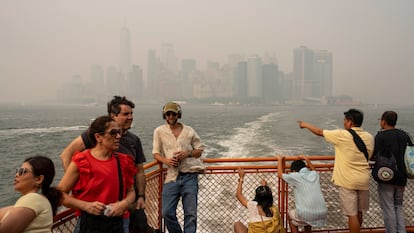

A dark cloud of smoke blanketed New York on Thursday, casting the city in an ashen hue and filling the air with the smell of burning. On the streets of Manhattan, many people wore face masks in the afternoon. In Central Park, Parks Department employees urged the few brave souls who ventured out for a walk to head back home. Those same workers, meanwhile, were instructed by their supervisors to finish their duties as quickly as possible and leave.
These scenes, worthy of the opening of a disaster movie, have their origins hundreds of miles away: in the hundreds of wildfires that have been ravaging the Canadian province of Ontario for days, blanketing the entire northeastern United States and southern Canada in smoke. All of this comes just three days before the World Cup final between Spain and Argentina is set to be played at MetLife Stadium in New Jersey.
Health authorities in both countries have warned of a sharp deterioration in air quality across several communities. After air pollution levels in New York reached the “very unhealthy” category, the city’s Office of Emergency Management urged residents to avoid spending more than an hour outdoors.
Health authorities in both countries warned that air quality has collapsed in several communities. After reaching levels described as “very unhealthy” in New York, the city’s Office of Emergency Management urged all residents to avoid being outdoors for more than an hour. “Listen to your body,” the department wrote in a post on X. “If you have watery eyes, a scratchy throat or difficulty breathing, reduce physical activity and go indoors.”
NYC air quality has reached 'Very Unhealthy' levels (AQI 201+). At this level, everyone, not just sensitive groups, may experience serious health effects.
— NYC Emergency Management (@nycemergencymgt) July 16, 2026
What to do:
✅ Reschedule or move all unnecessary activities indoors
✅ All New Yorkers should avoid strenuous and… https://t.co/3vxjqzL3Fg
But New York is not the worst of it. Other major U.S. cities, including Chicago, Cleveland, Detroit and Minneapolis, have urged residents to stay indoors as much as possible. Milwaukee has recorded the worst air quality in its history. And in Toronto, Canada, two hospitals reported an 80% increase in visits that may have been linked to the smoke, including respiratory ailments and chest pain.
Chicago records highest pollution index
IQAir, a website that monitors air quality in major cities, reported on Thursday afternoon that Chicago had the highest pollution index in the world, closely followed by Detroit, with both cities registering levels classified as “hazardous.” Next came New York, in the “very unhealthy” category, and Toronto, one step lower, merely “unhealthy.” Only then came the usual fixtures on such lists, including Kinshasa in the Democratic Republic of the Congo, Lahore in Pakistan and New Delhi in India.
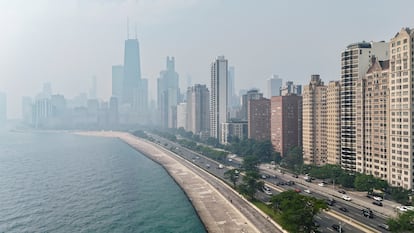
Meteorologists at the National Weather Service say the worst of the Canadian fires has passed and that the smoke covering the entire U.S. northeast should start to clear during Friday. But they warned that new plumes of smoke could return over the weekend (when the World Cup final will be played) and again next week. The smoke may also mix with rainfall on Saturday, leaving an unpleasant layer of soot on streets and cars. It is hardly the image the United States would want to project when the eyes of the world turn to the New York-New Jersey stadium to watch Spain and Argentina contest the FIFA World Cup final.
Unsurprisingly, the problems caused by the multiple wildfires, which are being linked ever more clearly to climate change, have already affected the strained relationship between the United States and Canada. Several Republican politicians have accused their northern neighbour of mishandling the fires. Senator Bernie Moreno, a Republican from Ohio, another state heavily affected by the smoke cloud, said he would introduce legislation to punish Canada for what he described as “an atrocity.”
“This is the third consecutive year we have had to write to Canadian officials about a crisis that Canada has the tools to prevent and has chosen not to,” four Republican members of Congress — John James, Jack Bergman, John Moolenaar and Lisa McClain — wrote on Wednesday in a letter. “Our hospitals are once again treating children, dialysis patients and older residents for the effects of smoke that did not originate anywhere near them.”
“We are asking for specifics, not sentiment,” the four Republicans wrote, adding that the United States might take responsibility itself for preventing cross-border wildfires.
Sign up for our weekly newsletter to get more English-language news coverage from EL PAÍS USA Edition









































