
Trump imposes new 50% tariffs on Canada amid USMCA trade talks
The president cites what he calls discriminatory treatment of certain U.S. products. Automotive materials, dairy products and alcoholic beverages will be subject to the new duties

U.S. President Donald Trump approved a new round of 50% tariffs on selected Canadian products on Monday, arguing that “Canada discriminates against U.S. goods.” Through three executive orders, the Republican president imposed new 50% import duties on automotive components, dairy products and alcoholic beverages.
“By doing so, President Trump is offsetting the burden and disadvantage on U.S. commerce from Canada’s discriminatory treatment of U.S. commerce and is leveling the playing field for crucial American exports — cars, alcohol, and dairy,” the White House said.
The White House said the tariffs will take effect in 30 days and will cover “products ranging from wine to hockey sticks to cement.” In a statement, it added that other goods, including fish and critical minerals, would be exempt.
The move had been widely anticipated. Three days before Sunday’s World Cup final, in which Spain defeated Argentina to claim the title, Trump had signalled his intentions. At the time, New York’s skies were shrouded in smoke from the dozens of wildfires burning across Ontario.
“We are holding Canada responsible for the fact that they are not properly maintaining their Forests, and brush therein, and the United States is being unnecessarily invaded by filthy, polluted and unhealthy air,” the president wrote in a social media post on Friday.
Threat to regional trade
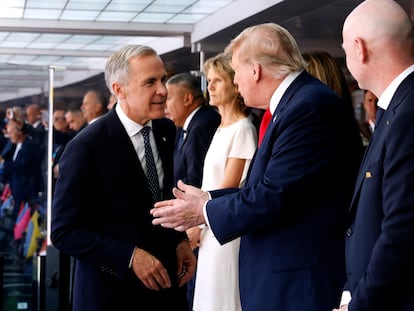
During the World Cup final at MetLife Stadium in New Jersey, Trump returned to the issue. As the two leaders watched the match together from the VIP box, the U.S. president warned Canadian Prime Minister Mark Carney that the wildfires had to be brought under control.
“I told him, I mean, ‘You got to stop these fires from coming in and, you know, poisoning our air. Our air has been poisoned,’” Trump said at Joint Base Andrews after the game.
“If we can help them, we’ll help them. But maybe they should pay some damages or something, or we should do some tariffs. But it was terrible,” Trump said. “I mean you had businesses closing in particular Michigan.”
Although Trump said he has a “good relationship” with Carney, he did not hesitate to approve new tariffs of up to 50% on several Canadian products.
The latest tariff salvo threatens to destabilize trade across the region at a time when the United States, Canada and Mexico are negotiating an update to the USMCA, the three-way trade pact signed in 2020 during Trump’s first term. At the time, Trump hailed it as the greatest trade agreement ever negotiated. Six years later, however, he appears reluctant to renew it and has erected new barriers against some of America’s closest trading partners.
Experts fear the measure could trigger a fresh wave of inflation and further heighten diplomatic tensions between the neighboring countries, whose relationship is already strained. A few months ago, during his first visit to Trump’s White House, Carney left with a bitter taste after hearing Trump suggest that Canada should become the 51st state of the United States.
“There are some places that are never for sale [...] [Canada] is not for sale. Won’t be for sale, ever,” the Canadian leader replied with a sombre expression.
But Trump, clearly enjoying the opportunity to provoke his guest, shot back: “Never say never.”
Although Trump admires Carney and frequently praises his intelligence and political acumen, he has not forgiven Canada for being one of the few countries to push back against his trade offensive.
“He’s a nice man, but he can be nasty,” Trump said of Carney, referring to his determination to counter U.S. tariffs. “He is a world-class leader. He’s a good man, he does a great job and he’s a tough negotiator,” he added.
Alongside China, Canada is one of the few countries to have responded with countermeasures to U.S. tariffs. Ottawa is, in fact, the only G20 member that has yet to reach a trade agreement with Washington.
A senior White House official said the president signed three executive orders imposing the tariffs under Section 338 of the Trade Act of 1930. Several Democratic lawmakers proposed repealing the provision last year, arguing that Trump could use it to destabilize the economy.
According to AP, another official said Trump had instructed his advisers to examine the possibility of imposing additional tariffs on Canada on the grounds that its wildfires were harming air quality in the United States.
Sign up for our weekly newsletter to get more English-language news coverage from EL PAÍS USA Edition









































