
Mexico will press the US to remove tariffs on autos and steel during the USMCA review
President Claudia Sheinbaum is confident that, in the medium term, the North American trade agreement will be renewed for another 16 years
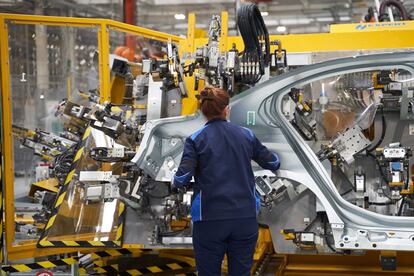

Mexico seeks to fight back commercially against the United States despite being on the ropes. After Donald Trump’s decision not to renew the USMCA for another 16 years—thereby triggering annual reviews of the agreement through 2036—President Claudia Sheinbaum’s government is sharpening its strategy to face the evaluation process before Washington head-on. In the next US–Mexico face-to-face, scheduled for July 20, Mexico will press for the removal of tariffs on steel and autos, the establishment of economic security frameworks, a protocol banning the application of unilateral measures, and a package of actions to boost investment certainty. In a report presented to the Mexican Senate on Wednesday, the Economy Ministry said this roadmap seeks to consolidate Mexico’s trade advantages in the new global commercial order.
The Mexican government told the Senate that it has already submitted to Washington a list of 13 trade concerns ranging from sectoral tariffs to trade barriers imposed by the United States at the state level. “Mexico has emphasized that these measures represent significant obstacles to bilateral trade and require immediate attention to maintain balance in the trade relationship between the two countries,” the document said. By contrast, the U.S. government expressed concern about its growing trade deficit with Mexico, the setting of new rules of origin and economic security measures, and the loss of manufacturing jobs.
President of Mexico Claudia Sheinbaum acknowledged at her Wednesday morning press conference that this year’s USMCA review will be the most crucial one of all, and rejected the idea that the U.S. refusal is a punishment for the country. “There is no uncertainty, of course. What we wanted was to renew the agreement for 16 years, but since the United States government decides on only ten years, we must agree on how the treaty will continue. I truly believe that the agreement will be renewed for another 16 years, even if that happens in four or five years, because economic integration is enormous,” she said at the National Palace.
The USMCA will remain in force at least until 2036, but it will now be subject to annual reviews and leaves open the possibility of termination if one of the three partners—Mexico, the United States or Canada—notifies its intention to withdraw. Latin America’s second-largest economy will continue to have access to the U.S. market thanks to the agreement’s validity; however, the outlook for companies and exporters has become more complicated due to greater regulatory and trade uncertainty with its northern neighbor. For Mexico, the United States is its main export market, with annual sales exceeding $530 billion, one of the main pillars of an economy that grew by less than 1% last year and is now projected to expand by only 1.2% in 2026, according to International Monetary Fund forecasts.
After the blow represented by the United States’ refusal to renew the USMCA on its current terms, the Mexican government says it has a plan, backed by Canada, that includes trade missions, increased bilateral trade and greater investment flows. In the same vein, Economy Secretary Marcelo Ebrard traveled to Washington this week to prepare the second round of talks with his U.S. counterparts.
Despite sectoral tariff measures and repeated threats against Mexico, the Latin American country remains a trading partner for the United States. In May alone, Mexican exports to the United States hit a record of more than $54 billion, a year-on-year increase of 17.5% and the largest amount recorded by the U.S. Census Bureau. Mexican shipments continue to gain ground in the U.S. market, accounting for 17% of all U.S. imports, ahead of Canada, Taiwan and China.
The US raises the stakes through uncertainty
With a border stretching 1,954 miles (over 3,000 kilometers) and nearly $900 billion in annual trade, experts say integration between Mexico and the U.S. will endure; nonetheless, they foresee tougher rules for Mexican and Canadian exporters. Rating agency Fitch called a U.S. exit from the agreement “unlikely,” given resistance from the U.S. Congress and business groups, but warned negotiations could be prolonged and tense. “The timing of a definitive trilateral agreement is uncertain. A prolonged period of annual reviews could worsen current uncertainty, making long-term visibility—crucial for corporate investment decisions—more difficult,” it concluded.
As an example of this business reconfiguration, Japanese automaker Toyota announced this week that it will relocate part of its production from the Mexican state of Baja California to Texas in 2030. The automaker will move assembly of its Tacoma pickup to one of its U.S. plants, where it will invest $3.6 billion and create 2,000 jobs. Although the company said its commitment to Mexico remains strong, it declined to provide further details about changes to its operations in the Latin American country, which since last year has faced a maximum 25% tariff on its auto exports to the United States.
Ignacio Martínez Cortés, coordinator of the Trade, Economy and Business Analysis Laboratory at the National Autonomous University of Mexico (UNAM), says Mexico needs to build a new relationship with its northern neighbor focused on balancing domestic development, without allowing impositions on the bilateral agenda or subordinating itself to the geopolitical interests of the White House. On balance, the specialist says the fractures in the USMCA will bring economic havoc to both sides of the border. In the United States, higher tariffs would cause supply shortages in corporate inventories, price increases and disruption of intrafirm industrial chains. On the Mexican side, investment and industrial production would be hit, unemployment would be pressured, and overall the Mexican economy could move from slowdown to stagnation.
Alfredo Coutiño, director for Latin America at Moody’s Analytics, adds that beyond the disappointment caused by the U.S. setback, at least the roadmap for the next ten years has been clarified. The agency stresses that the trade agreement will remain in force, markets will continue to function and trade will keep flowing in North America, but uncertainty will affect the business climate and investment. “Termination of the USMCA would harm all three countries, given the industrial integration developed over the past 32 years of trade agreements. Voluntary withdrawal by Canada and Mexico from the USMCA is unlikely, but it is greater than zero,” he concluded.
After months of bilateral meetings and trips to Washington, the Economy Ministry argues it has made “significant progress” by reducing the binational outstanding issues list from 54 to 14 items on the agenda. From Mexico’s perspective, these matters can be addressed through a regional strategy that strengthens production in North America and reduces dependence on imports from Asia; however, the last word will be spoken from the White House.
Sign up for our weekly newsletter to get more English-language news coverage from EL PAÍS USA Edition









































