
Latin America seeks to build an Atlantic alliance with Europe and the US: ‘The region has never been so central to the world’
Business leaders, analysts and heads of international institutions analyze the area’s economic opportunities in a world shaken by the reordering of blocs

Just a year ago, Latin America’s major business families — owners of some of the world’s largest fortunes — were watching anxiously for the effects of the tariff wall erected by U.S. President Donald Trump. One year on, they are observing with concern the geopolitical upheaval unleashed by Trump, with an unprecedented change to the liberal international order built after World War II. The new national security strategy outlined by the Trump administration singles out Latin America as a new priority. The Republican tycoon has designated the entire region as his sphere of influence: as both his backyard and his front yard.
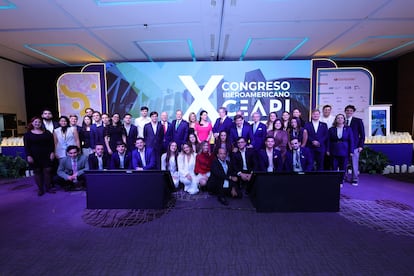
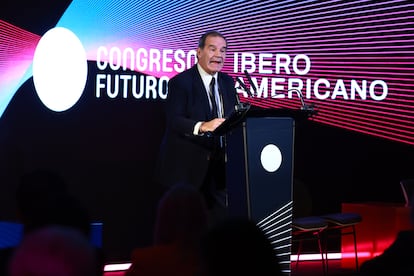
In this new political map, New World companies are debating what role they should play on the global stage, and redefining strategies to seize the opportunities opening up in an Atlantic alliance in which Europe is emerging as an alternative to U.S. hegemony. “We are at a hinge moment that will determine how the rest of the century is consolidated,” summarized Sergio Díaz‑Granados, president of CAF – Development Bank of Latin America and the Caribbean, during his remarks at the 9th annual congress of CEAPI, the business organization that seeks to deepen ties among companies across the region.
“These first four months of 2026 have seen a profound shift in the liberal order. For Ibero‑America, integration today is an imperative, not an aspiration or a slogan. It is an imperative for development and for global positioning as a region. In other words, no country here, however large or economically advanced, has the scale to influence the global value chain on its own,” said the executive of the multilateral institution, one of the continent’s most lucid voices on economic analysis.
“Latin America has never been so central to the world,” stressed Nuria Vilanova, president of CEAPI, at the organization’s annual congress held this past week in Mexico City, which brought together 630 business leaders from both sides of the Atlantic and was attended by several media outlets, including EL PAÍS. Vilanova noted that the United States had never paid so much attention to the region; Europe is strengthening ties by signing the Mercosur trade agreement, which had been blocked for more than 25 years, and by holding EU–Latin America and Caribbean summits (CELAC‑EU) that had not taken place for eight years; China and other Asian countries are also increasingly focused on the region. “The world is looking at Ibero‑America and we should seize that opportunity,” Vilanova said.
Unique moment
Latin American business leaders speak of opportunities — of a unique, decisive moment for the region. They note that despite rising uncertainty, they are experiencing a revolution on the bottom line. Almost all companies are increasing revenues and opening new markets. Stanley Motta, one of Panama’s leading businessmen and owner of airline Copa among other ventures, tries to stay grounded: “We are a region that is not at war, nor do we intend to be at war with our neighbors. That, when you look at the world, is an anomaly,” he said when asked about the region’s situation. “I do not mean to suggest we have no problems. All our countries face two internal wars: corruption and poverty. Now we have an opportunity to improve, but we must learn how to develop it.”
Andrés Allamand, secretary general of the Ibero‑American Secretariat, invites a flight of imagination to understand the region’s current position. He cites Austrian writer Stefan Zweig, author of the book Decisive Moments in History. “If Zweig were here now, he would say that Latin America is living — or is on the verge of living — a decisive moment,” the former Chilean minister said, justifying his claim by the way other blocs are staring at Ibero‑America with keen interest.
The United States, he says, has flagged the region as a strategic priority. “It aspires to be the partner of first choice for the countries of the region. Europe, for its part, aims for Latin America to be its natural partner. Ursula von der Leyen, president of the European Commission, says Europe aspires to be Latin America’s preferred partner. Never before has Europe done something like this with any region,” he argued. Allamand also highlighted China. “China is bent on creating a China–Latin America community in which all countries are its partners,” he said, while also noting India’s presence — often overlooked despite being the world’s most populous country and a technological and nuclear power.
Sergio Contreras, president of Mexico’s business council for foreign trade (COMCE), set out the region’s importance with figures. He explained that Ibero‑America has 721 million inhabitants, 9% of the world’s population; attracts more than 11% of global investment, about $182 billion; and accounts for 8.6% of global GDP and 8.6% of world exports. “Globalization no longer exists. What we now have is what we call regionalization. There are three major regions: North America, which includes Mexico; the European Union; and Asia and the Pacific basin.”
Allamand completed the picture: “Latin America used to be the example of the resource curse, but now it turns out to be a blessing of natural resources.” The region holds roughly 60% of the world’s lithium reserves, about 40% of global copper reserves, and significant mining deposits of silver, iron, gold, tin, bauxite, cobalt, rare earths and other strategic resources.
New partners
In this context of global instability and the formation of new blocs, countries are seeking new trading partners. This spring, Europe signed the Mercosur trade agreement after decades of deadlocked negotiations. Mexico signed a new preferential strategic agreement with the European Union last week, and relations among countries in the region are tightening.
Javier López, vice president of the European Parliament, explained why such deals are accelerating after years of deadlock. “It matters because we have a new global geopolitical scenario with a lot of turbulence — a more multipolar world in which Europe seeks allies with whom to share a vision of the world based on respect for rules, a willingness to maintain strong institutions and shared norms, and dialogue and cooperation to tackle global challenges. We share that vision with Latin America and the Caribbean,” he said.
López expressed some frustration that an agreement shelved for 25 years was only unblocked by a shift in U.S. policy. “The international landscape has ended up pushing Europe to think more strategically. Undoubtedly, the EU and Latin America must have a strategic relationship. Current U.S. policy contributes to that through its unpredictability; but also the Russian invasion of Ukraine has forced Europe to think more maturely, which explains the renewed interest in Latin America and the Caribbean,” he adds.
In that vein, the president of the European Investment Bank (EIB), Nadia Calviño, this week announced a major portfolio of projects that will mobilize more than $3 billion in energy, transportation and water. “While some are building walls and closing markets, our presence here is a testament to a determination to build bridges and open doors to those who share the same values and vision of the world,” said the former Spanish deputy prime minister for the economy.
At the same time, Mexico has begun talks with the United States to review USMCA, the free‑trade agreement among the three North American countries. “The commercial reorganization of the United States to reduce its dependence on Asia opens production opportunities for Latin America, particularly for Mexico,” said Mexico’s economy secretary, Marcelo Ebrard. The agreement is essential for Mexico and has repercussions across the continent. “I have good expectations,” Ebrard said. “I am not saying it will be easy; it is different. But we are already at the negotiating table,” he added. The deal would exempt thousands of products from tariffs, benefiting the Mexican economy.
Business leaders say that Donald Trump’s strident political statements about the region do not affect commerce. Luis Amodio, a Mexican businessman and chairman of OHLA, a multinational construction and civil engineering company, says that “the pressure the United States is putting on Mexico is more political than economic.” He added: “In that respect, I believe all companies are calm; I am calm. We have not felt any change.”
Contreras reminded listeners that Mexico can be the platform offering opportunities for the rest of Latin America to grow. “It is the most important platform with respect to the U.S. economy. We are the top trading partner of the world’s leading power,” he said, adding: “Europe needs to grow, and in Mexico we can provide the capacity to grow, whether through foreign trade or investments via nearshoring. Mexico is the Ibero‑American platform to provide outlets for European and Latin American companies to move into more consolidated markets.”
Fernando Lerdo de Tejada, director of Grupo Bimbo, acknowledged the changes and saw opportunities for regional firms: “You cannot yet speak of a new bloc because things are still settling. That requires us to be flexible, resilient and to maintain an entrepreneurial outlook. We must begin to look at other doors that are full of opportunities we haven’t previously explored in depth.”
Sign up for our weekly newsletter to get more English-language news coverage from EL PAÍS USA Edition









































