
Roberto Velasco: ‘Mexico’s sovereignty is the first thing that must always be defended’
After just two months in office, the foreign secretary is facing one of the most delicate moments in the US-Mexico relationship. The presence of CIA agents, the indictment of the governor of Sinaloa and the crisis in Cuba shape his horizon
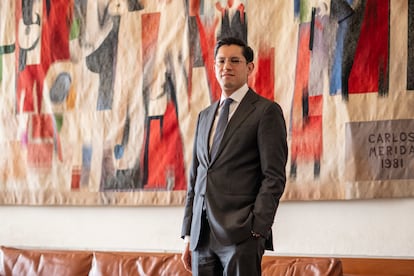
Roberto Velasco’s first two months at the helm of Mexico’s foreign ministry have been anything but calm. The 38-year-old chief of the country’s diplomacy — who had already served in the role temporarily during his predecessor José Ramón de la Fuente’s illness — is suddenly facing one of the most delicate moments in bilateral relations with the United States since Donald Trump returned to the White House. The death of two unaccredited CIA officers in the Sierra Madre of Chihuahua; the U.S. Department of Justice’s charges against Sinaloa’s governor, Rubén Rocha Moya; the renegotiation of the USMCA trade treaty… All of these issues push Velasco to choose his words with surgical precision, or even to steer clear of certain topics to avoid any hint of conflict. That caution runs throughout the entire conversation, held on Monday.
Besides the tension with Washington, Velasco is trying to reposition Mexico on other fronts. He has signed an agreement with the European Union that renews relations with the Twenty-Seven, welcomes the rapprochement with Spain following years of strained relations over Mexico’s demand for an apology for colonial-era abuses, and he hopes for a peaceful outcome in Cuba — all matters that are shaping Mexico’s foreign agenda these days. The foreign secretary meets EL PAÍS with exquisite punctuality in one of the rooms at the Secretariat of Foreign Affairs. From the 22nd-floor windows, the vastness of Mexico City seems suspended in an unlikely calm. For an instant, the city appears to offer a brief respite. It is but a mirage.
Question. The recent summit between Mexico and the European Union sealed a new rapprochement. What does that agreement mean in the current context of a more aggressive United States than ever?
Answer. It was a summit that had not been held in 11 years. The comprehensive agreement between Mexico and the European Union has been in force since 2000 and needed updating. It marks a mature phase in our relationship and allows us to open a new chapter. It is not intended to replace the treaty we have with the United States and Canada, which is Mexico’s most important. On the contrary, it seeks to complement and diversify our supply chains and, of course, to showcase the international leadership that Mexico’s government currently holds under President Sheinbaum.
Q. What would you say is the summit’s biggest achievement?
A. The most important thing is what it enables. For example, one of the announcements is that the European Union will allocate a €5 billion fund under the Global Gateway for investments in Mexico.
Q. A month ago there was a terrible accident in Mexico in which two CIA officers were killed. What were those officers doing on an operation in Chihuahua?
A. We have already said that the agents were not accredited; we informed the State Department that our laws must be respected and that we expect cooperation to continue, but under those conditions. Beyond that, it is the Attorney General’s Office that is determining how the Chihuahua authorities made their decisions.
Q. The White House criticized President Claudia Sheinbaum’s so-called lack of compassion over the agents’ deaths. Do you think the accident could have been handled differently?
A. The first thing we expressed, and have reiterated, is our condolences to the families of those who lost their lives in that accident. I conveyed this myself to the families and, naturally, to the U.S. Embassy.
Q. Then, if you expressed that, what explains the criticism of a lack of compassion?
A. Well, sometimes information does not flow as we would like; sometimes a story with a particular angle circulates on social media or in some outlets, and that is what reaches the audience.
Q. Shortly afterward an indictment was issued against the governor of Sinaloa and a number of other officials. How do you interpret those U.S. accusations?
A. We have already responded directly to the State Department on that matter. We asked them to present more evidence alongside these requests so a deeper analysis can be made. We will be awaiting their response.
Q. Do you think the timing chosen by the United States to announce that accusation is related to the agents’ accident in Chihuahua?
A. No, I do not think one thing is related to the other, but naturally that is a question you would have to ask the U.S. Department of State.
Q. President Trump has repeatedly said his intention is to have U.S. agents operating on Mexican territory. Do you think such an intervention is possible?
A. No. We have been very clear about that. We are willing to cooperate, but it must be with respect for our Constitution, our laws and the four principles we established between the two countries: respect for territorial integrity and sovereignty, mutual respect and trust, cooperation without subordination, and differentiated responsibility. On that basis we are willing to continue working. There have also been very important results. The latest figures published by U.S. Customs and Border Protection in April show, for example, a 76% drop in fentanyl seizures at the U.S. border. There has been a 91% decrease in irregular crossings of people from Mexico into the United States — the lowest figure in 50 years.
Q. And despite these results, do you think it has become harder now than at other times to defend sovereignty?
A. No, we simply must always defend Mexico’s sovereignty; it is the government’s principal function and we do so every day.
Q. What explains the Trump administration’s announcement that it would review the work of Mexico’s 53 consulates in the United States? How do you interpret that?
A. Our consulates fully respect the Vienna Convention. They carry out a unique role within the framework of the law. We will follow up on those statements, but so far we have no official confirmation or information that any measures will be taken at this time.
Q. What risks do you see of an invasion of Cuba?
A. Our position on Cuba will always be based on the constitutional principle of the self-determination of peoples; we will always hope for a solution on those terms to any situation. We are concerned about the humanitarian situation inside Cuba, which is why we have maintained cooperation in that regard.
Q. What has the United States asked Mexico regarding Cuba?
A. We have proposed to the U.S. government that we wanted to find a solution on the issue of oil shipments. We have also discussed Mexico’s willingness, if Cuba and the United States so decide, to facilitate some form of dialogue.
Q. Have informal talks between the United States and Cuba taken place in Mexico?
A. No. It is something we have proposed: if both parties agree to facilitation in Mexico, we would be willing to do so. To date, the dialogue has been direct between them.
Q. What are the next steps in the rapprochement with Spain?
A. The president had a very good meeting with Prime Minister Sánchez in Spain. There were a number of gestures regarding what Mexico has raised about the abuses during the conquest, especially toward Indigenous peoples and communities in our country. That acknowledgment is very important to us. We also know the King of Spain will come to Guadalajara to attend a match by his country’s team, which pleases us; he will be warmly received. And the Ibero-American summit in November is just around the corner, so there will be several opportunities for the rapprochement to continue.
Q. Is a meeting planned between the president and the King when he visits Mexico for the match?
A. I could not say yet, because we have not even received the King’s schedule, but I will discuss it with the president, the Spanish ambassador in Mexico and our ambassador in Spain.
Q. EL PAÍS has documented excesses by Mexico’s embassy in the United Kingdom. What is your view of those excesses?
A. There is a procedure before the oversight agency OIC. The president noted there is no regulation governing how people are housed in Mexican residences abroad. The secretary of economy [Marcelo Ebrard] also gave his perspective. All I can say is that it will be up to the OIC, which reports to the Anti-Corruption Secretariat but is housed here at the Secretariat of Foreign Affairs, to determine whether there was any wrongdoing. Once a determination is made about any sanction — if responsibility is found — that falls to the ministry’s Disciplinary Committee.
Q. When is this procedure expected to end?
A. The timeline is determined by the OIC itself; it is set out in the federal law on the responsibilities of public servants.
Q. What has prevented the United States, Canada and Mexico from comfortably concluding the USMCA review?
A. We have an ongoing conversation. There will be talks this week in Mexico City, the first formal meeting to address the various points raised. I am sure this trade relationship, worth nearly a trillion dollars, will weigh in this review. It creates millions of jobs and I trust that will lead us to a good outcome in this process.
Q. A change of ambassador to the United States is scheduled. What different contribution can the new profile bring?
A. Esteban Moctezuma did excellent work. Roberto [Lazzeri] comes from the world of finance, but he is also an excellent negotiator. I know this because I have participated in some conversations with the United States. He is creative and also understands perfectly that Mexico’s sovereignty is the first thing that must always be defended. I am sure he will be of great help.
Q. Is the possibility on the table that the extension to 2042 will not be reached and that there will instead be annual reviews?
A. Well, let us not get ahead of ourselves; let’s see the results of this week’s talks and soon we can tell you how the scenarios are looking.
Q. To what extent does the MAGA movement and its most radical elements harm Mexico?
A. We are seeing, and not only in the United States, an articulation of an international far-right movement that is trying to discredit, misinform and generate false, alarmist narratives aimed at creating conflicts between countries and within countries. It is also our role to provide another perspective to debunk many of these misinformation campaigns.
Sign up for our weekly newsletter to get more English-language news coverage from EL PAÍS USA Edition









































