
Mexico’s Sheinbaum shifts away from the inherited confrontation with Spain over colonial era abuses
The Mexican president is downplaying the demand for an apology from the Spanish monarchy, and instead focusing on promoting indigenous culture in a global context that requires prioritizing ties with other progressive governments
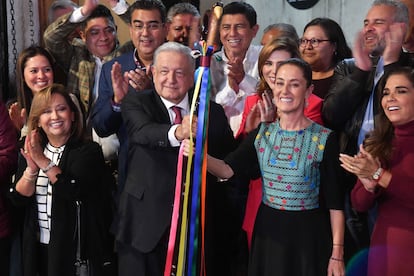

Some of the legacies of former Mexican president Andrés Manuel López Obrador are weighing heavily on her successor, and Claudia Sheinbaum has begun to shed some of them. The strained relationship with Spain, with whom Mexico shares strong historical and present-day ties, was one of them. Sheinbaum has gradually shifted toward a conciliatory stance, at the same pace that the European country has abandoned its stubborn refusal to acknowledge any atrocities during the Conquest of the Americas, at the origin of the bilateral tension. The two countries are now experiencing their closest moment in seven years. Sheinbaum has acknowledged the steps taken by Spanish authorities and she has reciprocated: at least for now, the calls for the Spanish monarchy to assume any responsibility for that historical period have ceased. The strategy now is more educational. “It is important that we continue sending many exhibitions, that Mexican anthropologists go to Spain to explain what the great civilizations were like, and that people hear about the arrival of the Spanish,” she said on Monday. Culture restored broken ties, and culture will be the way to deepen understanding.
It has taken years and countless gestures to reach this point, which comes at a crucial moment for both governments, otherwise aligned. The context, with U.S. President Donald Trump leading the global reactionary bloc, has forced both countries to set aside an issue that only posed an obstacle to forging a progressive alliance to oppose Trumpism. This Saturday, after eight years since the last visit by a Mexican president to Spain, Sheinbaum will arrive in Barcelona to promote this new alliance at a forum of world leaders to which she has been invited by Spanish Prime Minister Pedro Sánchez.
Little is known yet about the president’s specific agenda, beyond the fact that she will meet with Sánchez and will not have any meeting with the King and Queen of Spain. It is a brief trip in which her participation will be limited to the second day of the summit, which includes panels on migration, inequality, and democracy, among other topics, as well as discussions on the progressive alternative for a new world order. Regardless of the specific program she attends, the mere sight of the two leaders together is expected to inject energy into an ideological spectrum that, until now, has been trailing behind Trump’s interventionist agenda. Both leaders enjoy considerable authority in their respective regions, and their presence, along with that of other leading figures of the Latin American left, such as Brazil’s Lula da Silva and Colombia’s Gustavo Petro, sends a clear message of unity and strength.
It wasn’t easy for Sheinbaum to shed the legacy of López Obrador, which carried with it the enormous political capital of the former Morena president and touches many sensitive issues within the country. Dealing with the interpretation of the Conquest also means dealing with Mexico’s treatment of its indigenous communities. This topic also stirs up controversy in Spain. In a year and a half in office, however, the succession of events—with the U.S. president’s aggression against Venezuela and Iran among the most recent—has pushed Mexico to seek ideological and economic allies beyond its main trading partner, with whom relations are particularly strained. “Sheinbaum is trying to smooth over some of the rough edges left by the previous administration so that Mexico can have an important position in Latin America, serving as a bridge between the continent and Europe,” notes Claudia Márquez, an expert in international relations at UNAM.
The relationship with the Spanish government is key in this regard and works both ways. “Spain has always considered Mexico a strategic country. Mexico is the most internationalized and open country in Latin America,” said the economic and commercial advisor at the Spanish Embassy in Mexico in December. For the European country, she added, Mexico is the key “platform” for “expanding into other markets.” This economic aspect is complemented by an ideological context that encourages close ties with those who share core foreign policy principles, such as the pacifism that both Sheinbaum and Sánchez have championed in their respective countries.
The Mexican president must also take advantage of a context of ideological affinities among various Latin American governments, given that Brazil and Colombia are heading into elections this year, with polls still highly uncertain. Spain will hold its own elections next year, and a potential right-wing victory would only widen the gap between the two countries regarding the interpretation of the Conquest. “We must be sensitive [because] in Spain, the right wing said: ‘How is it possible that they recognize the indigenous people and the abuses that occurred during the Spanish invasion!?’” Sheinbaum acknowledged this Monday. The current scenario is the most opportune moment, and the leaders are aware that this is their best—and only—chance to promote their agenda, which is, essentially, the same.
The Mexican president is increasingly asserting her voice in foreign policy and distancing herself from her predecessor, who was reluctant to travel or attend international summits. The change of Foreign Secretary also points in this direction, with the appointment of the young Roberto Velasco, who brings “freshness” to the country’s relations with the world, according to the expert. Sheinbaum is putting her own stamp on this six-year term, and this is one of the areas where the shift is clear. “She will have a more active role [in international relations] and try to gain allies against a very aggressive player, the United States,” Márquez adds: “The president is seeking a balance.”
Sheinbaum navigates this delicate balance in every public statement, walking a tightrope to firmly defend her position in such a way that her U.S. counterpart will not view it as a direct affront. “Just speaking about the self-determination of peoples is already a very powerful message at this time, very important,” she said on Monday, without explicitly mentioning the war fronts opened by Trump, for example. Both countries are on the verge of reviewing the USMCA, the treaty that regulates trade in North America, and the smooth flow of negotiations will be key to achieving a satisfactory outcome for all. Sheinbaum has taken a step forward and committed to strengthening ties between Latin America and Europe. The 1,954 miles (3,145 kilometers) of shared border with the United States, however, are a constant reminder that any gesture or move she makes must be those of an acrobat.
Sign up for our weekly newsletter to get more English-language news coverage from EL PAÍS USA Edition.









































