
From clothing to yerba mate and cell phones: smuggled goods flood Argentina
A favorable economic climate and relaxed regulations have led to a surge in illegal merchandise. Business owners are warning consumers about the risks
In recent years, the circulation of smuggled goods has increased significantly in Argentina. This is something that consumers and business owners can attest to, even though the phenomenon eludes official records.
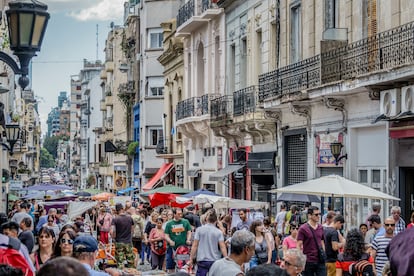
You can find this merchandise everywhere, in street markets and upscale shopping malls. You can buy contraband products in bazaars, on digital platforms, in bus terminals and airports, or in branches of well-known chains.
A survey by the business consultancy MAP indicates that there’s sectoral evidence and private studies showing that, in 2025, there was a sharp increase in smuggling and illegal trade in Argentina. This has become “a very serious problem” for the country.
“The problem has always existed, but it grew in conjunction with the opening and deregulation of the economy, which eliminated some mechanisms that were used to combat it. This has fostered a context of free movement of illegal goods, jeopardizing traditional oversight mechanisms,” the study points out. It concludes that, in 2025, at least $2.3 billion in tax revenue was lost due to smuggling, representing 0.3% of the national GDP. When contacted by EL PAÍS, the General Customs Bureau declined to comment, as did the Ministry of National Security.
Since Javier Milei’s administration began in December of 2023, there has been a lifting of import barriers, as well as a relaxation of controls. Another key factor has been an exchange rate that’s favorable to purchasing products abroad, combined with the elimination of the gap between the official and black market dollar rates (previously, it was more profitable to operate within legal channels). The expansion of e-commerce and online sales platforms has also contributed to the problem: without effective controls or clear identification of operators, this has allowed informal actors to enter the market, amplifying the scale and scope of the issue.
Marco Meloni, the owner of a textile factory in Luján – a city located about 40 miles west of Buenos Aires – and vice president of Industriales Pymes Argentinos (IPA), explains that merchandise enters the country illegally through border areas with Chile, Bolivia and Paraguay. This is in addition to “legal smuggling”: merchandise that passes through customs upon arrival, but is under-invoiced. For example, T-shirts are declared at a value of merely one cent each, which means that the importer pays less in taxes than if the merchandise’s true value were declared.
According to the businessman, the textile and apparel sector is “flooded with stock.” This is because both smuggling and imports have increased. The situation is compounded by a drop in demand, resulting from Argentines’ household budgets being tightened: they’re prioritizing other expenses.
How does this all impact the textile industry? “Since December of 2023 (the beginning of Javier Milei’s administration), 700 companies in the textile and footwear sector have closed. We’ve lost 20,000 formal jobs, [as well as potentially] 10,000 informal jobs. And there are record-breaking bankruptcy filings,” Meloni summarizes. He also believes that Argentines mustn’t lose sight of the health and environmental consequences of imported products. “In the developed world, there are increasingly more controls on social traceability, carbon footprints, phytosanitary issues and capital flows, while here, they’ve all been removed. Even the ban on importing used clothing – like the kind that accumulated in the Atacama Desert – has been lifted,” he laments.
Something similar is happening with thermoses, an essential item for storing and preparing mate, a herbal tea that’s a staple in Argentine culture. “It’s alarming how much the smuggling of toxic thermoses has grown,” Martín Nadler sighs. He’s the CEO of Lumilagro, the most popular Argentine brand. He explains that 50% of the thermoses currently in circulation entered the country through smuggling. And half of these are made with toxic metals that can cause health problems: they’re prohibited by authorities.
The key issue is that, to identify these products, consumers can only rely on the price (they should be suspicious if a one-liter metal thermos costs less than 40,000 Argentine pesos, or about $27 dollars) and the distribution channel. This is because the government has eliminated the tax stamp, which previously allowed for the easy identification of products that were legally imported through customs.
The smuggled thermoses cross primarily through the border with Bolivia. From there, they’re distributed throughout the country. “They’re in bazaars, on online platforms… and we’ve even seen them in official airport stores and convenience store chains,” Nadler points out.
Electronic devices are another example. One in three new cell phones activated in Argentina was neither manufactured in the country nor imported through legal channels, according to data from the Association of Argentine Electronic Terminal Factories (AFARTE). “Some sectors have historically been affected by smuggling – such as tires and tobacco – but now [we’re seeing] unusual items, like beer and flour. And the problem is that it’s been going on for two years and it’s eroding [the domestic] industry in a huge way,” says Ana Vainman, the executive director of AFARTE. She notes that there’s always been a smuggling rate of between 5% and 7%... but now, in the case of mobile phones, this figure exceeds 30%.
Vainman points out that most of the mobile phones enter through the border with Paraguay, although there are also other entry points. They’re then distributed throughout Argentina, where they can be purchased everywhere. This is unlike what happens with larger appliances – such as air conditioners or televisions – which, after entering the country, are typically sold in the border areas themselves.
Counterfeit cell phone accessories – such as headphones and chargers – are also circulating massively and are even offered in upscale shopping malls. “There’s low demand, because people don’t have money and there’s no financing available to offer [payments via] installments. Of what little is sold, a third is lost to smuggling. It’s a really messy situation for us,” Vainman warns.
A few weeks ago, in the Argentine province of Córdoba, a woman died in a car accident caused by a cell phone charger exploding. Vainman points out that such incidents are more likely when using accessories that don’t meet electrical safety standards and certifications. “These are extremely dangerous things: people don’t consider this when choosing based on price,” she warns.
According to the MAP report, in 2025, Argentina lost $2.3 billion in tax revenue due to smuggling, representing 0.3% of the national GDP. This lost revenue – from uncollected tariffs, value-added taxes (VAT) and excise taxes, among other sources – is equivalent to building 3,800 schools, 80 specialized hospitals, or nearly 1,200 miles of national highways.
The official response
According to business owners, the government is aware of the situation, but has so far taken only lukewarm measures. It has established a Smuggling and Counterfeiting Task Force and has begun issuing fines to companies that underreport the value of their imports. This is in addition to the regular operations carried out by the security forces.
Argentina’s Customs Bureau, for its part, announced that it will implement changes to door-to-door delivery and even raised the possibility of reviewing the “declarant” role created by the Milei administration, which allows an individual to carry out customs procedures without being a registered customs broker.
Nadler, the CEO of Lumilagro, warns that “there has been such a flood of contraband products that, even if strong measures are taken today, it will take a long time to clear the stock.”
There are currently bills in Congress that seek to address the problem, such as one piece of legislation proposed by left-wing Peronist representatives Guillermo Michel and Kelly Olmos, which aims to make online sales platforms liable for the transactions carried out on them. If approved, the digital platforms would, for example, be responsible for paying customs duties if they allow the sale of imported goods without the required documentation.
Sign up for our weekly newsletter to get more English-language news coverage from EL PAÍS USA Edition









































