
Organized crime is strangling Latin America
As drug production and trafficking increase across the continent, criminal groups of all sizes are diversifying their operations and increasing their firepower. Governments, meanwhile, stumble between hard-line policies and paralysis
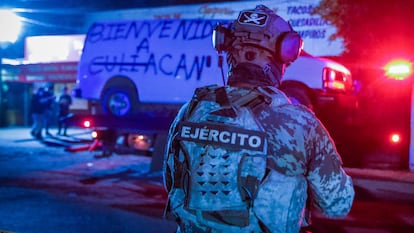
A small green piece of paper, with a phrase written in capital letters, summed up the crime problems plaguing Latin America. It appeared in Guerrero, on Mexico’s battered southern Pacific coast, but it could just as easily have been in Santiago, Chile, in Medellín, Colombia, or in any area of Guayaquil, Ecuador. It was a warning, a sheet pasted on corners and lampposts, a threat to merchants in a handful of neighborhoods, announcing that starting in December they would have to begin paying a “fee.” “This neighborhood has an owner,” the anonymous notice concluded.
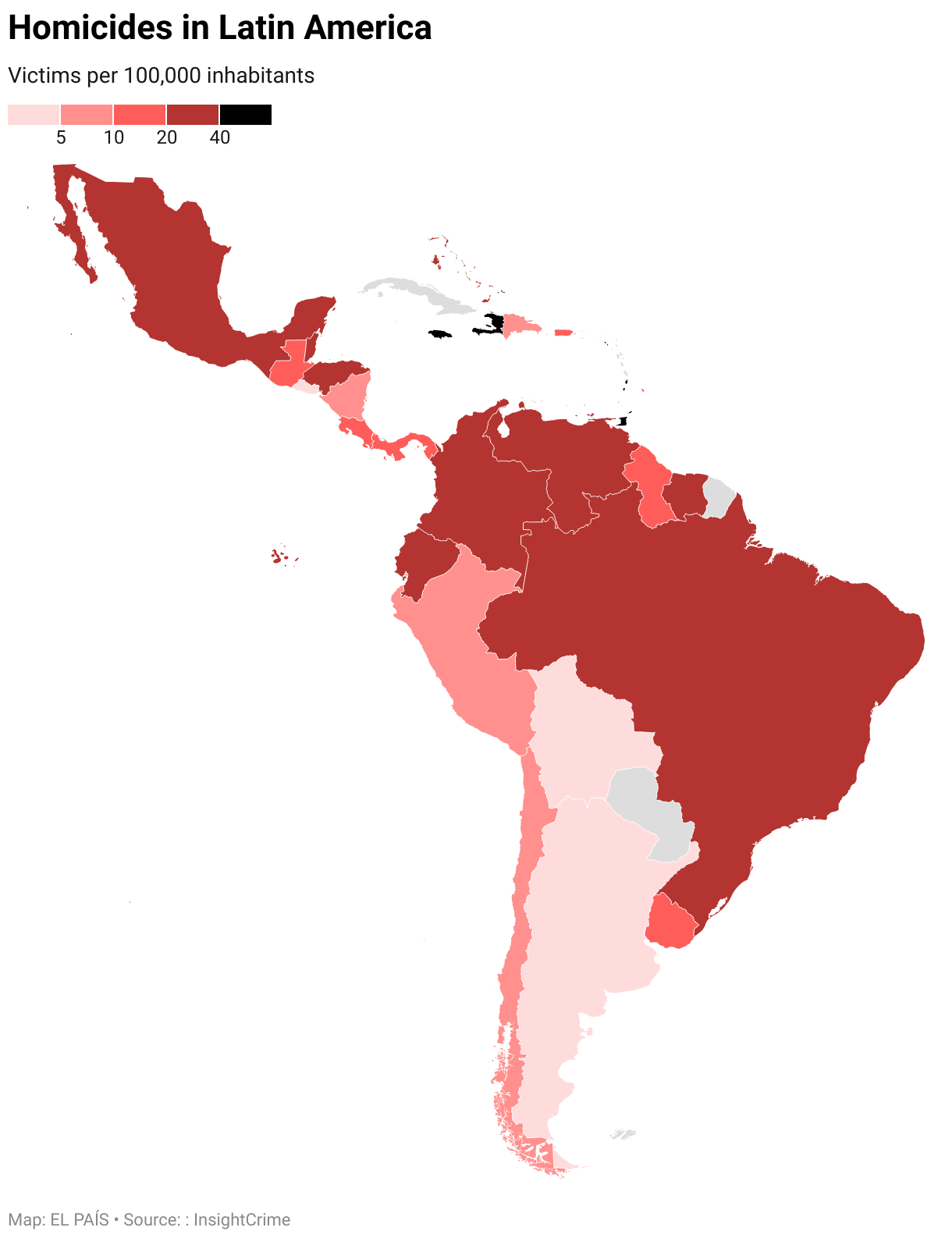
Extortion is a scourge hitting the continent like never before, and one that explains the region’s current state. Crime is flourishing in the Americas, particularly violent crime. The murder rate remains very high, at more than 20 per 100,000 inhabitants. The expansion of the drug trade, which is stronger than ever, has nourished the criminal landscape from the once-tranquil Uruguay to the perpetually troubled Guatemala. Armed groups born from the drug trade are seeking new businesses, left and right, top and bottom. None seems as profitable as extortion, as simple as it comes: pay up or die.
The Americas in general, and Latin America in particular, are going through a difficult moment. Experts consulted by EL PAÍS for this report see the diversification and fragmentation of the criminal underworld as a risk for countries in the region. The drug trade set the criminal factory in motion, from which dozens of gangs have emerged, each operating under market logics, each wanting its own slice of the pie. Extortion is the simplest; drugs are one possibility, but only one among many. The Americas harbor an impressive store of natural resources, and crime, hungrier than ever, is waiting its turn. Like a modern Hydra, gangs strike with multiple heads, spreading their reach to expand their business.
The countries in the region, which tend to look inward, seem to ignore that the predatory push of organized crime is the same everywhere, from the Andes to the Amazon. In Mexico, criminals steal fuel from the state oil company’s pipelines or import it tax-free, falsifying customs declarations; in Peru, Ecuador, and Colombia, offenders plunder gold and other mineral mines without authorization; in Brazil, thieves and smugglers cut down trees tirelessly to feed the global demand for timber… And all of this often occurs with the support of state actors. “In environmental crimes, this is very evident,” says Cecilia Farfán, head of the North America Observatory at GITOC, a civil society organization that researches transnational organized crime.
In addition to drug trafficking and extortion, these new criminal ventures take place alongside somewhat more traditional enterprises that are extraordinarily lucrative for organized crime: human trafficking — whether of migrants or not — and arms smuggling. In its latest report on the global crime situation, released a few weeks ago, GITOC specifically highlights the prevalence of firearms in the region as tools for committing homicide. Nowhere else in the world are so many murders carried out with guns as in Latin America and the Caribbean. “Compared to 20 years ago, organized crime has more and better weapons — so much so that people think they are better than those of the armed forces,” notes Farfán.
In this logic, violence serves both as a tool and a message — a means, but also an end in itself. Apart from a few notable exceptions — the murder of DEA agent Enrique Camarena in Mexico in the 1980s, the “Years of Lead” under Pablo Escobar in Colombia in the early 1990s — the drug trade did not start out as violent. To get drugs to major markets in the United States or Europe, secrecy was essential. Bribery and order: that could have been the motto of the trade. But the dismantling of the old drug cartels and the fragmentation of their protection networks, always backed — or directly embedded — in state security forces, changed the landscape.
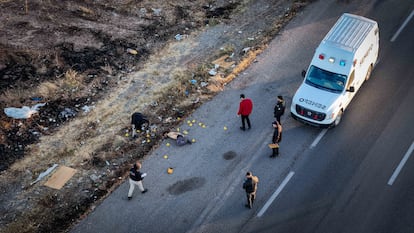
In the Americas today, small, dynamic criminal groups prevail, linked or not to larger criminal organizations, which may or may not be involved in drug trafficking and street-level sales. They extort money and try to exploit the environment and natural resources to their advantage. If there are mines, they take minerals; if there are forests, they take timber; and if there are cities, they take businesses, government offices, and transportation routes.
All of this is taking place in highly competitive environments where violence, the prevailing currency, is used to eliminate business obstacles, such as a forest defender, or to send messages to enemies, real or potential. “That is the great threat on the continent: criminal diversification and the fragmentation of criminal gangs,” says Marcelo Bergman, a professor at the Universidad Tres de Febrero in Argentina and one of the leading experts on criminal dynamics in the region.
Cocaine is back
Sacks of brown paper, hidden in an ordinary warehouse. That was how the 14 tons of cocaine that Colombian authorities seized in the Port of Buenaventura, on the Pacific coast, were disguised. The street value of the drugs would have reached approximately $400 million, according to Colombia’s National Police, a landmark seizure in the country’s recent history. The director of the agency said that it was the largest cocaine bust in the last 10 years. The bad news for authorities is that those 14 tons represent only 0.4% of the region’s annual production, according to the latest United Nations estimates.
Cocaine is back in fashion. Setting aside the heated debate over the numbers — a disagreement between the Colombian government and U.N. measurements — production of the drug continues to rise each year, along with the hectares of coca leaf, the raw material for cocaine. Colombia is the aircraft carrier of the trade, far ahead of Peru and even farther ahead of Bolivia. Of the 3,708 tons of cocaine produced in the region in 2023, according to U.N. estimates, 2,664 came from Colombia. Last year, that number climbed to 3,001 tons, as recently reported by EL PAÍS — a figure that has fueled yet another point of contention between the parties.
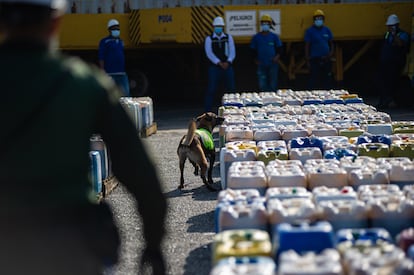
The rise of cocaine in South America and its markets, and the increase in seizures worldwide — again according to the United Nations — illustrates a broader regional trend: the expansion of drug production and trafficking. This applies to nearly all substances, except for heroin, which has fallen out of favor, and marijuana, which has been legalized in many countries. The rest are experiencing a boom, driven by the euphoria of prescribed alkaloids — a situation reminiscent of the golden age of the Medellín Cartel and the cocaine airlifted through the Caribbean to Florida in the mid-1980s, the era of Scarface and Miami Vice.
New drugs are fueling this surge further north, with few substances more prominent in continental trafficking than fentanyl and methamphetamine. The opioid and stimulant are replacing the old poppy and cannabis crops in Mexico, and laboratories are spreading across the western part of the country, all dependent on insatiable demand from the United States — despite the war on drugs waged over five decades by successive U.S. administrations, from Richard Nixon to Donald Trump. The current U.S. president has tried to pressure governments in the region to curb trafficking through threats of tariffs and naval strikes. So far, Trump’s missile strikes in the Caribbean and Pacific, aimed at halting the drug trade, have left more than 80 people dead.
Besides being a highly questionable operation from the perspective of victims’ rights, the logic of bombing drug routes is like the old adage about using a sledgehammer to crack a nut. How much cocaine have these strikes actually stopped from reaching U.S. consumers? Without official data, it’s hard to tell. In any case, it seems unlikely that such operations affect demand. “Despite the decades we’ve spent trying to stop it, cocaine has reached its highest-ever peak in terms of demand,” confirms Angélica Durán, a professor at the University of Massachusetts and author of several studies and books on violence and illegal markets.
The cycle comes full circle. Drug markets that weren’t originally violent — or at least not as violent as today — began generating a demand for new protection networks in response to rising competition and the decline or incapacity of old networks. In the meantime, new groups started exploring other ventures, hence the diversification, extortion, and so on. Governments in countries like Colombia, Mexico, or Brazil tried to dismantle these groups — for example, the violent Los Zetas — through sporadic arrests. In practice, however, the groups fragmented, and the remnants, under new names, kept doing the same business. Demand for drugs remained steady or even increased. And that bring us to 2025.
Now, this logic extends beyond traditional producing countries and appears — with catastrophic results — in transit countries like Ecuador, where the murder rate jumped from under eight per 100,000 people in 2020 to over 45 in 2023, as well as in the Caribbean region. Not so long ago, Ecuador, a bridge between Colombia and Peru, was rightly seen as a relatively peaceful oasis in South America, especially compared to Colombia. But in the past five years, it has become one of the continent’s main cocaine hubs — something also true of Costa Rica — where criminal networks move drugs bound for Europe, taking advantage of Ecuador’s status as the world’s leading banana exporter.
Colombia, the world’s top cocaine producer, is a paradigmatic case that complements Ecuador’s story. After the fall of the Medellín and Cali cartels in the 1990s, the groups that inherited the cocaine trade changed tactics. They stopped shipping to Mexico and began selling at the border. Profits were smaller, but there were fewer problems. At the same time, the United Nations recorded a steady decline in coca leaf and cocaine production until 2013. But the rebound since then has been dramatic: from 50,000 hectares under cultivation back then to over 250,000 today. Over these years, the fragmentation of criminal groups has been constant. As has their diversification. “Now they are switching from coca to illegal gold mining, depending on prices,” says Daniel Mejía, a PhD in economics from Brown University and former director of the Center for Security and Drug Studies at Universidad de Los Andes.
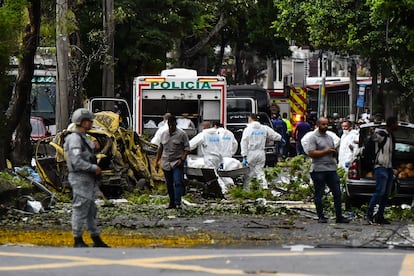
Mejía, like Marcelo Bergman, points out the extreme danger of situations in countries such as Colombia, Mexico, parts of Brazil, or Ecuador, where violent crime rates remain persistently high. “The expansion of criminal groups in Latin America is no longer just about controlling the drug market or mining. They are increasingly moving toward a logic of criminal governance,” he explains.
“When you reach situations like Mexico — 30,000 murders annually, rising extortion, looting of mines and forests, fuel theft — criminal activity has diversified to such an extent, with multiple criminal actors involved, that the state no longer has a deterrent capacity,” adds Bergman.

Revenge and forests
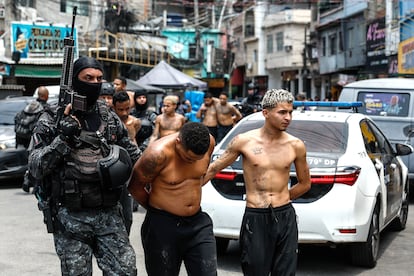
One early morning in late October, residents of a Rio de Janeiro favela went into the forest to collect bodies. While life carried on in the bustling southern zone of the city, on the beaches of Copacabana and Ipanema, dozens of men and women from the Penha favela, deep in the city’s interior, climbed into the forest to retrieve the bodies of their relatives, killed just hours earlier by state police in an operation that shocked the world. Reporters arriving later at the neighborhood square described horrifying scenes: dozens of corpses lying in rows, mutilated bodies, covered with makeshift tarps…
Although the exact number of victims from the police operation remains unclear, the most conservative estimates put it at 121. In a time when the president of a global power like the U.S. can dismiss the killing of a journalist as “things happen,” the response from Rio de Janeiro’s governor, Claudio Castro, to the favela massacre followed a similar tone. According to Castro, the operation was a success because 78 of the victims had serious criminal records. Surprisingly to some, polls conducted in the following days showed public support for the operation and the governor’s words. The hardline approach — a politically controversial move throughout the region — was backed overwhelmingly.
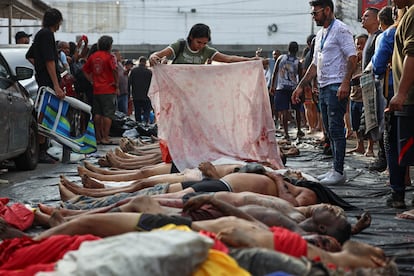
The massacre in the favelas of Penha and Alemão — the worst in the country’s history — reflects a broader trend across the continent: public desperation over insecurity and violence, and the search for magical solutions. It’s an approach similar to what has been pursed by El Salvador’s Nayib Bukele, who a few years ago, suddenly and forcefully, crushed criminality — when negotiations with gangs failed — by dismantling the rule of law. This is being seen in Mexico and Ecuador, but also in countries with much lower levels of violent crime, like Chile, where the homicide rate is around six per 100,000 inhabitants, low by regional standards but double what it was 10 years ago.
“In Latin America, there has always been a demand for tough-on-crime responses, a catch-all term,” says Angélica Durán, from the University of Massachusetts. There are many examples. For instance, the cases in the 2000s in Honduras and El Salvador. These were reactive approaches to crime, not part of long-term planning, but responses to crises. “There’s a tendency that when people perceive strong crime and impunity, the demand for these policies increases. And they’re easier for states to implement, even if they’re ineffective, because they give the impression that something is being done in the short term,” the expert adds.
At a time when populism is gaining ground in the region — especially right-wing populism, with the Bolsonaros, Mileis, Bukeles, and company leading the charge — the temptation to offer quick fixes is growing. All experts consulted agree on one point: the Bukele model can’t be replicated. “They were able to do it because it’s a small country that took control of the gangs very quickly,” says Bergman. In larger countries of 10, 15, or 20 million inhabitants, attempting something similar would mean imprisoning over 100,000 people. In Mexico, that number would be 1.5 million; in Brazil, more than two million.
While effective from a media perspective — what aspiring autocrat wouldn’t hyperventilate at the idea of building giant prisons to house hundreds of thousands of alleged criminals, clad in miserable white underwear? — the approach could be counterproductive. In his seminal book Prisons and Crime in Latin America, Bergman points out that over the past two, nearly three decades, the prison population in Latin America has nearly doubled, yet crime has not decreased. For two reasons: first, because the criminals incarcerated are links in a chain who can be easily replaced; and second, because prisons, far from reforming inmates, are preparing them to return to the criminal world even stronger.
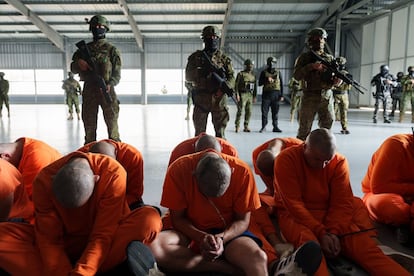
So what should be done? Daniel Mejía points to a possible answer. A university man by background, Mejía became Bogotá’s first security secretary in 2016, at a time when a huge criminal hotspot, known as El Bronx, was taking shape in the city center. If it had continued to grow, it could have become a major problem. “It covered about five blocks, but it was close to the courts, to city hall, in an area where not even the police could enter. And our basic principle was that we couldn’t have no‑go zones,” the expert explains. Mejía infiltrated agents into El Bronx, coordinated intelligence work for six months, and when he struck, he did so with all available force.
“We deployed 2,500 police officers, in addition to army personnel, who were in charge of the perimeter,” he explains. “The goal wasn’t to use excessive force, but to avoid using it altogether. In other words, to deploy so many people that they wouldn’t even think of retaliating.” And that’s exactly what happened. There were no shootouts or deaths. In just a few minutes, the police occupied the more than 140 establishments in the area where drugs were being sold, among other things. Although the particular nature of that situation makes it hard to replicate elsewhere, the lesson seems clear: intelligence, preparation, and overwhelming force to prevent criminals from responding. Mejía offers a warning: “Using force without intelligence leads to many mistakes.”
The prognosis isn’t good, but it’s not terrible either. “Crime isn’t going to disappear, but we must strive to limit it,” argues Cecilia Farfán. It’s a statement that masks a certain complexity. Limiting crime isn’t easy when for decades governments have just been reacting. And that’s not the only issue. “The big problem is that, in Latin America, states generally have very fragmented power, and there are many criminal groups, so any policy is very complicated. What’s more, these groups may be possibly connected to parts of the political establishment,” says Durán. Culturally, too, the struggle is equally difficult. Words like government or politics have lost much of their power to inspire. Disaffection reigns, and in such a context, other actors enter the scene.
People are drawn to wrongdoing; you only have to look at the success of corridos bélicos, a subgenre of Mexican regional music that has become a global phenomenon. Crime is no longer chosen purely out of necessity — it is often chosen out of revenge. “There’s a widespread sense of disappointment that the legal path — education, work — doesn’t offer answers,” says Bergman. “And so, these nihilistic, rebellious, violent paths… Well, today it seems that the great attraction is getting a gun, hurting others, avenging a terrible childhood, what was done to me. The number of people ready to engage in a life of crime because they can’t find answers in other ways is a serious problem.”
Sign up for our weekly newsletter to get more English-language news coverage from EL PAÍS USA Edition









































