
Pablo Nunes, public security expert: ‘The Rio police operation against drug trafficking was disastrous from every perspective’
The coordinator of the Center for Security and Citizenship Studies considers the operation an example of the lack of a clear strategy on the part of the authorities
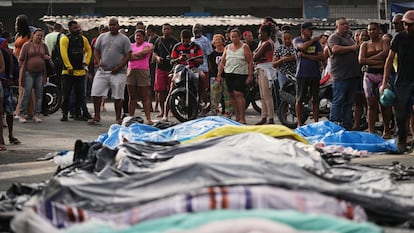
Following the police operation against drug trafficking that left more than 120 people dead in Rio de Janeiro, the state governor, Bolsonaro supporter Cláudio Castro, was quick to call it a success, adding that the only victims were the four police officers killed in the shootouts. Among experts, however, there is broad consensus that the bloody operation is the clearest example of the lack of a clear and effective strategy on the part of the government, as argued in this interview by Pablo Nunes, coordinator of the Center for Security and Citizenship Studies.
Question. How do you evaluate the Rio government’s operation against the Comando Vermelho (CV)?
Answer. From any perspective, it was a completely disastrous operation. So far, we have 120 dead, including four police officers, and a city paralyzed by the CV’s response… We have a scene of utter barbarism, a complete disaster, and a stark portrait of Rio de Janeiro’s institutional bankruptcy in the area of public safety. There is a total lack of authority, planning, and strategy. It’s the same thing we’ve seen in recent years: police officers acting on their own initiative, without any coordination, intelligence, or any action aimed at impacting the entire criminal network.
Q. In recent years, the CV has expanded, occupying new favelas and neighborhoods, often at the expense of militias or paramilitary groups. What accounts for this growing strength?
A. It has a lot to do with that total lack of planning and in-depth analysis. In recent years, we saw an expansion of the militias’ territorial control. The militias underwent significant changes after the departure of Ecko [killed by police in 2021], who was the great leader who held them together. There was a fratricidal war to occupy that leadership position. An authority vacuum was created that the CV took advantage of to expand its territory; this was entirely expected.
Q. What should the strategy be for weakening organized crime beyond one-off operations?
A. If we truly want to tackle drug trafficking, we have to find out how those weapons get to the favelas, how those drones and grenades used in this operation got there. We need to have a serious debate, and unfortunately, that debate is being blocked by the Rio state government’s stance, which is more concerned with creating scare tactics than offering real solutions. Just compare it to Operation Hidden Carbon; it struck at the financial heart of the Primeiro Comando da Capital (PCC) without firing a single shot, and it had far greater effects than what we saw in Rio. Those killed, those young Black men, shirtless, in flip-flops and swim trunks — who is naive enough to believe they are the ones leading the actions and maintaining the territorial control that the favelas have suffered for the last 40 years?
Q. The governor stated that Rio was alone in the fight against crime and that Luiz Inácio Lula da Silva’s government did not help by sending the armored vehicles he wanted, even though he never officially requested reinforcements. Is there a strategy of attrition already underway with an eye toward the 2026 elections?
A. Without a doubt. These deaths and the rhetoric Castro has adopted are entirely in line with a political strategy to try to win votes. The governor’s complaints are curious, because he and other right-wing governors were completely opposed to the government’s proposal for greater integration and more federal involvement in public safety.
Q. The proposal to amend the Constitution and give the central government a more prominent role in the fight against crime, at the expense of state governors, did not advance in Congress. Even though security is the responsibility of the states, could the federal government do more?
A. What we need to have is a very honest assessment that the public safety problems in Rio and other states today cannot be addressed with the design of the 1988 Constitution. That model became obsolete a long time ago. Obviously, the federal government needs to be more involved, recognizing the dynamics of these criminal groups, which are no longer confined to a single state, but now operate nationally and even internationally. The federal government has to play a role, but that can only be done with constitutional changes; that needs to be put on the table.
Sign up for our weekly newsletter to get more English-language news coverage from EL PAÍS USA Edition









































