
Comando Vermelho, a criminal organization focused on drug trafficking with 30,000 members
The Rio de Janeiro gang, the target of a bloody police operation, was born in prison almost half a century ago
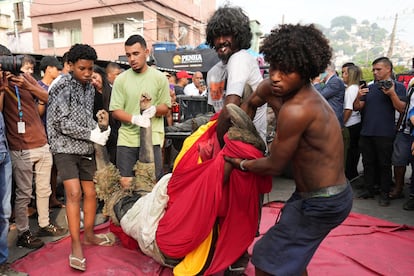

The Comando Vermelho (Red Command) gets its name from the alliance forged between common criminals and political prisoners in 1979, during the Brazilian dictatorship. The adjective, however, aptly describes the reputation for bloodthirstiness that has accompanied the most powerful criminal group in Rio de Janeiro and the second most powerful in Brazil ever since. Although it was the pioneer, it has long been surpassed by its main rival, the Primeiro Comando da Capital (First Capital Command, known by its initials PCC) of São Paulo. The Comando Vermelho (CV) “is the most violent faction, the one that most resists the police; its response is usually direct and confrontational,” explains Ignacio Cano of the State University of Rio de Janeiro. Cano, a scholar of organized crime, maintains that whoever designed the police operation to penetrate the CV’s main stronghold knew that its members would react furiously. They responded with hours of gunfire using heavy weaponry and bombs launched from drones, “like in Ukraine,” a Rio native remarked in amazement.
On Tuesday, pandemonium erupted in the favelas of Penha and Alemão. Civilians barricaded themselves in their homes, frantically exchanging information with neighbors and friends in WhatsApp groups. When the gunfire subsided, they knew there would be many victims, given the intensity and duration of the shooting. They were experienced in such situations. But it was difficult to imagine there would be so many. The police operation was so deadly that, with 132 people dead, it went down in history as the worst massacre in Brazil.
But the main target — the CV’s top leader outside of prison, Edgar Alves Andrade — was not arrested. Raised in the favela where residents lined up the dozens of bodies recovered after the operation, he is 55 years old and has a blood-soaked police record. Law enforcement accuses him of a hundred murders, including those of three children who died after being tortured because they had stolen a small bird from a drug lord and who were subsequently disappeared. Other accounts claim he ordered the killing of the four drug traffickers who brutally murdered the three children from Belford Roxo.
The CV, like other groups, imposes its own law in the favelas. Allowing the police to use your home during an operation can be punished with a painful death followed by a disappearance, meant to torment your family and discourage anyone from ever having officers in their home again. And getting into a fight at a funk dance can lead to being submerged in a tank of ice for hours.
Through the military decree that mixed common and political prisoners in the late 1970s in an inhumane prison located on the idyllic island of Ilha Grande, the criminals learned from the guerrillas fighting against the dictatorship how to organize themselves to defend their rights. Comando Vermelho began by pooling funds to finance prison escapes and alleviate the hardships faced by inmates. Their ideas soon spread to other prisons.
From there, they moved on to bank robberies, so fashionable in the 1980s. But they soon realized that drug trafficking was more lucrative and involved fewer risks. They started on a small scale, dealing marijuana in the morros, the hills of Rio de Janeiro where the favelas began to spring up.
Half a century later, Comando Vermelho is dedicated to the international trafficking of cocaine, marijuana, and weapons. It has 30,000 members, according to Insight Crime. Many are poor, Black kids from the favelas, the kind who wander around all day high on marijuana, wearing swimsuits and flip-flops, with no future. In the last decade, it has expanded throughout the rest of the country through alliances with other regional groups, and since 2022 it has reconquered — through murder — neighborhoods in Rio de Janeiro that had fallen into the hands of rival drug gangs or paramilitaries. In February, it sealed a truce with the PCC, which proved extremely short-lived, lasting just weeks.
That (and the 2026 presidential elections) is the context in which the governor of Rio de Janeiro gave the green light for the police to forcefully enter the two gigantic favela complexes that had become the headquarters of Comando Vermelho, a hideout amid 300,000 residents. During the police assault, the plumes of smoke rising over the Rio landscape were reminiscent of the Gaza Strip, back when buildings still stood there.
Although the CV led the way, it has been relegated to second place in criminal power for years, ever since the PCC — which also emerged in prison, but in São Paulo — consolidated its dominance in that state and jumped from there to the rest of Brazil.
The only two gangs with a national presence share many similarities, but their operations reflect the distinct cultures of Brazil’s two largest metropolitan areas. Rio residents are known for their enjoyment of life, their flaunting and boasting, and their complaints that Paulistanos only know how to work. The CV is more flexible and less hierarchical than the PCC, where the chain of command is clear. This is also reflected in how the respective state authorities combat them. Last August, the São Paulo police launched a major operation to financially cripple the PCC and shut down its legitimate businesses. And they didn’t fire a single shot.
“Unlike São Paulo, where the PCC maintains hegemony and doesn’t need to deploy large doses of violence to exert its dominance, in Rio de Janeiro, the CV is the group that controls the most territory, but it is not hegemonic. And when the state attacks it, spaces open up for other groups to fill those gaps,” explains Cano.
Three years ago, the CV launched an offensive in the city, recapturing several neighborhoods after wresting them from paramilitary groups and rival drug cartels. This is in addition to its successful operation to expand throughout the Amazon and the Northeast. The Comando Vermelho has managed to seize control of the Solimões River route, as the Amazon is known in Brazil, thanks to its alliances with local groups in border areas. These alliances have paved the way for the CV to receive cocaine shipments from Colombia, Peru, and Bolivia, which travel along the world’s largest river to the coast for internal distribution or shipment to Europe and Africa.
Rio authorities also wanted to crack down on the CV because it had offered refuge in the city to drug lords from other states, given the ease with which technology allows for managing businesses — both legitimate and illicit — remotely. In fact, some of those killed in the police operation were from outside Rio.
Sign up for our weekly newsletter to get more English-language news coverage from EL PAÍS USA Edition









































