
Latin America’s far-right networks: Digital newspapers, bots and fake news
A conservative network that originated in Brazil and spread through Argentina has reached Mexico, acting as a political weapon
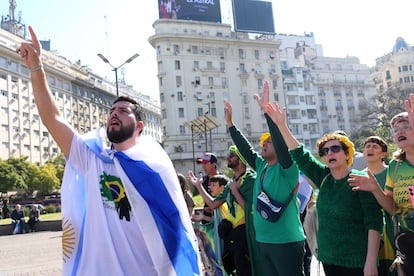
Brazil was the testing ground for the new digital weapons of the Latin American far-right. And the success was so resounding that a provocative and virtually unknown congressman named Jair Messias Bolsonaro became president in January 2019.
Four years later, the spotlight fell on Javier Milei: a vociferous Argentine economist with curly hair. The far-right phenomenon is now growing in Chile, spearheaded by Johannes Kaiser, until recently a presidential candidate. And now, the network is attempting to gain a foothold in Mexico, where it’s still searching for a figurehead.
Regardless of country, the strategy is always the same: armies of digital mercenaries spread their rhetoric outside of traditional media. On X, TikTok, Instagram and Facebook, as well as through streaming programs and digital newspapers, they call for revolt and civil disobedience (or even coup d’états) and organize “spontaneous” demonstrations to overthrow the establishment. One of these was held on Saturday, November 15, in Mexico City, to protest the administration of President Claudia Sheinbaum.
In Mexico, the far right has had little popular support and no institutional presence. There are only two far-right groups aspiring to become political parties before the 2027 midterm elections. One of them is led by actor Eduardo Verástegui, who once had a good relationship with the Argentine president. Their alliance was short-lived, however: an unexpected exchange of insults on X this past October ended the partnership. It also led to the cancellation of the Conservative Political Action Conference (CPAC) that was supposed to be held in Mexico this month.
Lacking electoral representation, the presence of the Mexican conservative movement is currently concentrated on social media. It was there that the controversial call for a demonstration — supposedly attributed to members of “Generation Z” — emerged. Although presented as a spontaneous movement similar to those that shook Nepal, Madagascar, or Morocco, an investigation by Infodemia — a Mexican government unit dedicated to analyzing disinformation — maintains that it was, in fact, a “coordinated digital strategy.” The report points to influencers, opposition figures and accounts linked to the Atlas Network — an ultranationalist organization founded in the early-1980s, with a presence in more than 100 countries — as being behind the campaign. According to the report, more than 90 million Mexican pesos (about $5 million) were spent in the last month-and-a-half to promote the march.
The official investigation also indirectly implicates Ricardo Salinas Pliego, owner of the TV Azteca network. Two weeks ago, the Mexican Supreme Court ruled against him after years of litigation, ordering the businessman to pay 50 billion pesos (nearly $3 billion) in back taxes. This setback intensified the debate about Salinas Pliego’s alleged role in the digital campaigns that criticized Claudia Sheinbaum when she was the head of the government of Mexico City (2018-2023).
Infodemia traces the origins of the most recent digital campaign back to early-October, when Azteca Noticias published a report on Generation Z protests taking place beyond Mexico. Dozens of social media accounts then emerged, with names like “generacionz_mx” or “somosgeneracionzmx,” all calling for a march to take place in the Mexican capital on November 15. Nearly 200 accounts promoted the protest on TikTok, with 50 of them created or reactivated during that period. On Facebook, more than 350 groups discussed the issue, with several of them administered from abroad.
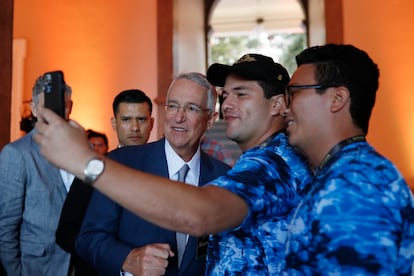
The tone of the messages shifted abruptly during the first-half of October. Then, following the assassination of a mayor in the state of Michoacán on November 1, the narrative shifted: there were calls for the president to be recalled from office, as well as accusations of the federal government’s inability to address violence. Infodemia argues that this change in tone was orchestrated.
The report points to the presence of Atlas Network bots and mentions an Argentine citizen: Fernando Cerimedo. Until a few months ago, he was in charge of Milei’s digital campaign.
Cerimedo is a well-known figure in the Southern Cone of South America. His name appeared more than 60 times in the police investigation into the coup plot against Luiz Inácio Lula da Silva, which led to Jair Bolsonaro’s conviction this past September. Cerimedo was accused of disseminating a supposed “investigation” that questioned the reliability of the Brazilian electoral system, in order to discredit the victory of the Workers’ Party (PT) leader. Ultimately, in February 2025, the police cleared Cerimedo of involvement in the coup plot, although they noted that the Argentine had circulated “unfounded content.”
Bolsonaro’s movement germinated on social media. There, far from the radar of Brazil’s major media outlets, the anti-establishment and anti-corruption rhetoric of a congressman — known only for his provocations — seduced millions of citizens in 2018. The majority of Brazilians voted for the retired army captain that year, united by their weariness with traditional politics and a visceral hatred of the Workers’ Party. Lula — who had previously served as president from 2003 until 2011 — was out of the picture, imprisoned on corruption charges that were later dismissed.
The patriarch of the Bolsonaro clan was so aware of the crucial role of the internet (especially WhatsApp messages) in his electoral victory that, on his inauguration day, his son Carlos — a city councilman and strategist for his father’s digital campaign — accompanied his father in the Rolls-Royce that took the far-right leader to the presidential palace in Brasília. Following the surprise victory, they managed to build a far-right political movement on Facebook, Twitter (now X), YouTube and TikTok. This decimated part of the traditional right and co-opted most of the remaining conservatives in the country.
The then-president launched a weekly Facebook page where — in the style of Venezuelan president Hugo Chávez’s TV show, Aló Presidente (1999-2012) — he invited ministers to boast about the government’s achievements. The digital militias that Carlos Bolsonaro created when his father came to power functioned like a well-oiled machine. He put together a network with influential politicians and allied media outlets, in order to launch synchronized attacks on rivals, silence critics, or place certain issues at the center of the national debate. The Bolsonaro digital ecosystem even spawned its own version of Netflix: this streaming service produced films and documentaries that centered the right-wing movement’s key themes of God, country and family.
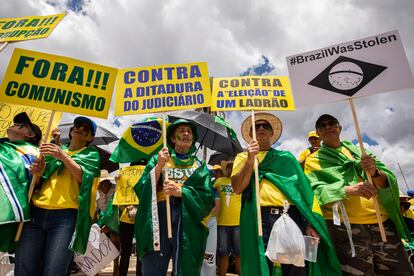
The digital world inhabited by the most radical Bolsonaro supporters — people who are fueled by biased or untrue information — was a fertile breeding ground for thousands of people to falsely believe that Bolsonaro had been robbed of the 2022 presidential election. They were persuaded to camp outside military barracks for two months, demanding that the soldiers intervene. Subsequently, they embarked on an all-out assault on the institutional heart of the republic, in Brasília. Hundreds of rank-and-file Bolsonaro supporters are now serving lengthy sentences for participating in an attempted coup d’état, while Bolsonaro awaits the terms of his 27-year prison sentence.
La Derecha Diario, an ultra-right-wing battering ram
Before Bolsonaro fell from grace, Cerimedo had already returned to Buenos Aires, where — since 2012 — he had been running La Derecha Diario (“The Daily Right”). This is one of the main digital disseminators of far-right ideas in Latin America, as well as a major propagator of misinformation against anything that smacks of progressivism. Cerimedo’s website isn’t known for having high traffic, but his account on X has over half-a-million loyal followers who amplify his message.
In June 2021, Cerimedo brought Javier Negre on board. The Spanish agitator had sensed Milei’s bright political future from Madrid (at the time, Milei was running for a seat in Congress). Negre decided to reinvent himself across the Atlantic, after a failed stint as a journalist in his home country. The new company was called Madero Media Group S.R.L. and started out with 100,000 Argentine pesos, or a little over $1,000 at the exchange rate of the time.
After years of frenetic activity, Cerimedo is now retired from La Derecha Diario (although he remains a founding partner) and has broken with the Milei administration, dissatisfied with the president’s communications strategy. Today, anyone wishing to contact him personally must travel to La Paz, Bolivia, where he serves as communications advisor to the newly-elected president, Rodrigo Paz.
Negre, on the other hand, continues his antics in Buenos Aires, after a brief stint in the United States and Israel (he traveled there to tell “the truth” about the war in Gaza). In Argentina, he quickly became popular for provoking other journalists at press conferences held by Milei’s former spokesperson, Manuel Adorni. Those who knew him during his first months in Buenos Aires remember him as a “snake oil salesman” and a “loudmouth” who unsuccessfully tried to buy Argentine media outlets to expand his influence.
Negre’s influence would eventually reach Mexico, when Salinas Pliego offered to finance a local version of La Derecha Diario. In fact, it was within this digital ecosystem that the November 15 demonstration took place. Many of the Mexican influencers identified by Infodemia have no prior connection to politics: they’re content creators focused on makeup, video games, or music, who suddenly began posting messages in support of the march with just a few days’ notice.
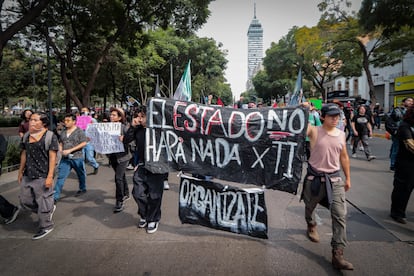
While protests led by Generation Z have toppled governments in various countries, in Mexico, online participation seems to lack sufficient mobilizing power. Even so, President Claudia Sheinbaum ordered metal fences to be placed around the National Palace and several other historical buildings, while the movement’s social media accounts shared instructions about how to tear them down.
Sign up for our weekly newsletter to get more English-language news coverage from EL PAÍS USA Edition









































