
Shortage of troops in Ukraine reopens debate on recruiting women
A social majority rejects an idea that authorities are not officially considering, although an increasing number of female voices raise the issue

Ukraine is short of soldiers. It is the main weakness of its army, Defense Minister Mykhailo Fedorov acknowledged in January, and its commanders have been lamenting since 2024. The shortage of troops forces thousands of men in the Armed Forces of Ukraine to spend months in combat positions without relief, without rest. Could recruiting women be a solution?
Two debates resurface intermittently in wartime Ukraine: should the age of men subject to compulsory conscription be lowered? The current minimum age is 25. Should mandatory enlistment for women begin? Both options provoke a strong backlash and broad social rejection. On the question of female recruitment, the issue touches on something more sensitive, says Roman Kovalov, an army colonel: tradition.
“The problem is not whether it is necessary or useful, the problem is tradition, culture,” says this battalion commander. “For our traditional society, a woman is the guardian of the home and the children’s educator. A man is the warrior and defender. The idea of mobilizing women would be perceived negatively by society.”
The debate resurfaced this April when about a dozen women in Ukraine received military summonses to join the ranks. Only career female service members and healthcare professionals are required to be registered in the military census. Even so, a doctor or a nurse can refuse mobilization for many reasons. The women summoned in April did not have the profile to join the military and the Ministry of Defense said the cases were computer errors.
The accumulation of cases led media outlets to speculate about a covert mobilization of women. The army was forced to issue a statement denying that was true and ruling out any plan along those lines.
“Female recruitment is a debate that causes much more unease than lowering the conscription age for young men. In a patriarchal society, the army is not seen as a place for us,” explains Andriana Kucher, a Ukrainian journalist.
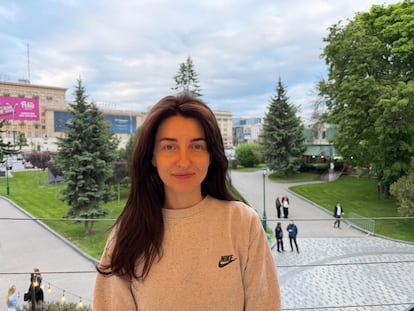
Kucher is considering joining the Armed Forces of Ukraine this summer, after a reform of the recruitment system takes effect that will let her sign a service contract of just 14 months. “It’s time to do it; someone has to relieve the soldiers who have been fighting for more than four years,” says the 33-year-old TV presenter, who has worked with EL PAÍS as an interpreter.
The recruitment reform should allow the gradual withdrawal of soldiers who have been in the army longest, volunteers from the first year of the invasion, in 2022. “But the forced mobilization of women would be interpreted by society as a sign that things are going very badly, as a last resort,” Kucher warns.
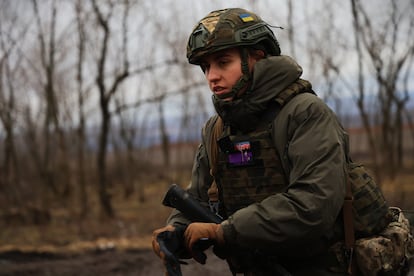
Seven percent of the Ukrainian army is made up of women: 75,000 personnel, of whom 5,000 perform combat duties. The voices most strongly advocating a female mobilization system are precisely the women already serving in the military.
On May 11, in the digital outlet Hromadske, drone commander Yana Zalevska argued in favour of mandatory female conscription. Zalevska leads a drone pilot unit composed of women and men. From her experience she confirmed that a woman must face difficult situations — condescension and what she calls “inappropriate courtship” — but her conclusion is that the military must be feminized because the country needs it.
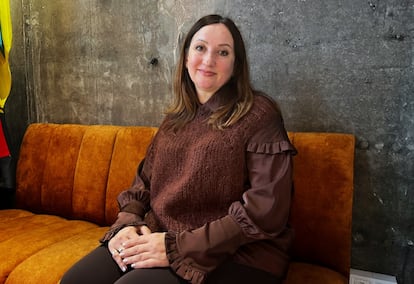
The Armed Forces of Ukraine have Oksana Grigorieva as their head of gender affairs. In May 2025 Grigorieva reopened the mobilization debate by expressing support for reinstating compulsory military service in Ukraine for both men and women. Grigorieva acknowledged that this could not include forcing women to serve in wartime because “the country is not ready for it, there would be a lot of protests.”
Out of the discussion sparked by Grigorieva’s proposal, soldier and activist Yulia Kobrinovich published a vigorous plea for the recruitment of women in 2025 in the digital outlet Censor Net. The piece drew attention for its frankness. It summarized in three points why, for her and her comrades, serving in the army had been an experience “of unpleasant and repulsive memories”: firstly, because women are “systematically regarded as inferior actors”; secondly, because it is a major physical challenge; and thirdly, because of the sexual harassment many of them endure.
“I think every woman has her chest full of this filth,” Kobrinovich wrote. At the same time she said the experience had helped her form a “civic conscience” and that she believes gender equality passes through this ordeal: “The mobilization of women is necessary because we have the same rights and responsibilities as men.”
But Kobrinovich added two conditions: women should serve in units separately from men; and they should not carry out the toughest tasks on the front line.
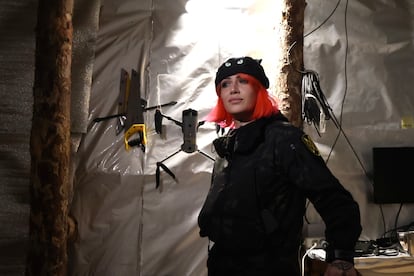
Daria Dshk agrees with some of Kobrinovich’s arguments. Dshk (her nom de guerre) commands the Harpies drone unit in the 9th Unmanned Systems Brigade of the Ukrainian army. Her group is made up of women who pilot drones and men who perform logistical work. A veteran combatant, Dshk confirms the problems Kobrinovich highlighted, but says that as time passes the situation improves: “The key is to set red lines and improve the trust relationship between women and men.”
Dshk spoke to EL PAÍS on the outskirts of Kharkiv, in the east of the country, in an underground workshop. Trained as a doctor, she also fought briefly in assault forces, the army’s spearhead. “I took part in three missions and I will not do it again. There are actions on the front that, by nature and physical requirements, only 0.001% of women can take on, that is the truth.”
The commander of this squadron of female pilots is not in favor of mandatory female mobilization. The first reason she mentions is that, in her view, a woman’s primary role is to have children. Dshk, who has two daughters, frames her words by also citing the catastrophic demographic situation Ukraine faces. She adds that, whether women or men, people conscripted by force lack motivation: “I don’t want them in my unit; they are not good soldiers.”
Dshk does favor universal compulsory military training because it would allow society to better understand the army and the many career opportunities it offers.
In feminism the debate is theoretical and long-standing. Does equality require that women enter so patriarchal and violent an institution? Virginia Woolf was already asking this in 1938 in her book Three Guineas, a year before World War II broke out: “What does patriotism mean for a woman? Has she the same reasons for being proud of England as an Englishman? To love England and to defend it?” “The Navy and the Army are closed to our sex,” Woolf continued, “we are not allowed to fight, nor are we authorized to be stockbrokers, we have neither the power of force nor the power of money.” For her, feminism could not be detached from pacifism.
Daria Dshk takes the opposite view: armies are inevitable, especially when your country is being invaded, and women cannot be left aside: “The Ukrainian army is transforming, it is becoming more inclusive, and that is good.”
Sign up for our weekly newsletter to get more English-language news coverage from EL PAÍS USA Edition









































