
From cook to sniper: Ukrainian women fight for equality in the army
‘My dream is that some of them will become generals,’ says the head of gender affairs for the Armed Forces of Ukraine, in which around 7% of the one million personnel are women
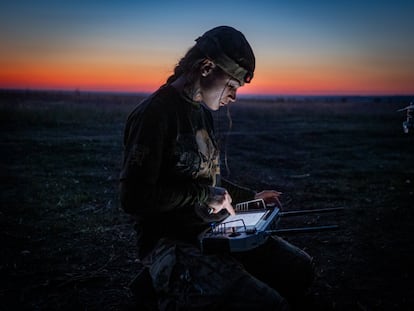

“Why did you abandon your children? Are you earning a lot in the army?” they asked Vatra, a mother of a boy and a girl. “You’re serving instead of raising them. You should stay home,” they told Bilka, a mother of two girls. “What if you die? If you’re not a mother, you’re nothing,” Ruta, a mother of three, was told on her social media.
The testimonies of these Ukrainian soldiers reflect the arduous path toward equality between men and women in the army during the Russian invasion. They are part of the Veteranka campaign, which aims to normalize the presence of women in the Armed Forces of Ukraine. Prejudice and stereotypes are not only found on the front lines, but also in society and within families. “Being a woman in the army means facing the doubts of others every single day,” stresses combat medic Katerina Priimak, who leads this independent initiative.
“My dream is that some of them will become generals,” says Oksana Grigorieva, 49, the army’s head of gender affairs. Grigorieva held this position in the Spanish army until last May, having worked in this capacity since 2022, giving her several years of experience in the field. However, she acknowledges that the task ahead is not easy, as many, she points out, still see women as cooks or seamstresses rather than as snipers or tank drivers.
Currently, there are approximately 72,000 women in the Ukrainian army, representing about 7% of its one million personnel. Of these, 19,000 hold civilian positions, like Grigorieva. Around 5,500 are deployed in combat zones. The mandatory conscription of men between the ages of 25 and 60 under martial law has reduced the percentage of women in the army — which they join voluntarily — but their numbers continue to rise.
Ukraine is planning reforms, including in the military, to move closer to the European Union and NATO. At the same time, it has been embroiled in war since 2014, when Russian troops entered the east of the country, before the Kremlin launched its full-scale invasion in 2022. Since 2018, a new legal framework has been promoting equality, Grigorieva points out. Now, on paper, women can study for a military career and access any position, including combat roles. “This is our great achievement, and we are proud to have accomplished it,” she emphasizes.
Prejudice and sexism, however, continue to complicate the path for women who choose a military career and aim to rise through the ranks: “Just because someone is young and pretty doesn’t mean they are anyone’s mistress,” Grigorieva laments, referring to a mentality rooted in the past and indifferent to merit. These attitudes hinder legislative changes aimed at decisively combating crimes such as rape, sexual abuse, and harassment, since, during the times of the former Soviet republic, it’s an issue that was barely addressed, she adds.

“Those who were previously civilians now join the army without knowing what the Istanbul Convention is,” says the gender officer, referring to the Council of Europe treaty on preventing and combating violence against women, an initiative to which Kyiv has acceded. “Well, I was just flirting because I like her,” is another expression that can be heard from soldiers, according to Grigorieva, who explains that all military training programs include chapters on ending discrimination and harassment. Gone are the days when such behavior resulted in a fine of a mere 360 hryvnias (about $8). Now, under the new military disciplinary code, such comments can lead to the withholding of a substantial portion of one’s salary. In any case, Grigorieva emphasizes the presence of gender advisors in all units — there are about 700 of them — and maintains that harassment is not among the main problems.
She is more concerned that, once women are accepted into combat positions, “not all commanders see them as capable of leadership.” That is why her “main objective” is to have “as many women as possible in leadership positions,” she emphasizes, because “we don’t even have one woman leading a brigade” (consisting of 5,000 to 7,000 personnel) and “only one leads a battalion” (of about 500). But she points out that this is essentially the path they must follow in their military careers after the new legislation of 2018. However, not everything can be managed through written rules that must be implemented. “It is true that the loss of a woman is still felt much more deeply than that of a man,” Grigorieva explains, referring to a case she knows of involving the death of a combat medic.
Among the motivations that lead some to volunteer are cases where they end up wearing the uniform because they want to keep the war away from their children. Or because they have lost a family member and use that loss as a driving force to join the defense of Ukraine.
However, one of the stories that she found most shocking is that of a married couple, both contract soldiers, with two children: an eight-month-old baby and a three-year-old from a previous marriage. In 2022, they decided that she would be the one to go to the front lines as a combat medic. The law allows, in the case of a married couple, for one of them to be exempt from military service. The woman — whose name Grigorieva does not reveal — even declared, amid the doubts of her partner’s family, “I am a combatant.” After three years, the relationship has fallen apart and the army has intervened to ensure that, in the divorce proceedings, she does not lose parental rights and, in turn, has called up her ex-husband for mandatory service. Now she remains a soldier, but on the home front.
In combat positions, the cramped quarters and the danger prevent the distinctions between men and women that are possible, for example, in training camps or barracks away from the front lines. Intimacy knows no gender in the trenches. After more than 11 years of war, social media sometimes reflects the transformation Ukraine is undergoing. A photo of a makeshift latrine spattered with urine on the front lines, posted by a female soldier, serves as a wry reminder: “Here, too, you have to know how to aim, comrades.”
Sign up for our weekly newsletter to get more English-language news coverage from EL PAÍS USA Edition









































