
Ukraine trains civilians and journalists to survive under drone attacks
Public administrations and NGOs are preparing citizens in risk zones with action manuals and survival courses
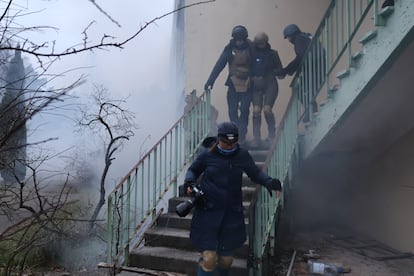

Imagine a projectile that doesn’t follow a fixed trajectory but can maneuver, tracking the movements of a person or vehicle until it strikes. This is perhaps the biggest difference between the war in Ukraine and other past conflicts: the massive use, by both sides, of bomb drones and drones that launch explosives while pursuing their target. More than 60% of casualties on the front lines are caused by small unmanned aerial vehicles, most of them commercially available technology, accessible to anyone, but adapted to kill.
This percentage of dead and wounded, according to Ukrainian military data, is not limited to soldiers. Civilians are also victims of indiscriminate attacks. Russian drones have killed more than 200 civilians and injured 2,000 since July 2024 in towns near the front lines. This data comes from a United Nations report published last October, which concludes that Russian troops are deliberately committing these war crimes against the civilian population.
The “kill zone” is the military term for the area saturated with drones — especially first-person view (FPV) drones, which the pilot controls with goggles that serve as a screen — and other models, such as the Mavic, which have the screen integrated into the pilot’s controller. The kill zone extends 20 kilometers (12 miles) from the front line. The city of Kherson, in the south of the country, lies on the zero line; only the Dnipro River separates it from the Russian positions. It is there, according to the United Nations, that the invaders are most actively targeting civilians.
Based on their experience in Kherson, the 2402 Foundation, Ukraine’s largest organization training civilians to survive in combat zones, has produced a manual this year that is being distributed to government agencies and non-governmental organizations. From clothing to walking techniques, its advice is basic but can save lives.
A civilian’s clothing in the kill zone should not be camouflage (which would make them look like a soldier) but should be in colors and tones that blend into the surroundings. Going outside should be limited as much as possible. The best days are overcast, with low clouds and windy, which are the worst weather conditions for drone flights. Walk quietly, without drawing attention, under cover or in the shade, as this makes it more difficult for the pilot to identify their target.
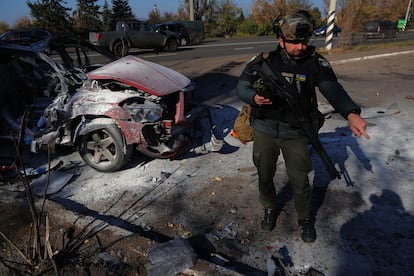
In an imminent attack outdoors, the chances of escaping unharmed are slim; if it’s an attack involving multiple drones, there’s little one can do. This is the first point emphasized by experts from the Kruk military pilot training center. On December 9, they conducted a survival training course for about 20 Ukrainian journalists in the Kyiv region. The number of media professionals killed by drones has skyrocketed in 2025.
One advantage in terms of surviving drone attacks is that the sound of their propellers allows for more reaction time than the sound of artillery shells, bullets, or missiles. In survival drills conducted by Kruk and the organization Daily Humanity, both FPV drones and Mavic drones could be heard from about 150 meters away. This range depends on the absence of other ambient sounds and wind conditions. In the case of large, long-range bomb drones, such as the Shahed, their sound, similar to a lawnmower, is detectable from hundreds of meters away.
10 seconds to react
From the moment a drone is heard in the kill zone, there are 10 seconds to react. That’s the time the pilot has to launch the attack, according to Kruk. A person’s instinctive reaction upon hearing the drone is to freeze and scan the sky for it, and that’s a fatal mistake. What you should do is scatter and seek shelter immediately, “behind a solid wall, inside a solid building, under a concrete structure; even a ditch or depression in the ground is better than an open space,” according to the 2402 Foundation’s instructions.
It is better to run in a zigzag pattern, changing direction every seven to 10 meters. This proved crucial during the simulation exercises. An observation drone analyzed ground movements from above, guiding the FPV kamikaze drones and Mavic drones that release explosives. The drones follow the observation drone’s commands and pursue the targets in a near-impossible race for survival. To make it more realistic, Kruk’s unmanned aerial vehicles repeated the simulations both day and night. The drones can be guided using thermal cameras or cameras adapted for low-light conditions.
Sound detection is not always possible: winged drones can glide with their engines off during their descent, following a ballistic trajectory. The same applies to waiting drones, which are stationary along a flight path and activate when the target is nearby.
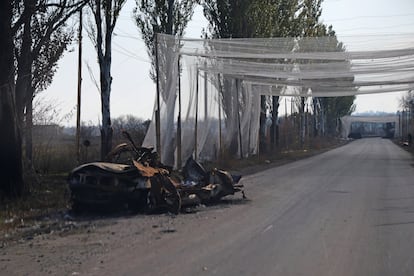
Not just any building will do as a shelter because drones can maneuver and find a way in. This was demonstrated in the Kruk drills: a drone carrying grenades entered through the window of a house where a group of journalists were taking refuge. When the grenades were released (they were blanks), half of them reacted well, instinctively leaving the room, while others simply huddled together. Similarly, when a projectile hits the ground, the best position for protection is lying flat on the ground with your head covered.
In a wooded area, the instructions are to stay put under a tree. This approach is inefficient but still the best option, according to Mikita Gabrilenko, an expert from Kruk. This scenario was also practiced among the trees during a training exercise for journalists, and although one of the participants was injured (in a simulation), the drone, maneuvering among the branches, crashed and fell to the ground.
The average time between hearing a missile’s whistle and its impact is three seconds. The paradox is that this is also the time one has to take cover when a kamikaze drone (usually FPV) is identified at the last moment. Kruk technicians project a video demonstrating this, footage that went viral in November. A van belonging to the civilian evacuation NGO Proliska is parked on a street in Kostyantynivka, a city besieged by Russia in the Donetsk region. Between the driver spotting the drone, warning the passengers to abandon the vehicle, and the impact, three seconds elapse.
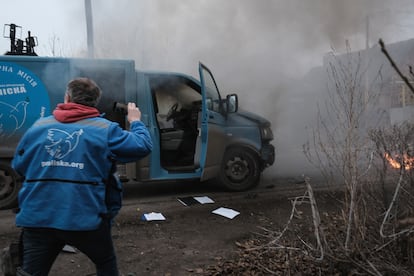
Vehicles are a priority target for drones, even more so than people. According to statistics released by Rubicon, Russia’s top drone combat regiment, 14% of their targets are cars and 3.5% are people. Troop transport on both sides is carried out by car, so any vehicle in the kill zone, especially if it has markings that might indicate military use, can be a target. This not only disables a vehicle but can also cause injury or death to multiple people.
Last September, the Kharkiv region distributed a protocol of recommendations to municipalities regarding the threat posed by drones. One of the key guidelines was to minimize travel by vehicle and regularly vary routes, making journeys as unpredictable as possible. Additionally, it was recommended not to fasten seatbelts to ensure a quick exit from the vehicle.
While driving, you are especially vulnerable because your hearing and vision are greatly reduced. It’s best not to form groups and not to stand still next to a parked vehicle. The vehicle should be parked under something that makes it harder for long-range surveillance drones to spot, as these are undetectable by sight or hearing because they are kilometers above the ground.
10 meters to save yourself
Escaping unharmed from a moving car attack is largely a matter of chance, though the driver’s skill also plays a role. Based on an analysis of military videos showing drivers narrowly avoiding the immediate explosion of drones, Kruk’s team estimates that the driver must execute a sharp change of direction when the enemy aircraft is about six to 10 meters away. Calculating this requires nerves of steel and exceptional reflexes, especially since the drone hurtles toward the car at a similar speed.
For professionals working on the front lines, whether journalists, NGO workers, or members of the public administration, the ideal solution is to travel with two drone detectors. These devices, which can be about the size of a small radio transistor, detect the telemetry signal, video, or the drone’s wave spectrum. This technology alerts authorities to drone flights and provides progressive warnings of their approach once they reach a distance of five kilometers (3.1 miles). The video detectors analyze the images transmitted by the drone to the pilot, allowing them to identify its direction of travel.
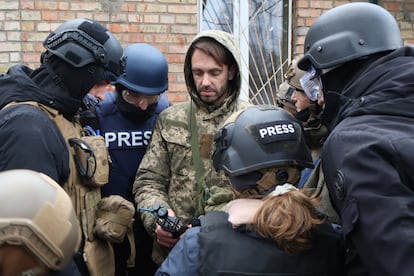
The Kharkiv province manual acknowledges that survival depends on constant vigilance: “While official recommendations often begin with the words ‘if you hear or see a drone,’ the ability to effectively hear or see one in a complex urban environment is a skill that must be developed.” The protocol calls for regularly testing one’s senses “and teaching children which sounds to pay attention to.”
“It’s about transforming a passive existence into a state of active environmental vigilance,” the document states. In drone warfare, the civilian becomes like a forest animal in constant tension, ever vigilant from birth, constantly on the lookout for the predator that stalks them.
Sign up for our weekly newsletter to get more English-language news coverage from EL PAÍS USA Edition









































