
Nicaraguan bishop critical of Ortega reported missing after police interrogation
Four days after being questioned, people close to 80-year-old Abelardo Mata say they have been unable to verify his whereabouts or state of health
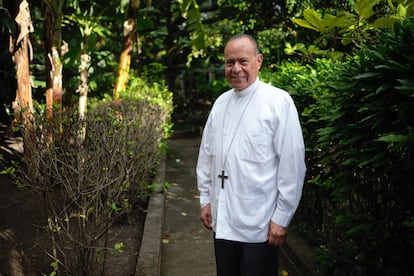

Retired Bishop Abelardo Mata, 80, is “missing” in Nicaragua, according to people close to him. Four days after the regime of Daniel Ortega and his wife and co-president, Rosario Murillo, subjected him to a police “investigation,” church sources consulted by EL PAÍS say they have been unable to see him or verify his condition. Although the government stated that he had been returned to his home, religious sources insist: “We have not been able to see Bishop Mata.” They describe an atmosphere of fear among family members and people connected to the Diocese of Estelí, in northern Nicaragua, which Mata led until 2021 and which remains under police surveillance and harassment.
The complaint reopens the issue of religious persecution against the Catholic Church in Nicaragua, one of the institutions most heavily targeted since the 2018 social protests demanding an end to Ortega’s rule. In recent years, the government has exiled bishops and priests, expelled religious orders, confiscated church property, shut down charitable works, and restricted public expressions of faith. Mata’s case once again draws attention to the Diocese of Estelí, one of the dioceses most affected by religious repression.
“After they returned him to his house, according to the government statement, we have not been able to see him,” the sources said. “His family is terrified because they are being followed. The same is happening to people who worked with him in the Diocese of Estelí.”
Mata was arrested after praying “for the persecuted Church of Nicaragua” at the Cruz del Calvario parish in Estelí on June 28, according to an alert from Monitoreo Azul y Blanco, an organization that tracks political prisoners and disappearances in Nicaragua.
His Mass was monitored and photographed by armed civilians aligned with the regime. That same day, police detained him for the first time. He was briefly released, then arrested again and returned to his home “under police custody.”
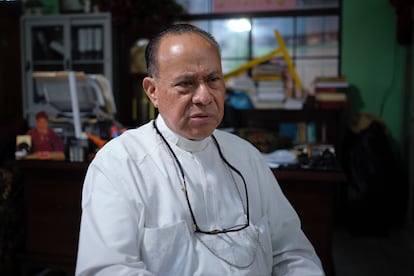
Pressure intensified the following day. On June 29, the retired bishop and several people close to him were detained again. While the civilians were released in Estelí, Mata was transferred to an unidentified police station in Managua. Hours later, he was taken to his residence in Tisma, Masaya, where authorities imposed constant police surveillance and what amounted to de facto house arrest, according to Monitoreo Azul y Blanco’s timeline.
The third detention occurred on July 2 at 7:00 a.m. during a shift change among police officers stationed outside his home in Tisma. From that point on, the monitoring group reported that Mata was in a condition of “enforced disappearance,” with no official information about his whereabouts, physical well-being, or health status. The organization also warned of the risks posed by his age and medical condition.
US demands his release
On July 4, after the United States called for Mata’s “immediate and unconditional” release and condemned the “ongoing and cruel religious persecution and repression” in Nicaragua, the Nicaraguan Interior Ministry issued a statement claiming that the retired bishop had been returned to his home.
The ministry said the bishop had been subjected to a police “investigation” concerning the “origin of properties and family ties that do not correspond to his priestly status,” but provided no verifiable details about the procedure, where he had been held, or the conditions of his release.
Former U.S. diplomat Kevin O’Reilly, a former chief of mission in Managua, criticized the Ortega-Murillo government’s detention of Mata. In his view, the crackdown on the bishop demonstrates that “the dictatorship lives in fear” of any social activity it cannot co-opt or control, particularly the independence of the Catholic Church.
O’Reilly argued that the regime’s reaction reflects “resentment, paranoia, and an awareness of its weak authority when confronted with the religious and social conscience of Nicaraguans.”
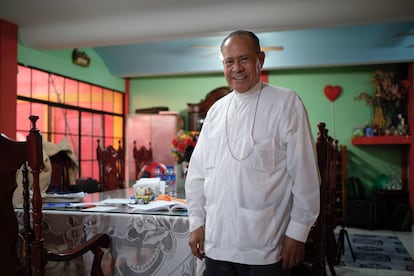
The campaign did not stop with Mata. At the same time, police detained Father Rigoberto Delgadillo Sánchez of the Divino Niño parish, Father Francisco Morales of Cruz del Calvario parish, and Deacon Wilfredo Arauz Rodríguez, also from Cruz del Calvario.
Morales and Arauz were later released under what amounted to a form of de facto “conditional freedom,” subject to police monitoring and the threat of re-arrest, according to Monitoreo Azul y Blanco.
While serving as bishop of Estelí, Mata was one of Ortega and Murillo’s most vocal critics. His public criticism was often even sharper than that of other church leaders opposed to the regime, including Auxiliary Bishop Silvio Báez, who was later exiled and stripped of his nationality. The Holy See accepted Mata’s resignation on July 6, 2021, and his public profile has diminished considerably since then.
According to the report Nicaragua: A Persecuted Church, prepared by researcher Martha Patricia Molina, the Diocese of Estelí has suffered at least 81 attacks since 2018. The diocese currently does not have a resident bishop, nor do the dioceses of Matagalpa, Jinotega, and Siuna, due to the exile of clerics. Molina warns that Estelí is effectively forced to operate “without leadership and with only 42% of its clergy,” placing a heavier pastoral burden on the priests who remain active in Nicaragua.
Mata’s case also stands in contrast to the public caution of Cardinal Leopoldo Brenes, Archbishop of Managua.
During the Feast of the Most Precious Blood of Christ on July 5 at Managua’s Metropolitan Cathedral, Brenes revealed that he had held a “very private” one-hour meeting with Pope Leo XIV at the Vatican, where they discussed the Church in Nicaragua, his health, and the continuation of his ministry.
However, he did not publicly address the arrests, exiles, police surveillance, or restrictions on public religious expression.
Instead, he encouraged worshippers to take photographs of the celebration and share them to show a Church that is “alive and deeply filled with faith,” countering what he described as “fake news” about empty churches, low attendance, and isolated priests.
Cardinal Brenes has frequently been criticized by exiled clergy for what they describe as an overly accommodating stance toward a regime that a United Nations group of experts has accused of committing crimes against humanity through religious persecution.
Sign up for our weekly newsletter to get more English-language news coverage from EL PAÍS USA Edition









































