
Immigrants say they are being held for days in a Miami ICE office under ‘horrific’ conditions
According to testimonies, detainees are spending nights at the Miramar immigration facility designed for short-term processing, while others have been transferred to a federal prison where they report inadequate medical care
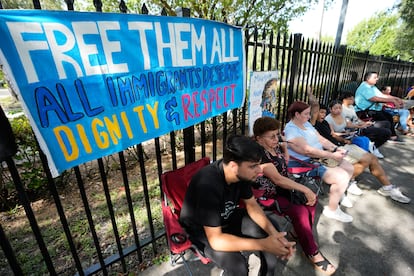

Yajaira González and her husband, Marco Rodríguez, arrived before 6 a.m. for a routine appointment with U.S. Immigration and Customs Enforcement (ICE) in Miramar, north of Miami. They knew the process: for five years they had been reporting to that same office while their asylum case moved through the courts. But on Sunday, June 28, only González came out. Rodríguez, 36, was taken into custody and spent three days in an overcrowded room with about 70 other people, with barely any water or food and a single toilet.
His case is part of a series of complaints from relatives, activists and immigration attorneys that some people are spending several days detained in Miramar, at a facility designed for processing and short-term detention, despite lacking beds, bathrooms, water, food or adequate conditions for overnight stays.
The complaints come amid a nationwide surge in immigration arrests, which totaled more than 10,000 over a five-day period late last month. They also follow the closure of the notorious Alligator Alcatraz detention center in the Everglades, as well as evacuations caused by wildfires at the Krome detention center southwest of Miami. According to witness accounts, the Miramar office has been receiving people arrested elsewhere and then holding them there for several days.
Immigrant-rights activists say they have noticed a significant increase in recent weeks in unmarked vehicles arriving at the facility “loaded with people,” allegedly detained at other locations. On one day alone, they saw more than 30 vehicles unload detainees, according to María Bilbao, coordinator of the American Friends Service Committee.
That was the case for Roger Moisés Flores Oviedo, a 19-year-old Honduran who was detained the Saturday before last as he left a gas station in Pompano Beach, north of Miami, after buying something for lunch.
His wife, Koren Noblig, says Flores works in construction, has no criminal record and has a pending asylum application. On Saturday night, he called her to say that ICE agents who detained him “put him in a van and took him to Miramar, where they placed him in a room with 50 other men, many wearing work clothes and boots, sitting on the floor with their hands behind their backs,” with barely enough room to move.
He remained there until Tuesday, when he was transferred to Krome. By the day of the transfer, there were already 70 people in the room. Noblig says he was given only one bottle of water a day and a piece of bread with peanut butter. At Krome, he was able to shower, sleep in a bed and communicate with her, she says.
Democratic Congresswoman Debbie Wasserman Schultz made an unannounced visit to Miramar last week and described the conditions as “horrific.” “What I saw were people packed in like sardines, in conditions I wouldn’t wish upon my worst enemy,” she said at a press conference.
Lack of medical care
The complaints extend to the Federal Detention Center (FDC) in downtown Miami, where authorities transferred some immigrants from Krome in the middle of last month because of wildfires that swept through the western part of the county.
Among them is Noslén Sendra, a 41-year-old Cuban who was detained during an appointment in Miramar in November, spent five months at Alligator Alcatraz and was sent to Krome in early April. His wife, Anisley Cortés, says Sendra is diabetic and suffered pancreatitis while in detention because of extremely high triglyceride levels, requiring hospitalization. According to Sendra, he is not receiving the medical treatment he needs at the FDC, and she fears he could suffer another health crisis.
Prison officials tell her “they cannot give him another medication because they are not responsible, that ICE is responsible,” Cortés says. “I’m desperate because I’m afraid he’ll have another pancreatitis episode in there. The doctors say they can’t do anything, that they can’t provide medications. I don’t know what to do. I don’t know who to turn to.”
A Department of Homeland Security spokesman told EL PAÍS in an email that “any claim that there are substandard conditions in ICE detention centers is FALSE,” arguing “all detainees are provided adequate meals, medical care and opportunities to communicate with family and attorneys.”
“As the number of beds has expanded rapidly, we have maintained a standard of care higher than that of most prisons that house U.S. citizens, including access to adequate medical care. Detained population figures fluctuate daily at ICE facilities in Florida and across the country,” the statement added. It also said remaining in detention “is a choice” and encouraged people to use the CBP Home app to self-deport.
Alligator Alcatraz, a symbol of Trump’s immigration crackdown, was emptied last month less than a year after it opened during a visit by President Donald Trump. The detainees, whose numbers had reached nearly 1,400, were transferred at night and without prior notice to relatives or lawyers to facilities in Louisiana, Arizona and other states, as well as the FDC in Miami.
During a press conference with border czar Tom Homan announcing the closure, Florida Governor Ron DeSantis said that about 21,000 people had been “processed” there and that the site had been designed as a temporary solution to support the federal government, while the Department of Homeland Security expanded its own detention capacity. The governor insisted that Florida would continue cooperating with ICE through 287(g) agreements and by detaining immigrants at other facilities such as Deportation Depot in Baker County, north of the peninsula.
The Department of Homeland Security has backed away from a plan to convert industrial warehouses into immigrant detention centers following changes in the agency’s leadership, including the dismissal of Kristi Noem and the appointment of Markwayne Mullin as her successor.
Sign up for our weekly newsletter to get more English-language news coverage from EL PAÍS USA Edition









































