
Mexico watches US–Canada trade tension with uncertainty
The Latin American country is negotiating its tariff terms while navigating the uncertain future of the USMCA trade agreement
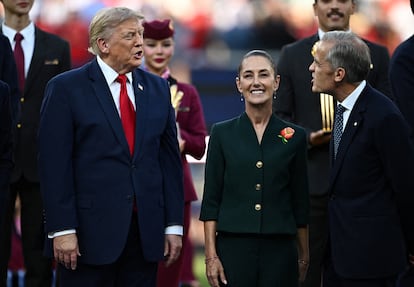

The partners of the United States-Mexico-Canada Agreement (USMCA) are in crisis. The U.S. and Canada have escalated their trade war in recent days, imposing mutual tariffs and casting uncertainty over negotiations about the future of the pact they share with Mexico. The Latin American country has not been part of the convoluted talks, but it is on edge about how the tension between Washington and Ottawa could affect its own negotiations with the Trump administration and, ultimately, the economic impact of the Republican president’s feud with Canadian Prime Minister Mark Carney. Mexican President Claudia Sheinbaum has avoided going into detail about the rupture between the United States and Canada, but she sent Economy Secretary Marcelo Ebrard to Washington on an emergency basis. “I am optimistic that an agreement can be reached,” the president said at her Monday press conference.
Ebrard’s mission is to gauge the mood inside Trump’s team, but also to secure a new deal on the tariffs the U.S. government maintains on goods from Mexico: 50% on steel and aluminum, and 25% on cars and auto parts. “We have been working for more than a year to see how these tariffs can be reduced,” the president said. That was the same objective Canada’s negotiating team had last week, an effort that was upended by more aggressive tariffs that have, for the moment, frozen talks between Washington and Ottawa.
Since the start of 2026 the Trump administration has held tentative talks with Mexico to evaluate the future of the USMCA ahead of the July 1 renewal deadline. In June, Mexico and the United States launched a series of bilateral negotiation rounds to share the items of the trade deal they sought to modify. Canada announced it would hold its own talks with the United States at another time. Finally, the Office of the United States Trade Representative (USTR) announced at the last minute that it would not extend the treaty and would carry out annual reviews of its content with the partners. Ebrard then said Washington had a list of 14 issues to review with Mexico City, so the negotiation rounds would continue.
The Trump government has prioritized bilateral talks on the grounds that the issues worrying Canada and Mexico are not necessarily the same. It has also avoided setting a date for a possible trilateral meeting. Mexico has the next round scheduled for September in the U.S. capital. From the perspective of some analysts, Mexico has gained more from these meetings by being more consistent and blurring strictly commercial lines to address U.S. requests on other matters. “Mexico has forged a strong reputation on multiple fronts, such as security, immigration, drug trafficking, and imposing limits on politicians with alleged links to criminal organizations, which could help it face this difficult stage of the negotiations,” an analysis by Bradesco notes.
The alliance that Sheinbaum and Carney sealed a year ago to advance the USMCA does not appear to have been damaged by Canada’s split with the United States. The Canadian prime minister called the Mexican president on the eve of the end of his talks with Washington. “They underscored the importance of renewing the Canada-United States-Mexico Agreement as soon as possible to provide greater certainty for North American businesses and workers,” the prime minister’s office said in a statement last Thursday night, without giving details on whether the battle between Canada and the United States figured in the conversation. Throughout the year Canada and Mexico have avoided getting in each other’s way to push the USMCA forward. However, Ottawa has borne more of Trump’s pressure, who has attacked the country and its leaders directly. “Canada has been ripping off the United States of America for years,” was his latest insult.
Sheinbaum, by contrast, has held numerous phone calls with the Republican, who has done nothing but praise her and granted some concessions. Mexico’s progress in negotiations does not appear to have damaged its relationship with Canada. “Mexico has been a reliable partner at all times, and will likely speak up for Canada if the chance arises, but it is unlikely to become a martyr for its cause,” Bradesco’s analysis adds. The September round of talks and the negotiations over sectoral tariffs in the coming days will provide evidence of the impact that the tension between the two northern partners will have on the future of the USMCA. “We are in a very good position because, if you average everything we export, we have some of the lowest tariffs of any country in the world. We have achieved that thanks to communication, negotiation, and the joint work of the team that has been going to the United States,” Sheinbaum said.
Sign up for our weekly newsletter to get more English-language news coverage from EL PAÍS USA Edition









































