
Europe’s major rivers are drying up, threatening energy security and trade
The EU Copernicus Climate Change Service warns that the flow of 12 of the continent’s largest waterways was the lowest in 30 years this summer
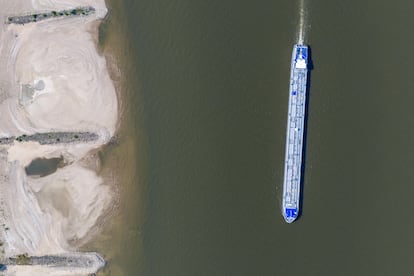

This past summer has been, for Europe, “the summer of truth,” as Ursula von der Leyen said a couple of weeks ago in her State of the Union debate speech. The president of the European Commission was warning about the consequences of global warming, which has again struck the continent hard. And the Copernicus Climate Change Service quantifies this sweltering summer in its seasonal assessment, published on October 2. The season in Europe was marked by heatwaves that were unusually intense and early (the first arrived in May). Across the continent this was the third-warmest summer on record. But focusing on western Europe, the summer of 2026 was the worst on record. It surpassed 2003, which shocked many EU countries with tens of thousands of deaths linked to extreme heat.
Pending a detailed accounting of heat-related deaths in Europe, Copernicus experts highlight the situation in the continent’s major rivers, which had serious consequences for power supplies and trade. “Prolonged and severe drought conditions across Europe set the stage for the summer with the lowest river flows on the continent since records began at the European Flood Awareness System in 1992,” they note. They also point out that many of Europe’s main rivers — including the Rhine, Danube, Po, Loire, Rhône and Seine — recorded simultaneous record low flow levels during July and August.


The Copernicus report focuses on 12 of the continent’s major rivers. Many of them play a key role in, for example, freight transport or cooling nuclear plants, such as the Danube or the Rhine. Experts analyzed mean discharge at the rivers’ mouths for June, July and August since 1992 and conclude that this summer’s levels were the lowest on record.
“Since the mid-2010s we have seen summer river flows well below average across Europe, especially in eastern Europe,” said Samantha Burgess of the European Centre for Medium-Range Weather Forecasts, which oversees Copernicus. “And we also know,” she added, “that southeastern Europe is warming faster than the European average.” Burgess thus points to climate change as a key driver of this trend, although she cautions that their dataset starts in 1992, making it harder to firmly establish the relationship. “It is a short-term dataset for truly analyzing long-term trends,” she admits.
Regarding the direct influence of climate change, Burgess said Copernicus has not yet carried out an attribution study for the summer of 2026. For that reason they cannot “directly quantify the role of climate change.” But it is well established that the high temperatures associated with this crisis increase “evaporation and soil moisture loss,” which exacerbates droughts. In addition, climate projections have for years pointed to “a reduction in river flows in summer across many parts of Europe,” as is already happening.
Beyond impacts on biodiversity, the drop in river flows caused “major disruptions” in many industrial sectors, including “cargo transport, which affected supply chains,” Copernicus noted, and it also listed the “cooling” problems experienced by several nuclear reactors, the fall in hydropower generation and restrictions on drinking water in multiple cities. “This highlights the close link between climate change and geopolitical challenges such as energy security,” the European service added.
Freight transport
The drop in flow of major rivers had significant impacts in western European Union states, where inland waterway freight traffic is intense. In August, for example, vessels departing Rotterdam (the Netherlands) or Antwerp (Belgium) could navigate the Rhine with only 15% of their normal loads to avoid running aground. “Similarly, on the Danube, barge-carrying capacity was reduced to around 30% of its usual level,” notes another recent report by the International Transport Forum (ITF) at the OECD. “As a result, inland waterway freight rates have risen,” the analysis center explains, “at times doubling transport prices.”
In 2018, during a similar Rhine low-flow episode, GDP in Germany dropped by up to 0.4%, according to a scientific study on the impacts of that drought. “Similar economic effects could be expected with the current low water levels,” the ITF adds.
The organization’s experts warn that “as droughts become more frequent and severe in many parts of the world, navigation on rivers that carry vital goods becomes increasingly difficult.” Among the consequences of lower water levels are “supply chain disruptions” and higher “logistics costs.” Spain, although it also suffers recurring drought problems, is less exposed in this case because inland waterway freight transport is practically nonexistent. But in countries such as Belgium, the Netherlands, and Romania, inland waterways account for between 15% and 45% of total freight traffic, the ITF summarizes.
Nuclear power
Another collateral impact of low river levels in Europe has been on energy, specifically nuclear plants that rely on river water for cooling. In some cases, such as in France, plants were affected this summer by water temperatures that were too high to be used at certain facilities, which had to shut down under national environmental regulations.
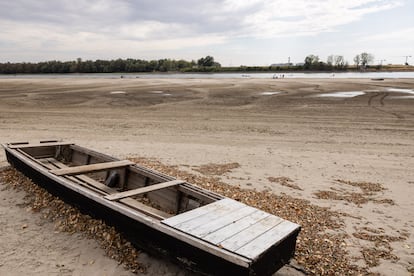
In other cases, the problem was falling water levels. Hungary’s Paks nuclear plant, on the banks of the Danube and which produces over 40% of the country’s electricity, had to scale back operations because the river could not provide enough cooling water. Hydropower production in the Alps was similarly affected: Austria generated only 51% of its usual output and Switzerland 26%.
“These are not isolated incidents but early warning signs of a systemic challenge to how billions of people access energy,” said another study by the Organization for Security and Co-operation in Europe (OSCE). “Industrial activity slowed as power supplies became less stable, and wholesale prices surged amid rising demand,” the study on this summer’s impacts notes. “It was necessary to activate emergency protocols across energy infrastructure, revealing pressure on national security,” it warns as a caution about what could happen in coming years.
Sign up for our weekly newsletter to get more English-language news coverage from EL PAÍS USA Edition









































