
María Corina Machado intervenes in US midterms with endorsement of Trump critic María Elvira Salazar
The Venezuelan opposition leader has backed the Florida Republican congresswoman’s reelection bid amid tensions with the president over immigration policy
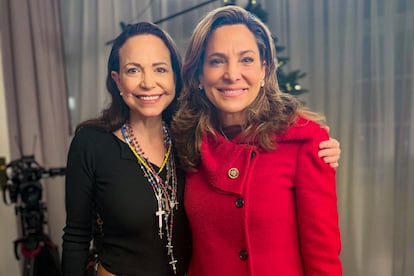

The leader of the Venezuelan opposition in exile, María Corina Machado, has decided to intervene in the United States midterm elections. She did so by publicly endorsing Republican congresswoman María Elvira Salazar, who is seeking a fourth term in the House of Representatives for Florida’s 27th District. The statement, released Wednesday via video, comes at a particularly sensitive moment for the Cuban-American lawmaker, who has clashed with Donald Trump over her criticism of the White House’s immigration policy and who faces an increasingly tight race in Miami.
“Today I want to recognize and express our support for María Elvira Salazar,” Machado said in the recording, in which she described the congresswoman as “a steadfast and loyal ally of Venezuela’s cause for freedom.” The opposition leader highlighted Salazar’s commitment to opposing Chavismo and thanked her for backing the opposition over recent years. “When others have doubted, you have stood firm in your position. When others have remained silent, you have raised your voice,” she said. The congresswoman in turn thanked Machado for the gesture, which her campaign included among the endorsements for her reelection on November 3.
The relationship between the two politicians goes back a long way. Salazar has defended the Venezuelan democratic cause for years, and recently questioned senior officials such as Secretary of State Marco Rubio about the direction of the transition after Nicolás Maduro’s capture. The congresswoman was also present at the presentation of the Nobel Peace Prize awarded to Machado last December in Oslo.
La libertad de Venezuela nunca ha sido una causa lejana para mí. Desde Miami hasta Washington, la he defendido con convicción.
— María Elvira Salazar 🇺🇸 (@MaElviraSalazar) October 7, 2026
Por eso, el respaldo de María Corina a mi reelección me honra profundamente.
Su valentía y su lucha por una verdadera transición democrática… pic.twitter.com/hWy2MyNYbF
The announcement comes barely two weeks after Salazar clashed with the president. On September 17, the congresswoman posted a video warning that her administration’s immigration operations had gone “too far” and that many Hispanics who helped deliver his 2024 electoral victory felt betrayed. Trump responded by questioning her positions and later shared posts on Truth Social that labeled her a traitor and even called for replacing her with another Republican candidate.
Machado, for her part, has said she has been prevented from returning to Venezuela up to seven times, and recently published an opinion piece in the New York Post (one of Trump’s favored newspapers) titled Why I must return to Venezuela — and the people must vote, another attempt to secure Washington’s support for a return that still has no confirmed date.
A TulchinResearch poll conducted in September among 600 likely voters put Salazar at 47% and her opponent, Democrat Eliott Rodriguez, at 46%, a gap of just one percentage point when the Republican previously won Florida’s 27th congressional district by more than 20 points. The contested jurisdiction has a majority Hispanic population of about 75%, and includes Cuban, Venezuelan, and other Latin American communities that in recent weeks have been alarmed by immigration operations in south Florida. ICE detained 50,925 people in August, the agency’s highest monthly total on record.
Salazar has generally operated in a gray area on immigration. Two years ago she was a staunch supporter of allocating billions of dollars to ICE and Border Patrol, but she is now seeking to distance herself from the most aggressive aspects of that same campaign as parts of her electorate reproach her for not speaking out sooner against the authorities’ actions.
Reactions
Machado’s endorsement has drawn contrasting interpretations in the U.S. political sphere. On a Telemundo 51 debate, Democratic analyst Marco Frieri linked it to the Venezuelan leader’s need to maintain interlocutors among those in power in Washington, although he questioned the results of Republican policy toward Venezuela. Republican analyst Andrés Malavé, by contrast, celebrated the statement as recognition of Machado’s allies within Trump’s party.
Criticism has also come from academia. Orlando J. Pérez, a political science professor at the University of North Texas at Dallas and a specialist in Latin American politics, called the decision “politically ill-advised and strategically counterproductive.” Pérez pointed out the risk of Machado alienating Democrats over an endorsement that, in his view, is unlikely to affect the electoral outcome. He also recalled that Eliott Rodriguez has defended Venezuela’s democratic cause and could become an ally of the opposition to Chavismo in Congress.
In the same vein, Debbie Mucarsel-Powell, a former Democratic congresswoman from Florida of Ecuadorian origin and a former U.S. Senate candidate, warned that Machado’s electoral intervention “runs the risk of undermining the bipartisan coalition that has supported the Venezuelan people in their struggle for freedom and democracy.” Mucarsel-Powell argued that Washington’s support for the Venezuelan cause should remain above partisan disputes. “I hope that, in Venezuela, leaders are guided by the same principle,” she concluded.
Sign up for our weekly newsletter to get more English-language news coverage from EL PAÍS USA Edition









































