
Pentagon to broadcast first firing-squad military execution since 1945
Former military psychiatrist Nidal Malik Hasan, who killed 13 people at Fort Hood in 2009, will be put to death on December 3
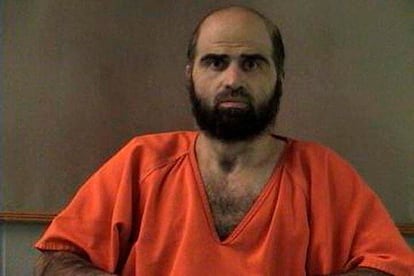

The Pentagon plans to broadcast a firing-squad execution live, a practice that might seem more characteristic of terrorist organizations such as the Islamic State than of governments that are signatories to the Universal Declaration of Human Rights. According to a senior Defense Department official, the institution plans to stream online the execution of former military psychiatrist Nidal Malik Hasan on December 3; Hasan killed 13 people in a 2009 shooting at the Fort Hood military base in Texas.
The United States ended public executions nearly a century ago because they were deemed barbaric; such practices still take place in countries like Iran, Afghanistan, and North Korea. The Pentagon ended executions by firing squad in 1945. The last military execution in the United States took place in 1961.
Defense Secretary Pete Hegseth told the ultraconservative Real America’s Voice program Human Events Daily on Thursday that he planned to make Hasan’s execution public, although he did not specify how. He did say that executing the former psychiatrist on a Thursday around 1.00 p.m. local time at Fort Hood, at the same site and roughly the same hour as the 2009 massacre, was “the right thing to do.”
U.S. military law stipulates that an execution by firing squad must be approved by the U.S. president. The Pentagon said on Monday that Donald Trump had given the go-ahead on the recommendation of Hegseth.
“We’ll make sure that people are able to watch it, that it’s public, because people need to understand that there’s serious consequences for these types of things,” Hegseth said in the interview, which was recorded aboard the aircraft carrier Abraham Lincoln as it returned to port after a deployment of almost a year.
Asked whether Hasan had expressed any last wishes, Hegseth replied: “Don’t care. We’ll see him on December 3rd.”
A military jury sentenced Hasan to death in August 2013 after finding him guilty of 45 counts of premeditated murder and attempted premeditated murder. In addition to the 13 people he killed, 32 others were wounded when he opened fire with an automatic pistol fitted with a laser sight at a medical center at Fort Hood where soldiers were screened before deployment to Afghanistan. The attack was the deadliest shooting in history on a U.S. military base and occurred weeks before the date the then-sergeant was due to be deployed to Afghanistan.
Hasan, 56, was paralyzed by police gunfire when he was apprehended and has used a wheelchair since. The military doctor, who defended himself at the court-martial that convicted him, acknowledged the crime. At trial he said he had “switched sides” and wanted to defend the Taliban in Afghanistan. For years the psychiatrist had treated veterans returning from missions in Iraq and Afghanistan with post-traumatic stress disorder at the Walter Reed military hospital in Washington, and he was transferred to Fort Hood a few months before the shooting.
Since his conviction, Hasan has been held at the U.S. Disciplinary Barracks at Fort Leavenworth, Kansas. The Supreme Court rejected a petition to review his case in March last year. If his sentence is carried out, it will be the first execution by the U.S. Armed Forces since soldier John Bennett was hanged for rape and attempted murder in 1961. Then-president George W. Bush in 2008 approved the execution of another service member, Ronald Gray, convicted of murder and rape, but that sentence was stayed by a federal court.
The last public execution in the United States took place in August 1936 in Owensboro, Kentucky. More than 20,000 people witnessed the hanging of Rainey Bethea, a young Black man convicted of raping an elderly white woman.
The firing squad is, along with electrocution and gas inhalation, one of the methods the Trump administration added to the list of acceptable execution options for the most serious federal crimes. Part of the reason the list was expanded was the difficulty in obtaining the compounds required for lethal injection, such as pentobarbital.
Since 1976 the United States has carried out only six civilian executions by firing squad: three in Utah and three in South Carolina, the latter occurring last year, according to data from the Death Penalty Information Center. Only five states permit that method of execution: Idaho, Mississippi, Oklahoma, Utah, and South Carolina.
The Pentagon’s announcement that it plans to stream the execution came shortly after Christa Pike survived an attempted lethal injection in Tennessee. Pike, 50, who was sentenced to death for the 1995 murder of a fellow college student, is hospitalized and conscious.
Sign up for our weekly newsletter to get more English-language news coverage from EL PAÍS USA Edition









































