
A journey to Ningde, the Chinese city turned world capital of batteries for electric cars
CATL, a producer that accounts for nearly 40% of the global market, is trying to transplant the industrial ecosystem it built in its hometown to Europe, and is using AI to develop the next generation of batteries

Zhong Zihao, 20, has heard that the area around Chijian Lake, in southeast China, was farmland before the rice paddies gave way to factories. It is hard to imagine that landscape among the industrial sheds, bridges, roads and buildings that now rise on the reservoir’s shores. Zhong knows his hometown used to be one of the poorest and least industrialized corners of Fujian province, but now, he says with pride, “when I introduce myself, I only have to say I’m from Ningde, the CATL place.” “For a small town to be remembered because of a company is a huge boost to local confidence,” he says.
In barely three decades, Ningde has become the world capital of battery manufacturing thanks to CATL (Contemporary Amperex Technology Co., Limited), the planet’s largest producer of batteries for electric vehicles. Its Chinese name, Ningde Shidai, is a clear statement of intent; it means “the Ningde era.”
“One in every 2.5 electric cars in the world is fitted with our batteries; every time you see one, it’s very likely it carries a CATL battery,” Chen Qingrong, a senior engineer at the firm, said on September 20 during a guided visit to the company’s headquarters attended by several international media outlets, including EL PAÍS. The company’s estimate broadly matches data from South Korean consultancy SNE Research, which attributes a 39.9% global market share to CATL between January and July 2026.
Traveling to Ningde makes it possible to understand the model that CATL is trying to export. Together with automaker Stellantis, it is building a gigafactory in the northern Spanish town of Figueruelas, in Zaragoza province, with a capacity of up to 50 GWh a year, scheduled to start up in 2027. In Europe, CATL has been producing cells since 2022 in Arnstadt, Germany, and assembles modules in Debrecen, Hungary, where tests of the first cell lines began on September 22. The Hungarian plant could reach 100 GWh when completed. CATL also has a plant in Indonesia that became operational in July. CATL’s global capacity reached 772 GWh in 2025 and the company expects to surpass 1,000 GWh this year.
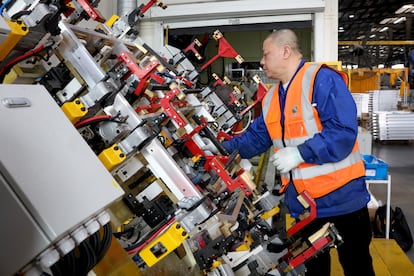
Production at the Jiaocheng base in Ningde was halted when this newspaper visited, but engineer Yu Ruoqiang reconstructs the sequence. A battery cell starts as a mix of gray powders that becomes a thick paste spread over copper and aluminum foils thinner than paper. Until it is finally sealed under a blue film, its manufacture involves almost 20 automated processes in which machines cut, roll and compact materials, detect potential leaks and inject the electrolyte.
Jiaocheng has 12 production lines (eight dedicated to vehicle batteries and four to energy storage) and employs about 6,000 people. CATL’s plants in Ningde together have an operational annual production capacity of around 330 GWh; the Jiaocheng base contributes close to 60 GWh. The facilities run 24 hours a day and stop a couple of times a month for maintenance. Each line can produce more than a hundred small cells per minute, with between 35 and 40 workers per shift.
Yu notes that the incorporation of artificial intelligence (AI) has greatly improved product quality and optimized processes; he places the share of valid cells above 96.5%. Automation has transformed the work: operators monitor voltages, temperatures, electric currents and possible anomalies while machines adjust parameters.
CATL works with machine builders and material suppliers located near its plants. The company says all equipment at Jiaocheng comes from Chinese manufacturers, although it reserves the design of some critical components. That industrial network, now one of Ningde’s advantages, barely existed when battery production began there. Its development is linked to Zeng “Robin” Yuqun, CATL’s founder.
Born in 1968 into a peasant family, Zeng studied naval engineering at the prestigious Shanghai Jiao Tong University and left a job at a state-owned company to move to Dongguan, in Guangdong, one of the manufacturing hubs that emerged after China’s economic opening in the late 1980s. There he co-founded ATL in 1999, focused on batteries for electronic devices. In 2008, he moved part of the business to his hometown and, three years later, created CATL to manufacture batteries for electric cars, backed by Beijing’s subsidies and policies to boost the clean energy sector.
CATL’s rise attracted manufacturers and suppliers. The landscape surrounding its facilities, wedged between mountains and sea, shows the formation of an industrial ecosystem that integrates production, suppliers, research centers and services for tens of thousands of workers. By the end of 2025, the cluster included more than 90 suppliers whose combined output exceeded 300 billion yuan a year (about $44 billion). The prefecture’s GDP reached 425,172 million yuan in 2025 ($62.5 billion), nearly five times that of 2011. CATL went public in Shenzhen in 2018 and has also been listed in Hong Kong since 2025. The company’s rise has placed Zeng among the world’s wealthiest: Forbes ranks him 39th.
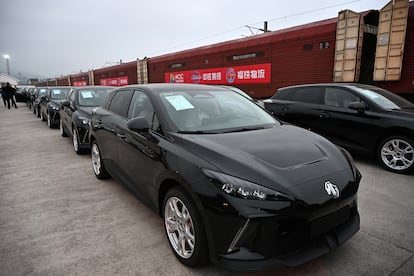
That very industrial fabric is what CATL acknowledges it cannot immediately replicate in Europe. “Building the entire battery supply chain there is very difficult. In China it also took around 10 years,” Zhu Lingbo, head of technology for the international automotive business, said during a meeting with journalists and consultants. Expansion is not just about moving machinery; it also requires transferring the knowledge and experience accumulated over the course of years. In October, the first group of professionals hired for Figueruelas is scheduled to travel to China. A company source estimates that at full operation only 5% of the workforce will be Chinese. At its German counterpart, the figure is below 10%.
Zhu says CATL intends to progressively localize the manufacture of essential components in Europe (from cathode materials to electrolyte, separators and aluminum casings). Company sources aim for the entire supply chain, except for critical machinery, to be in Europe within five years.
That move is partly a response to Brussels’ demands. The European Commission has proposed in the Industrial Acceleration Act (still under negotiation) introducing origin requirements for electric vehicles bought under public contracts or benefiting from certain subsidies. Under the proposal, cars would have to be assembled in the EU and their batteries would have to incorporate cells and components made there.
Zhu says regulation is not the only reason to bring suppliers closer: shipping many components from China reduces the advantages of producing them at scale. When choosing where to build a plant, the central criterion is “cost, cost, cost,” the executive summarizes. The calculation includes subsidies, wages, labor, and access to sufficient, cheap and clean electricity and water. That combination makes the Iberian Peninsula a particularly attractive destination, according to the senior executive.
The other advantage CATL wants to preserve lies in its laboratories. In 2025 it devoted 22,100 million yuan (about $3.27 billion), 5.23% of its revenues, to research and development, an area with 23,000 employees. AI not only detects tiny defects in factories — “better than humans,” engineer Yu asserted — but also makes it possible to simulate chemical compositions and material structures before physical testing. This reduces the almost unmanageable universe of combinations when developing a new battery. CATL has created an academy dedicated to applying AI to scientific discovery and a center with 3,000 researchers, some focusing on longer-term technologies.
Asked which battery will dominate the market in two or three decades, Zhu admits CATL does not yet have an answer: “We are exploring.” Sodium, more abundant and potentially cheaper than lithium, is a possibility but not a definitive solution. After turning Ningde into the world capital of batteries, CATL is determined to keep its dominance. “We have been at the forefront for 15 years, but we cannot keep doing the same thing in 15 years. We must evolve. AI gives us millions of possibilities; we must be creative,” concludes Jin Wenjing, director of the AI-based engineering department.
Sign up for our weekly newsletter to get more English-language news coverage from EL PAÍS USA Edition









































