
From Lake Ontario to Lake America: Who gets to decide the names of geographical places?
While an executive order can impose a name within the United States, it cannot dictate how the rest of the world identifies a shared territory
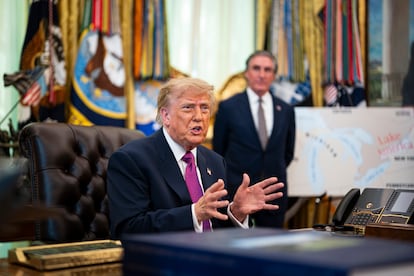

Donald Trump has opened a new front in his tariff dispute with Canada, and one of the latest collateral victims is cartography. Just as he did at the start of his term with the Gulf of Mexico, which was renamed the “Gulf of America” within the United States, the U.S. president has now turned his attention to another geographical feature shared with America’s northern neighbour. In an executive order signed on Thursday, Trump declared that Lake Ontario should henceforth be known as “Lake America.” But is it really that simple to rename a geographical feature? And what practical effect can such a decision have?
“Creating this innovation by executive order in the 21st century says more about the personality of the autocrat than anything else,” says Jesús Burgueño, a geographer and professor at the University of Lleida.
As he explains, geographical name changes are normally proposed through cartographic institutes, where countries typically have toponymy commissions responsible for studying the origin and evolution of geographical names. That was not the case with Trump’s unilateral decision.
Even though it is not the product of a historical process agreed upon over many years by specialists, the decision will nevertheless have effects within the United States. “In terms of practical force, it certainly does,” Burgueño says.
For one thing, it is far from unusual for the same physical space to have different names, particularly in border regions. Burgueño points to one of North America’s major rivers, which forms part of the border between Mexico and the United States: in Mexico it is known as the Río Bravo, while in the United States it is called the Rio Grande.
Something similar occurs with the Sea of Japan, which is known in both Koreas as the East Sea. Different names can even coexist within the same country. In Spain, for example, both Golfo de Bizkaia and Golfe de Gascogne remain in use, even though the former has historically been far more widespread, Burgueño notes.
The impact of Trump’s decision domestically is further strengthened by the concentration of power in the White House. “All U.S. government agencies are now under the control of the White House, including the U.S. Board on Geographic Names,” says Frédéric Giraut, professor of political geography at the University of Geneva and holder of UNESCO’s Naming the World Chair.
New York Governor Kathy Hochul, however, has already said that her administration will not adopt the change.
Companies responsible for producing and distributing maps within the United States are nevertheless likely to follow the new nomenclature. “Under the current administration, National Geographic, for example, will not dare publish a map that violates Trump’s order,” Burgueño argues.
International limits
As a general rule, countries can exercise sovereignty over geographical names only within the portions of a lake that fall under their jurisdiction. In the case of shared bodies of water, however, long-established usage may give rise to a common name that is also recognized internationally.
When a name change does occur, the countries concerned must update their official maps, nautical charts and national legislation. But Canada has shown no sign of yielding to Trump’s latest move, just as Mexico refused to adopt the term “Gulf of America.” Canadian Prime Minister Mark Carney has already publicly rejected the initiative.
“The name Lake Ontario comes from the Wendat word Ontari’io, which, appropriately, means ‘the lake is beautiful, the lake is big,’” he shared on social media. “The name is more than 400 years old, predating both the Confederation of Canada and the Declaration of Independence of the United States of America.”
The ultimate impact of the White House’s unilateral decision will therefore depend on the institutions that produce, validate and disseminate geographic information internationally, Giraut explains. According to the scholar, other sovereign states “should not alter their exonyms” — the official names they use for foreign places — and therefore “should not reflect the change in their cartographic documents or official texts either.”
International bodies responsible for maritime boundaries and geographical nomenclature are not involved in the matter. The International Hydrographic Organization (IHO) maintains a standardized nomenclature for seas and oceans, which are identified and named within its system, but it neither covers binational lakes nor acts as an arbiter in toponymic disputes. Likewise, the United Nations Group of Experts on Geographical Names (UNGEGN) recommends preserving the stability of place names and respecting established usage.
Digital cartography
“The main challenge today lies in the digital maps distributed by private and collaborative platforms,” says Giraut. “The precedent of the Gulf of Mexico showed that the main platforms, Google Maps and Apple Maps, accepted recording and displaying the new imposed name.”
In much of the world, he notes, those platforms adopted a dual-label approach, displaying “Gulf of America” in parentheses and as a secondary designation. In the United States and Mexico, however, users were shown different names depending on the country from which they accessed the service.
“Other major private platforms, especially those intended for in‑car navigation systems — Bing Maps, TomTom Maps and Here WeGo — have not endorsed or propagated the change,” he adds. “The same is true of the leading collaborative mapping platform, OpenStreetMap.”
Giraut sees a common thread running through the place-name changes championed by Trump. “One has to take into account the supremacist dimension of these initiatives, which are invariably carried out at the expense of names of Native American origin [such as Denali, Mexico and Ontario].” In 2015, the administration of then-president Barack Obama restored the Indigenous name Denali to Alaska’s highest peak, officially replacing the name Mount McKinley. On his first day back in office, Trump reversed that decision and reinstated the mountain’s former name.
Sign up for our weekly newsletter to get more English-language news coverage from EL PAÍS USA Edition









































