
Raivis Melnis, Latvia’s defense minister: ‘We are preparing to fight’
The veteran soldier admits Russia has stepped up its hybrid war, but does not see an ‘imminent’ risk of conventional aggression
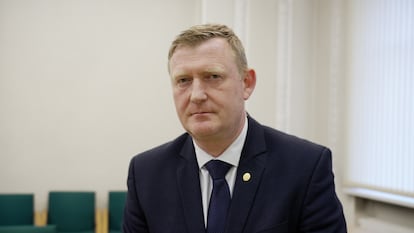

Raivis Melnis walks down a long corridor inside Latvia’s Ministry of Defense, located in an aging building in central Riga, the capital. He shows up all alone, a striking oddity for someone with government responsibility. Born 48 years ago in the Balvi municipality, about 20 kilometers (12 miles) from the Russian border, the Latvian army colonel has held the defense portfolio since late May. That was when several attack drones penetrated the Baltic country’s airspace without encountering any opposition. Two struck near an empty fuel depot. The crisis prompted then–prime minister Evika Silina to dismiss the defense minister and turn to Melnis.
A military adviser with deep knowledge of Ukraine; a veteran of the war in Afghanistan and trained at prestigious institutions such as King’s College London, Melnis seemed the right man, but then the prime minister fell, and with her his appointment. However, the new head of government, Andris Kulbergs, judged that there was no one better than the colonel to shield the country from the threats coming from the East.
Question. The strike by several drones in the country’s east triggered a serious government crisis five months ago. Is Latvia better protected now?
Answer. They no longer pose a major challenge. They remain a challenge, but one that we can manage. When I took up the position, we shot down the first one and then the second one. I set a deadline to build new military capabilities to bring to the border to intercept drones, and that has been done. By October we already had additional radar systems, drone interceptors and the corresponding software. We have developed quite capable systems along the border with Russia and Belarus. It ensures we can detect and intercept drones with equipment manufactured in Latvia. I cannot say the problem is completely solved. More will come; we will use our systems and we will have NATO’s support.
Q. But defending the eastern flank is more than countering drones.
A. The eastern flank belongs to NATO and the European Union; it is not only about Latvia but about Europe and the Alliance as a whole. For that reason I am grateful to all NATO countries that have deployed troops to Latvia, Estonia, Lithuania, Finland and Poland. At present we are focusing more on hybrid activities and threats. Drones are a key factor, but another big challenge is illegal immigration. We are taking action and supporting our border guards and have deployed military units.
Q. Do you have enough resources to face that hybrid war?
A. We must strike a balance: on one hand, deploy our forces to support the Interior Ministry and our security services in the fight against hybrid activities carried out by aggressive states, both Russia and Belarus; and on the other, keep our army prepared to fight in the event of war. Our resources are limited, but we must understand that the principal challenge is hybrid activity.
Q. Estonia has moved soldiers close to the Russian border — has Latvia done the same?
A. We have kept our forces near the border for years, with units permanently deployed, countering illegal immigration. We regularly conduct exercises with other NATO countries, such as Spain [with about 600 troops at the Adazi and Lielvarde bases]. That brings deterrence, reassurance and a clear message: our friends are here not only to train, but also to fight if necessary. It is a firm message to Russia and Belarus.
Q. You served as Latvia’s military liaison in Ukraine. Has your perception of the risk of Russian aggression changed in recent months?
A. Any possible attack against Latvia or our neighbors would be an attack against Europe, against NATO — which would mean a forceful response from the Alliance and EU countries. That is what our aggressive neighbor must take into account. It would be a strategic mistake for Russia to decide to attack a NATO country. For now, I do not see an imminent conventional threat. Russia is challenging us with other types of activities: drones, cyberattacks, illegal immigration, provocations, sabotage, propaganda. It has stepped up these activities; we are seeing more incidents of this kind.
What Russia seeks is to break our cohesion, our will to support Ukraine and to support one another. I trust Russia will not succeed, because we have shown strong unity. We are preparing in case we need to fight. I am not necessarily speaking of an immediate future, but there is a threat across the border and we need to work together.
Q. That perception is different in Spain.
A. Undoubtedly it is different, because we live next to the threat and you live somewhat farther away. However, I disagree that everyone perceives the threat differently, because Spanish soldiers see themselves as part of the country that lives with the threat. You do not live right on the border, but that is why we cooperate, hold dialogue, convey those messages and demonstrate that the threat exists and that we must be prepared.
Q. Some, including leaders of neighboring European countries, believe Russian aggression has already begun.
A. Do hybrid threats respect borders? No. Cyberspace? It has no borders. Drones? They can be launched and operated remotely. Incidents that happened in Leipzig, Germany, or in the United Kingdom can occur anywhere in Europe. We must cooperate to fight them. In conventional terms, we are closer, but there is no imminent threat. Russia has stalled in Ukraine. It has not achieved its objectives. The Ukrainians are counterattacking and managing to push Russian forces out of some areas. They are conducting successful offensive operations thanks to their fighting spirit. It is our duty to support them, because they are also fighting our battle. Russia intensifies these hybrid activities to erode our will to support Ukraine and to divert our attention and resources toward our own internal problems.
Q. The president of the United States, Donald Trump, has suggested they might establish a permanent base in Lithuania. What would that mean for the Baltic states and the defense of the eastern flank?
A. The United States is a strategic partner. They deploy forces in other regions to guarantee security, but they are also present in the Baltic region, providing capabilities, deterrence and the means for us to train together, integrate and, if necessary, fight. They have been in the region, they are there now and I am convinced they will remain. That is the message: deterrence; the message that the United States stands with us as a strategic partner, a key global actor and a solid NATO member that guarantees security. But, of course, EU countries and other NATO members must invest in our own capabilities; we have to allocate sufficient resources and funding to develop them rather than always expect the United States to come take care of everything.
Sign up for our weekly newsletter to get more English-language news coverage from EL PAÍS USA Edition









































