
Putin’s invisible front: Drones, sabotage, and hybrid warfare test Europe
As the war in Ukraine continues, Russia is intensifying a covert pressure campaign on NATO’s eastern flank that is unnerving European governments and intelligence services
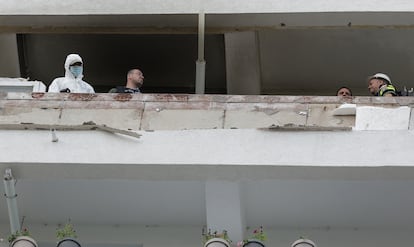

From the cold waters of the Baltic Sea to Romania’s border with Ukraine, Europe is experiencing a quiet escalation from the Kremlin. A war of gray zones that is not fought only with tanks or missiles. Drones crossing NATO airspace, sabotage of submarine cables, disinformation campaigns and covert operations have turned the continent’s north and east into Vladimir Putin’s new hybrid-warfare laboratory.
Last Friday, the impact of a Russian drone on a residential building in Romania — the most serious incident with casualties directly caused by Russia on the territory of a NATO country since the start of the invasion of Ukraine in 2022 — sounded alarms in Brussels and eastern European capitals. European governments and intelligence services have warned for months that Moscow is intensifying operations below the threshold of open war to test Europe’s political, military, and psychological response. And the Old Continent has not measured up.
The Atlantic Alliance described the incident as “reckless and unacceptable.” But beyond this particular case, what happened adds to other incursions and again exposes cracks in European air-defense and protection systems. “It is clear that NATO’s deterrence and defense posture, especially air defense, must be strengthened,” Estonia’s foreign minister, Margus Tsahkna, said.
Huge doubts arise about the Alliance’s ability to counter those unmanned aircraft with its sophisticated air-defense systems, which are designed more to act against missiles than drones. “We will continue to enhance our readiness to deter and defend against any threat, including from drones,” NATO secretary general Mark Rutte said.
What happened with the Russian drone in Romania is “serious,” not only because of the incident itself but because it indicates that the Kremlin “is warming up” its tools, a European intelligence source warns, speaking on condition of anonymity. “Pressure from Russia is growing because they are using a strategy of attrition. Today the threat is direct,” the source adds.
On Europe’s eastern flank, incidents are piling up with a regularity that has begun to alter everyday perceptions of security. In March 2026, a drone that entered Estonian airspace struck the chimney of the Auvere power plant, in an episode Estonian authorities are investigating as part of a series of aerial incursions that also affected Latvia. Weeks earlier, Finland and Estonia opened several investigations into ships linked to the so-called Russian ghost fleet — the network of vessels flying other flags that the Kremlin and its orbit use to move oil and evade sanctions — after a wave of suspicious damage to submarine cables and Baltic Sea energy interconnections.

Adding to this pattern is electronic pressure from the Russian exclave of Kaliningrad. Lithuanian and Polish authorities have documented thousands of GPS interference episodes that affect civil aviation and maritime navigation across the Baltic region, disrupting positioning systems hundreds of miles away.
In Lithuania, authorities have linked networks associated with Russian intelligence to several plans of sabotage and deliberate fires targeting logistical and commercial infrastructure. In Poland, security services are investigating attacks on rail infrastructure used for transit to Ukraine. Further north, Norway has warned of an increase in espionage activities and possible sabotage operations against energy infrastructure in the Arctic, while airlines and European authorities record recurrent episodes of electronic interference even on official flights near the Russian border.
The new Russian doctrine is gray war. And it is feared it will intensify. Carsten Breuer, the military chief of the German Armed Forces and the highest-ranking officer in the army, went further, saying Russia could be capable of launching a large-scale attack against NATO territory starting in 2029. “I am not saying this will happen automatically, of course not. But the possibility exists,” he said a month ago in a German military outlet.
In Moscow, the response has been ambiguous. The Kremlin’s circle has spoken of Western “hysteria.” Yet Dmitry Medvedev, deputy chair of Russia’s Security Council and a former president of the Eurasian country, has threatened Europe. “Citizens of EU countries, You should realize your authorities have unilaterally entered into a war with Russia,” he wrote on social media. “So be vigilant and don’t be surprised by anything. The peaceful sleep is over. But you know who to ask why!” he added.
The intensification of these hybrid operations is reflected in several recent intelligence and European analysis center reports. Russia has stepped up hybrid warfare against Europe since 2024, according to a recent assessment by Dutch intelligence. “The Russian armed forces are preparing for a possible conflict with NATO and are conducting various activities to test the West’s willingness to escalate the conflict,” the document states. A NATO report from last January describes some of the hybrid forms the Kremlin is focusing some of its capabilities on: propaganda, deception, sabotage of essential infrastructure, and other nonmilitary tactics.
“For Russia, using a set of hybrid tools to achieve its objectives is cheaper and easier to deny than military aggression,” says Anastasia Pociumba of the German Council on Foreign Relations (DGAP). “Hybrid measures take longer to attribute and keep target states under constant pressure, thereby weakening their institutions,” the expert adds; together with Ricarda Nierhaus she has published research on Russian hybrid warfare in Europe.
William Dixon and Maksym Beznosiuk warned last December, in a report for the Royal United Services Institute, that 2026 would be the year of hybrid escalation. “We must prepare not for a resurgent Russia, but for a desperate one,” they say. Thus, they argue, escalation becomes not an option but a necessity.
Sign up for our weekly newsletter to get more English-language news coverage from EL PAÍS USA Edition









































