
The pool as therapy for people with severe neurological diseases: ‘I can do things without fear here’
A specialized water-based therapy unit in Madrid, Spain treats people with stroke, ALS and spinal cord injuries. The water gives them a respite from what burdens them the rest of the day: their own bodies
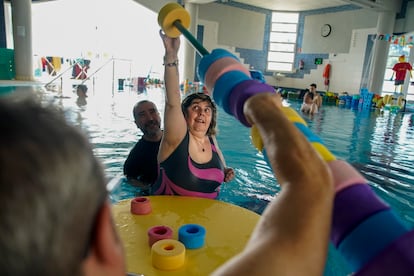

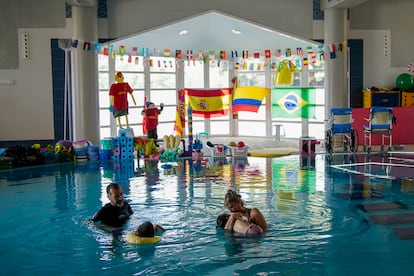
A heavy heat is the first thing you notice when you enter the pool area of the Fundación Instituto San José in Madrid’s Latina district. The space is completely enclosed and the water is 33ºC (91ºF) in the middle of summer. But the temperature is comfortable and the facility has a system that controls chlorine and humidity with clinical precision. Nobody comes here to swim or cool off; they come to recover movements that disease or injury had made impossible.
For Ángel García Rincón, the facility’s rehabilitation assistant, the effect of the water on these people is truly significant. “Think of someone who spends their life in a bed or a wheelchair. They come in, they get in the water and suddenly they can look the person in front of them in the eye instead of from below. That alone is a huge benefit,” says the health professional from this unit, which has been operating for nearly two decades.
People with stroke aftereffects, brain damage, ALS, spinal cord injuries or those who are recovering from accidents come to this therapeutic pool, which is the shape of a perfect octagon. Also treated here are infants only a few months old with developmental disorders and teenagers with motor disabilities. For a few minutes, the water gives them a respite from what burdens them the rest of the day: their own bodies.
Paco Ramos, a former optician who was diagnosed with amyotrophic lateral sclerosis (ALS) eight years ago, has just finished his session while his granddaughters wait for him outside the pool. “Today I was able to walk on my own in the water,” says the 62-year-old patient.
His wife, Isabel Camacho, watches him with the girls: “He was always a swimmer. When the disease appeared he thought that was over. But he gets in the pool and walks again. It may sound trivial, but it means the world to him. He grows inside that water.”
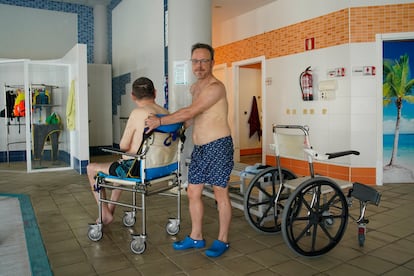
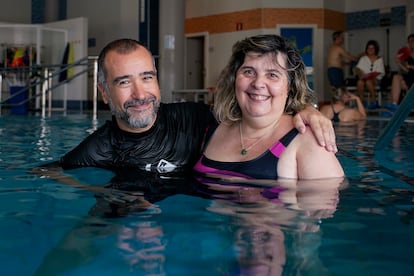
Also here is Mónica Cabrero, a 53-year-old Madrid resident. Before descending the ramp she adjusts the prosthesis on one of her legs. With one hand on the railing, she moves forward slowly as the water begins to cover her body. “Here I can do things without fear,” she says. “If I fall, at worst I’ll take a dip.”
Twelve years ago a stroke changed her life completely. She had a job she loved as a social worker at an emergency center for women who are victims of gender-based violence. Afterwards she spent months in hospital, and emerged with a permanent disability. Since then she has never stopped rehabilitating. “For me it’s like a job,” she says.
Cabrero receives physiotherapy at home, attends a center specialized in brain injury and reserves Tuesday mornings for the pool. “Water is a kind medium for those of us with physical limitations,” she says.
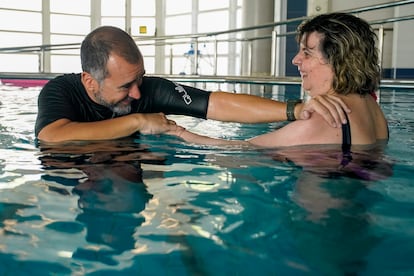
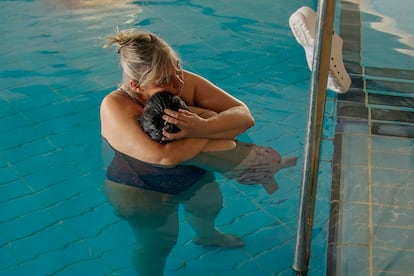
Slow movements are evident in the pool. Some raise their arms with devices to learn to swim. Others move forward holding their physiotherapist’s hands. Sessions combine different aquatic rehabilitation methods adapted to each patient.
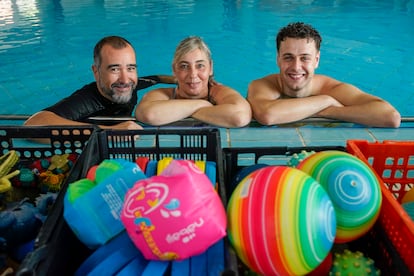
María Alonso Fraile, head of the unit, says that although they use fins, underwater weights and interactive screens, their main tool is the water. She has been at the foundation for more than 30 years and was one of the people behind the project. “Water facilitates movement, provides security and allows work on abilities that would be impossible on dry land,” emphasizes the health professional.
Isaac Fernández, another of the physiotherapists, has been at the pool for two years: “Many cannot walk out of the water but they can here. It’s a physical matter, but it also changes how they feel.”
The report Piscinas y salud en España, presented in June by the Spanish Association of Pool Sector Professionals (Asofap), argues that pools are still an underused infrastructure. In a country with more than 1.3 million public and private pools, the paper defends their potential to prevent disease, support rehabilitation and improve mental health, especially in an increasingly elderly Spain with a life expectancy above 84 years and more than 10 million people over 65.
In that document Asofap highlights the foundation’s work, and also mentions two initiatives in Barcelona and a third project in Granada.
A history of care
For decades the San José Institute Foundation has taken in those who found no place anywhere else. It was founded 127 years ago to care for children with epilepsy, but the institution expanded its mission according to the needs of each era. There were wounded people from the Spanish Civil War (1936-39), patients with neurological diseases and, when AIDS was still stigmatized, people that hospitals refused to treat.
Today the complex houses a hospital, a residence, a special education school and this aquatic therapy unit. Water rehabilitation is a private service costing around €300 per month for two weekly sessions. About 230 patients pass through here, from infants only a few months old to people over 90. Most are sent here from other centers or come as part of a broader treatment.
Some studies suggest that exercise in water can improve mobility, balance and gait in people with neurological diseases across the lifespan, from children to older adults.
In the case of multiple sclerosis, a review of several studies published in 2016 concluded that aquatic exercises produce improvements like the ones mentioned above. According to the Spanish Society of Neurology (SEN), between 4,000 and 4,500 people currently live with ALS in Spain, but the number of patients in Europe is expected to increase by more than 40% over the next 25 years as a result of population aging. Likewise, about 90,000 new stroke cases occur in the country each year, SEN says, warning that up to 90% could be prevented with healthy lifestyle habits.
“Now I can walk without pain”
In one of the foundation’s corridors there is a reproduction of Triste herencia, a painting that Joaquín Sorolla made in 1899. The scene shows several children with crutches heading to the sea accompanied by a clergyman. García Rincón, the rehabilitation assistant, discovered that painting and managed to get the Sorolla Museum to send them a copy. “It impressed me because it represents exactly what we do here more than a century later,” he says. “Back then they already took children to the water because they intuited its benefits.”
Physiotherapists correct support, hold an arm, support a back. García Rincón has been at the foundation 36 years and has seen babies who are now teenagers and patients who have been part of the house for more than a decade: “In this world of difficulty and suffering, your scale of values is rearranged.”
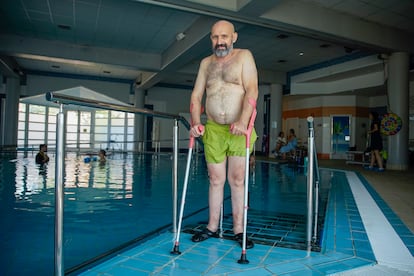
Another patient, age 61 but who prefers not to give out her name, arrived here just a few months ago after spending five months immobilized with a vertebral fracture after slipping in the shower. Pain prevented her from moving. “Now I can walk two or three hours without pain,” she says. “I can afford this therapy,” she adds, “but there are many people who would also benefit greatly and cannot. This should be subsidized somehow.”
In the next shift, a patient named Andrés París shows up. He is 68 and lives with secondary progressive multiple sclerosis. He is one of the unit’s longest-running users. For 15 years he has come to this pool twice a week. “I’m practically in the same state as when I started,” he says. With another disease that phrase would sound disappointing. With his, it’s a victory: “I haven’t gotten worse.”
He drives his own car to the foundation and says his family has always been there for him. Years ago, one of his sons received a La Caixa scholarship to study multiple sclerosis, precisely the condition that affects him. Two different ways of resisting. While his son fights the battle in a laboratory, he holds it with slow steps in this pool.
Sign up for our weekly newsletter to get more English-language news coverage from EL PAÍS USA Edition









































