
Christina Koch, the first woman to travel to the Moon: ‘We saw blue flashes when we closed our eyes’
The astronaut and scientist speaks with EL PAÍS about her experience during the historic Artemis 2 mission and warns of the dangers of the space race with China
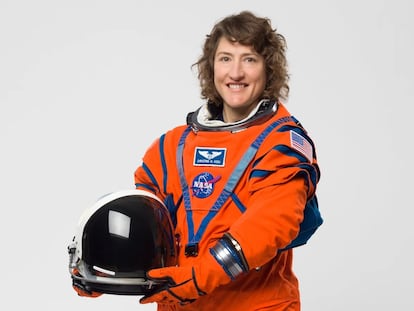

Astronaut Christina Koch, 47, is the first woman to travel to the Moon. She is also one of the four people who have ventured the farthest into space, serving as a specialist on the Artemis 2 mission. An engineer and physicist, Koch is the first civilian scientist astronaut — with no ties to her country’s military — to achieve all those milestones; she also holds the record for the longest continuous time spent in space by a woman and took part in the first all-female spacewalk.
In this video interview with EL PAÍS, Koch revisits some of the most intense moments of her historic mission to the Moon last April and reflects on what lies ahead in the race to the Moon and Mars. The astronaut also discusses her future: she believes her time in space is behind her and that she is ready to pass the torch to a new generation of astronauts who will be called on to colonize our satellite and prepare for the first missions to the red planet. Koch says humanity is fully prepared for that goal, both physically and mentally. The scientist and astronaut is due to visit Spain later this month to receive the Princess of Asturias Award for Concord alongside the rest of the Artemis 2 crew.
Question. After returning to Earth, you spent two weeks without looking at any mission images because you wanted to treasure your memories and write them down. Can you share one you haven’t talked about yet?
Answer. I’m afraid maybe all the fun ones have already been shared. I just recently read a lot of my journals and a lot of what I wrote down were things I was feeling in the moment; and many times I was feeling or processing things that I did that I felt were mistakes, wondering if I had made the right choice or done the right thing in the little things, in terms of how I interacted with the crew, with the ground, or in how efficient we were in a certain moment.
One thing I have passed on to future crews is that no matter how much we trained to do things in a very specific way, there were moments in the mission when we deviated from that expected operational concept and process. The environment took us completely out of everything we had practiced, to the point where we were reinventing things up there, to our surprise. I learned that when humans are put in a new and different, stressful environment, you have to really rely on well-practiced habits to make sure you carry those forward.
Q. You will accept the Concord award for what the Moon mission has meant for humanity. But on the other hand, there is a ruthless race for the satellite: projects to colonize it, extract its resources, and there are even generals talking about war there. How do you reconcile this?
A. That’s a great question. I’m really happy I have always been part of NASA’s civilian space program, whose goal is peaceful exploration. We’ve written the Artemis Accords, which outline how nations that are involved in this should cooperate with each other, respect history, and manage these shared spaces. We like to lead with our values and principles.
People have asked before about changing the Moon in the ways we have changed the Earth, and I would just encourage people to remember that this is our choice. There are plenty of models for how to go somewhere and bring back the scientific and industrial benefits in a responsible way. For me, having been part of the Antarctic program, the Antarctic Treaty governs how we explore that continent and it’s a wonderful model in so many ways for what we’re doing now in exploring the Moon. It’s a complicated question; what we are doing is a step forward for peace and human unity, but we have to make sure we’re making the right decisions along the way so it stays that way.
Q. Will a woman set foot on the Moon in 2028? Will it be you?
A. I can’t speak to who it will be, but I’m excited to know it will be a friend, because the astronaut corps is a very close group and everyone is incredibly capable. As for my own aspirations, I think that the time has come to pass the torch. I’ve had a long, far-reaching mission; I feel I’ve fulfilled all my space dreams and more. Now I’m excited to see the next generation take over.
Q. You have worked for NASA and NOAA, agencies facing significant cuts from the government of Donald Trump. As a woman and a scientist, are you worried about the current state of science in your country?
A. I will always be a lover of science. The discoveries we can make, both by exploring the universe with instruments and through human presence on the Moon and Mars, are incredibly important. My first role at NASA was building X-ray telescopes to study the deepest and highest-energy events in our universe, things that tell us about cosmology and the origin of the universe.
But from my experience working with climate stations, I also know that Earth science is incredibly important. We have to keep learning even more about Earth as we probe the universe and other planets to understand how we can take care of our own planet. Fortunately, NASA continues to receive support for major missions, so hopefully we can keep asking those tough questions about how we allocate resources properly to address all of these amazing things.
Q. Are we prepared as a species for long-duration trips, such as going to Mars? And out of curiosity: Apollo astronauts said they saw “flashes of light” when they closed their eyes on the Moon. Did you experience that too?
A. When I got back from my nearly 11-month mission on the International Space Station, the one thing I said to everyone was: “Absolutely, humans can do an 18-month Mars mission.” There was nothing in the mission that for me precluded staying longer. The countermeasures we have were absolutely enough to make sure we had the bone and muscle health we needed. There were countermeasures to make sure we stayed mentally happy: staying connected with loved ones and new sensory experiences so we could continue to thrive. I was heartened by our prospects for deeper and longer space travel.
Regarding the light flashes, yes, we did see them. On board the Space Station, I saw it maybe a couple of times throughout the mission, when I had that flash in my eye that I could really identify. On Artemis 2, we all agreed that when we closed our eyes before falling asleep at night, we saw between six or 12 flashes, maybe every minute or so. We attributed that to the higher radiation environment.
Q. Isn’t that a bit concerning?
A. They’ve studied the radiation environment and we had dosimeters with us. As these are shorter missions, they are concerned about it, but not to the degree of being beyond what we’ve accepted as the lowest reasonable amount of radiation for an astronaut. All of this is highly tracked, and we received a lot of classes about it. Radiation was not only predicted but we measured it with dosimeters; we even knew which parts of the vehicle had more or less radiation due to the craft’s shielding design. It’s always been a very important part of human space travel.
Q. As a scientist, what is the biggest question left for us to answer?
A. Are we alone?
Q. What do you think?
A. I definitely think there’s something intelligent out there, but we haven’t discovered it yet. There’s proof of concept of microbial life on Mars in the past and evidence of other planets orbiting distant suns; those are the cool things to probe right now and we have the resources to answer this question within our lifetime, and I think we are poised to be able to do that.
Sign up for our weekly newsletter to get more English-language news coverage from EL PAÍS USA Edition









































