
Eduardo García Llama, NASA mission engineer to the Moon: ‘There are two moments when our hearts will be in our mouths’
The Spaniard is leading a team of 70 people dedicated to solving serious problems during the first manned trip to the satellite in more than half a century
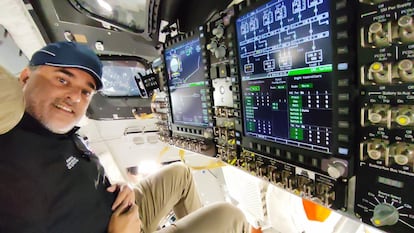

If the four astronauts on the Artemis 2 mission to the Moon encounter a problem, it’s highly likely it will end up in the inbox of physicist and aerospace engineer Eduardo García Llama, 54. The full title of this native of Spain’s eastern city of Valencia is as long as it is important: Chief Engineering Flight Controller for Guidance, Control, and Proximity and Docking Operations Systems. This means that when things go wrong on board, it’s his team of 70 people, based at NASA’s legendary Mission Control Center in Houston, Texas, who provide answers and recommendations for action, which are then carried out by the operations team. In a videoconference interview with EL PAÍS, he explains what the most critical moments will be during the first crewed mission to the Moon in more than half a century. Beyond the space race with China and the current geopolitical tensions, this will be a “historic” step forward for all of humanity, he asserts.
The four crew members of Artemis 2 will be the first people to travel aboard NASA’s most powerful rocket ever built, the Space Launch System (SLS), and the Orion spacecraft. This marks the first time that critical systems such as oxygen, water, and air purification—essential for survival during the 10-day journey to orbit the far side of the Moon and return to Earth—will have been tested. For the first time in history, all of these systems, as well as their 33 boosters, were not built by the United States, but by European companies coordinated by the European Space Agency (ESA). After a two-month delay due to technical problems, the pressure is immense, as the White House is determined to accelerate the launch to prevent China from gaining the upper hand in the new conquest of the Moon.
Question. What’s going through your mind right now?
Answer. We are so focused on mission preparation, the technical aspects, and the operations that there isn’t much time left to think about its obvious historical significance. It is the first time humans have been sent to the lunar vicinity since the Apollo program in December 1972, with Apollo 17. But our minds right now are very much focused on preparing it as best as possible and finalizing all the details. The real personal impact will come when it’s all over.
Q. What stage are they at now?
A.The launcher is currently back on the launchpad and, in principle, the 50-hour countdown to launch on the first opportunity of the launch window, which begins on Wednesday, April 1 and ends with the opportunity on April 6, will begin on Monday, March 30.
Q. Would you get on that ship?
R. Yes. After testing the Orion for 26 days on an uncrewed trip to the Moon [in 2022], on a very complex mission, everything went very well. It’s “a beautiful flying machine,” as a test pilot might say. It’s nice to hear astronauts say they would feel safe in this spacecraft. Obviously, there’s always a risk, and we all accept that, but we try to minimize it. On this mission, we tested not only the survival system but also the crew’s ability to manually maneuver the spacecraft. Those are the two most novel aspects.
Q. What will be the most critical moments?
A. Launch and atmospheric reentry. In both, the spacecraft is subjected to vibrations, thermal loads, and very large pressure differences. But in addition, there’s the fact that the spacecraft is actually sitting atop a rocket, which is essentially a controlled bomb. It’s filled with hundreds of thousands of gallons of liquid oxygen and hydrogen. And then there are the solid rocket boosters on the sides, which, once ignited, cannot be stopped until they separate after two minutes. It’s a phase where, frankly, we’re going to have our hearts in our mouths.
Q. Will there be any other tense moments?
A. Yes, on the second day of flight. At that point, there’s an engine burn and the insertion into lunar orbit occurs. Once you take that step, you’re sending the four crew members on a long-duration mission. They’re leaving Earth’s orbit and its sphere of influence. To take that step, we have to be very sure. At some point, you’ll hear: “Go for TLI” [Translunar Injection]. For me, it will be one of the most historic phrases of the mission because, although it’s a technical operational term, what it really means is: “You have permission to go to another world.” It carries a very strong human weight.
Q. Reentry is another key moment. Some experts have warned of potential safety issues with Orion’s heat shield, and NASA has decided to change the reentry angle. Is there any danger?
A. A heat shield’s safety depends on the entry path. Even the most powerful shield, if inserted into an unsuitable path, won’t withstand it. Obviously, we’ve designed the path so that the shield’s efficiency won’t pose any problems.
Q. This mission takes place in a very turbulent geopolitical context, with the United States in the midst of a war. How does this influence it?
A. Beyond the geopolitical circumstances or rivalries between countries, reminiscent of those that may have existed between Spain and Portugal 500 years ago, this is a historic moment of progress for humanity. I don’t reduce it to local spatial and temporal concerns; it is humanity progressing and venturing beyond our own world. Unlike Apollo, we intend to go there to have a permanent presence. It is an enormous step, and this will be evident in the distant future.
Q. So Donald Trump being the current president is just a historical accident?
A. I wouldn’t call it an accident, but it is certainly a circumstantial fact. During the Apollo program, there were several presidents in the Oval Office. And this will happen again now. There will be different presidents, different administrations throughout the Artemis program. Keep in mind that we are only seeing the very beginning of the program now. There are many missions ahead. The program aims to develop technologies to be self-sufficient on another world. The Moon will be a testing ground for techniques needed for a future mission to Mars. Ultimately, all these advances will find their application on Earth, and we will benefit from these progressive leaps in space.
Q. What are the chances you see of China reaching the Moon first with its taikonauts?
A. We have no idea because we have no information about what progress or setbacks China might be experiencing. To tell you the truth, it’s not something we’re thinking about. Perhaps in political circles it is, I don’t know, but I guarantee you that no one I work with has that on their mind.
Sign up for our weekly newsletter to get more English-language news coverage from EL PAÍS USA Edition









































