
Iyad Ag Ghali, the most wanted jihadist in the Sahel, is making Mali tremble
The leader of the local Al Qaeda branch is the architect of the strategic alliance between Tuareg rebels and radical Islamists threatening to overthrow the government
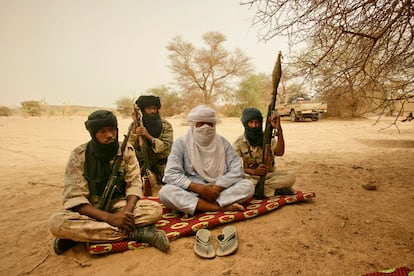

Mali is under siege by two insurgent movements, the Tuareg rebellion and the jihadist insurgency, which have joined forces with the aim of overthrowing the government. Following last weekend’s joint offensive, which cost the life of the military junta’s Minister of Defense Sadio Camara, the jihadists have imposed a blockade on the capital, Bamako, attempting to prevent the entry of goods and people via the main roads. In the north, Kidal, a perpetually contested city, has fallen into rebel hands. The architect of this alliance is none other than Iyad Ag Ghali, the leader of the Support Group for Islam and Muslims (Jama’at Nusrat al-Islam wal-Muslimin, JNIM), who has spread the jihadist threat throughout the central Sahel and whose life story could easily fill a novel.
Ag Ghali has been a fighter in Lebanon and Chad under Muammar Gaddafi, a Tuareg rebel, a lyricist and percussionist for the band Tinariwen, an advisor to the president of Mali, a hostage negotiator, a diplomat, and, after being radicalized by a group of Pakistani preachers, a jihadist leader. With a unique blend of violence and negotiation, Iyad Ag Ghali is no ordinary terrorist. He leads a powerful armed organization capable of challenging armies, governments, and Russian mercenaries, but at the same time, he understands the intricacies of politics and wields unparalleled control over tribal and communal power structures, key to the history and internal balance of his country.
“Without Iyad Ag Ghali, this alliance between Tuareg rebels and jihadists would not have existed. He knows both movements perfectly, he was involved in the rebellion of the 1990s, and currently, he is the one who directs all of JNIM’s katibas (units) because he controls the logistical resources and the financing,” says Bakary Sambé, director of the Timbuktu Institute-African Center for Peace Studies. On the Tuareg side, the path to this agreement was paved after the unification, at the end of 2024, of the different rebel factions into the Azawad Liberation Front (ALF), led by Alghabass Ag Intalla, brother of the Ifoghas’ amenokal (tribal leader), the community to which Ag Ghali himself belongs, and a former militiaman of Ansar Dine, the group Ghali created in 2012. The connection between the two is close.
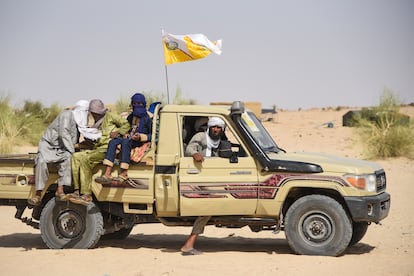
Accused of war crimes and crimes against humanity by the International Criminal Court, Ag Ghali is one of the world’s most wanted terrorists and fights his enemies with extreme violence. But unlike other African jihadists, such as the deceased Abubakar Shekau (Boko Haram) or Abu Walid al-Sahrawi (Islamic State), who were known for their bloodthirstiness, Ag Ghali is capable of presenting a more conciliatory face and promoting agreements with local communities and other armed groups wherever he operates. With one hand he wages war, and with the other he passionately dedicates himself to politics.
Born in the Kidal region in 1958, he grew up in an environment of rebellion: his own father was killed during the first Tuareg uprising of the 1960s. As a teenager, he fled to Libya to find refuge under the wing of Gaddafi, who wanted to spread his revolution throughout the Arab world. There he received military and guerrilla training and met the founders of the Tuareg musical group Tinariwen, with whom he collaborated in its early days. After leading the Tuareg rebellion of the 1990s, Ag Ghali signed a precarious peace with the government and briefly served as an advisor to the president of Mali, Alpha Oumar Konaré, until, in the mid-1990s, through contact with a group of fundamentalist preachers from Pakistan, he began to radicalize.
In 2006, the government sent him to Saudi Arabia as a diplomat, from where he was expelled in 2010 for his contacts with Al Qaeda. His return to Mali coincided with the uprisings in Libya, the seeds of a new Tuareg rebellion. Ag Ghali dreamed of unifying the two ideologies that had shaped his life and claimed command. But the younger cadres distrusted his new jihadist leanings and his close ties to Algeria and rejected him.
Ansar Dine
Hurt by his exclusion and aware that war was looming, Ag Ghali founded his own jihadist group, Ansar Dine, closely linked to Al Qaeda. In January 2012, jihadists and rebels launched an offensive and, barely three months later, occupied two-thirds of the country, although ultimately it was the radicals, better armed and more numerous, who prevailed. Only French involvement in the conflict, beginning in January 2013 with the deployment of more than 5,000 soldiers, managed to halt their advance south.
Ag Ghali then returned to the shadows and took refuge in the desert, where he twice escaped almost certain death. “His strength lies in his charisma, in the respect he has earned over the years from a population that has felt abandoned by its government. He is a jihadist, yes, but he is also someone who has always defended the Tuareg. He knows the delicate balance of power in northern Mali very well and navigates the terrain like no one else.” This is how a journalist who spent years in his company, and who prefers to remain anonymous, describes him. In 2017, after a period of internal reorganization, the veteran mujahideen reappeared as the leader of JNIM, a terrorist umbrella organization under which numerous groups operated, such as the Macina Liberation Front (central Mali) and Ansarul Islam (Burkina Faso).
Meanwhile, in Bamako, the waters were becoming turbulent. In 2020, the military staged a coup and seized power. The new authorities broke agreements with the northern separatists, expelled the French, and negotiated with Russia for the arrival of over 1,000 Wagner mercenaries as new allies in their fight against both insurgencies. The army and contractors of Yevgeny Prigozhin, the Wagner leader who died in 2023, launched a counteroffensive. While harassing the jihadists, in 2023 they achieved a symbolic victory by wresting Kidal from the Tuaregs, who had controlled the city since 2013.
But in July 2024, the tide turned against the military junta once again. The rebels launched an attack against a Russian-Malian column heading to the town of Tinzaouaten and, with the support of Ag Ghali’s men, killed more than 80 mercenaries and soldiers. This victory marked the beginning of a collaboration between Tuaregs and jihadists that has now become a strategic alliance. “This agreement between the FLA and the JNIM shows that there has never been a clear separation between the Azawad movements and the terrorist groups,” Sambé emphasizes. From his bases in the sandy north of Mali, Iyad Ag Ghali has managed to tighten the noose around the neck of the military junta, whose leader, General Assimi Goïta, feels the ground trembling beneath his feet.
Sign up for our weekly newsletter to get more English-language news coverage from EL PAÍS USA Edition









































