
Russian Africa Corps mercenaries incorporate Madagascar into their expansion across the continent
The pattern of military cooperation in exchange for resources that originated in the Central African Republic and later spread to the Sahel is growing
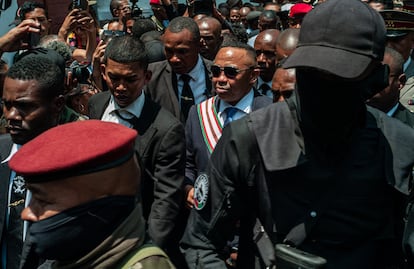

A Russian delegation of approximately 40 members, headed by General Andrei Averianov, head of the Africa Corps militia, met in late December with Madagascar’s interim president, Colonel Michael Randrianirina. During the meeting, Russia offered personal protection to the Malagasy leader, who has repeatedly stated that he feels threatened. In this way, Russian President Vladimir Putin intends to add Madagascar to the growing list of African countries under his direct influence, following the same pattern of protection and military cooperation in exchange for access to resources. This list already includes the Central African Republic (CAR), Mali, Burkina Faso, Niger, Libya, and Equatorial Guinea, among others.
During the meeting — which was confirmed by the acting president of the Malagasy parliament, Siteny Randrianasoloniaiko, via social media — Russian representatives donated weaponry, including 16 kamikaze drones, 50 pistols, and 50 Kalashnikov rifles, to the Malagasy Presidential Guard. Russia expressed “its readiness to support and assist Madagascar, especially in the area of training and strengthening the capabilities of the Armed Forces.” The delegation also confirmed that, if deemed appropriate for the national interest, this cooperation could extend to the economy.
In early December, Randrianirina secretly traveled to Dubai to negotiate various economic projects with investors. “There are people who want to assassinate me,” he later said to justify the secrecy surrounding his trip. This sense of insecurity felt by a military man who came to power after the October coup is precisely one of the gateways for Russian influence in Africa. Moscow has followed the same pattern, for example, in the Central African Republic, one of its most successful cases on the continent.
At the end of last year, amid the campaign for the December 28 presidential elections, a gigantic mural appeared in Bangui, CAR’s capital, depicting President Faustin-Archange Touadéra shaking hands with Putin, both flanked by soldiers and paramilitaries. This propaganda piece is the clearest expression of Russian influence in the country, where the first Wagner mercenaries arrived in 2018 — following the French withdrawal in 2016 — with the country mired in civil war.
The Russian militia, which protects the reelected president, Touadéra, and fights alongside the army, has played a decisive role in inflicting severe defeats on the rebels in exchange for access to Central African gold.
Russia’s other major gateway to Africa was Libya. By 2019, years after the start of the war triggered by the fall of Muammar Gaddafi in 2011, the presence of Wagner mercenaries fighting on the side of Marshal Haftar was already significant. Haftar controls important oil fields, which are used as a bargaining chip for military support. Russian influence has not been limited to the battlefield. Its backing of several political parties demonstrates the extent to which it seeks to extend its reach in Libya and the region. The Maaten al-Sarra military base is one of the nerve centers of this military presence, from where Moscow also plays the card of interference in neighboring Sudan and Chad.
The Central African model was exported to Mali after a 2020 coup by the country’s military. The sequence of events was similar: expulsion of French troops, arrival of Russian mercenaries fighting alongside the army against armed groups — in this case, jihadists and Tuareg rebels — and the commission of massacres and all manner of abuses against the civilian population living in the conflict zone. In Mali, however, Wagner’s record has been mixed: while its participation was key in the recapture of the city of Kidal from the rebels, it has also suffered severe defeats, such as Tinzawaten in 2024.
In Mali, and later in Burkina Faso and Niger, demonstrations of support for the military regimes that seized power were adorned with Russian flags, a tangible example of the virtual campaigns launched by Moscow to pave the way for its troops. However, while General Assimi Goïta’s regime in Bamako opened its doors wide to Wagner, his counterparts Ibrahim Traoré and Abdourahamane Tchiani, in Ouagadougou and Niamey respectively, opted for a more discreet approach, deploying dozens of Russian instructors and soldiers to protect and train their army, but leaving the on-the-ground deployment to volunteers and national forces.
I support Obiang
General Averianov’s trip to Madagascar was not his only visit to Africa in recent weeks. Last November, the head of Africa Corps — the new mercenary group created after the death of Wagner Group leader Yevgeny Prigozhin — traveled to Equatorial Guinea, where his men have been operating since August 2024 in both Malabo and Bata, supporting the dictatorial regime of Teodoro Obiang.
“Equatorial Guinea and the Russian Federation have signed mutually beneficial agreements in the area of training Equatorial Guinean military personnel by Russian instructors. Furthermore, within this policy of understanding, there is a strong interest in Russian investments in the energy and cybersecurity sectors, as well as the possibility of a joint space mission,” the Equatorial Guinean government states on its website. The African country’s oil and gas are also on the negotiating table.
For Russia, it’s about resources, but also about breaking the political and economic isolation that the West has sought to impose since the 2014 annexation of Crimea, an isolation that intensified following the war in Ukraine. For African military or dictatorial regimes that are severing ties with Europe, such as those in the Sahel, military cooperation with Moscow is a very viable alternative. But they are not alone. The Africa-Russia summits in Sochi in 2019 and St. Petersburg in 2023 saw virtually all African leaders eager to forge new ties with Moscow in attendance. A third of the weapons Africa buys come from Russia, according to the Stockholm International Peace Research Institute, with Egypt and Algeria being the main destinations, but also Angola, Mali, Nigeria, and Sudan.
Sign up for our weekly newsletter to get more English-language news coverage from EL PAÍS USA Edition









































