
The Guinean Obama who plasters Madrid with posters in a bid to become president
Mariano José Nsué Obama, the son of a former minister of agriculture, wants to rule Equatorial Guinea and change the country’s name to the Republic of San Rafael Nsué Nchama
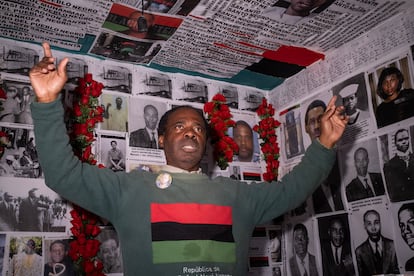
Former U.S. president Barack Obama had just turned three when another Obama, Mariano José Nsué Obama, was born in Equatorial Guinea 61 years ago. However, their political careers could not be more different. The year the former became leader of the Democratic Party, the latter arrived in Spain with nothing to his name. And when, in 2009, Barack Obama became president of the United States and gathered the masses in front of the Capitol, the latter held one of his most well-attended rallies in the center of Madrid... in front of eight people.
Barack Obama has now been out of power for eight years since leaving the White House, but his namesake is still not throwing in the towel. In fact, he has spent his entire life embroiled in a never-ending election campaign from which there is no respite. Although his rallies are sparsely attended, his face is widely known to anyone walking through downtown Madrid thanks to the dozens of posters he puts up himself. That is his daily routine.
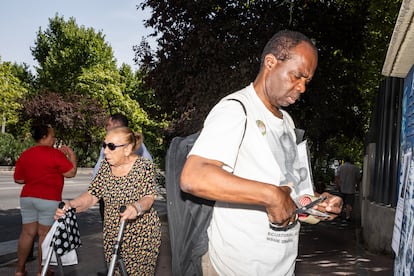
Every morning, Mariano José Nsué Obama takes to the streets and walks for hours through the Spanish capital with a roll of tape, a stack of sheets of paper under his arm with his face printed on them, and a backpack containing a biography of Simón Bolívar. Come rain or shine, he walks the streets without missing a single lamppost, light box, construction fence, or wall on a vacant lot...
The Guinean Obama walks tirelessly and wears out a pair of shoes every month running for president among those who cannot even vote for him. “It’s a calling I have inside me. I could have lived my life, but I haven’t because something inside me drives me, which I can’t avoid. Most Guineans ignore me and politics because they are only interested in putting bread on the table and living their lives,“ he says. ”Under the name of the Republic of San Rafael Nsué Nchama [because the first thing he wants to do is change the name of the country], I will be the third president of Equatorial Guinea,” he insists, as his only political ideology.
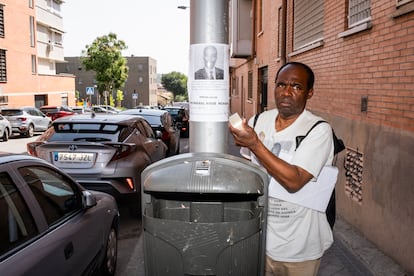
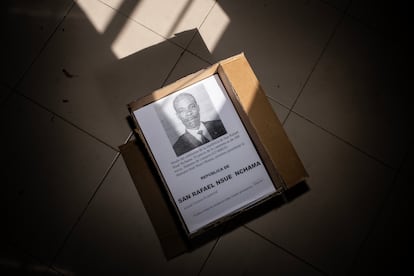
In recent years, from the Madrid neighborhoods of Usera and Gran Vía, to La Latina and Malasaña and from Tribunal to Conde Duque, his enigmatic face has appeared plastered everywhere. “Long live San Rafael Nsué Nchama! Long live San Nelson Mandela! Long live Africa! Long live!” read the A4 posters which include a photo of him in a suit and tie from his younger days. He claims to embody the essence of his father, Rafael Nsué Nchama, a former minister of agriculture who was shot after the coup led by Teodoro Obiang, who has ruled the country with an iron fist since 1979. “He was killed for fighting for the emancipation of Black people,” he says.
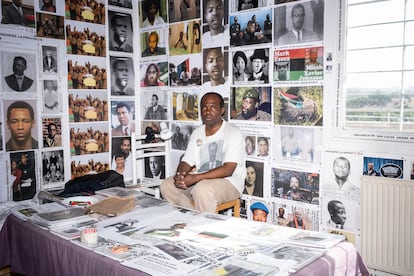
Since then, Nsué Obama has led the party he founded, hoping to reach power after a 30-year campaign whose biggest rally could fit around the table where the interview is taking place. Why so much effort? “Because it is my destiny and I have the ability to convince people,” he insists in a café in downtown Madrid during a break from his eternal campaign. Currently, the Guinean Obama earns about €700 ($800) a month, which he uses to pay for a room that is also his party headquarters, a temple papered from top to bottom with the faces of “Black saints” such as Malcolm X and Martin Luther King.
Nsué Obama hasn’t held any public events for several months, but the one he staged last year on San Bernardo Street left passersby speechless. It was a Friday in September, and 20 young people who had just left school were there when he climbed onto a bench and started shouting “Obama, Obama, Obama...” Those passing by didn’t know whether to call the police or give him a euro for his campaign. But for him, “it was one of the happiest days.”
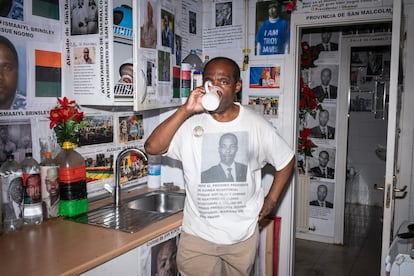
However, it hasn’t always been like that. For many years, Mariano José Nsué Obama slept on the streets and lived off handouts. But he spent everything he got from charity on organizing rallies, paying for photocopies, and buying second-hand biographies of illustrious liberators such as Bolívar, Julius Caesar, and Churchill. However, no one attended the rallies he organized every month in a park, so with the money he had left, he sought out drug addicts and beggars on the street and “gave them €20 [$23] to attend,” he says without blushing.
The fact is that one day the strategy got out of hand. It was 12 years ago in Torrejón de Ardoz, to the east of Madrid, when he managed to gather 200 people, whom he promised €50 [$57] for attending his speech. Retirees, students, unemployed people, immigrants, and drug addicts all turned up one day in May 2013. But when Nsué Obama arrived and saw such a large crowd, he backed down. “Friends, you’ll have to forgive me, but... What is €50 when I’m offering you a future in my country?” he told them. Of course, they almost beat him up.
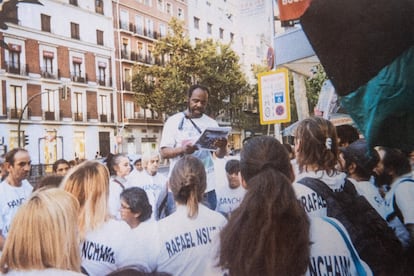
On the last Friday in September, he was more resourceful and positioned himself in front of the Lope de Vega Institute on San Bernardo Street. A group of young people gathered for reasons unknown. The fact is that Obama appeared for five minutes, and delivered a 35-second political speech.
The 81-year-old dictator Teodoro Obiang Ngema has been at the helm of Equatorial Guinea for 45 years, following the 1979 coup d’état in which Francisco Macías was overthrown and shot. To bring about the dictator’s downfall, Obama is working hard at rallies, putting up posters, giving interviews, and delivering monologues on YouTube, where he really lets loose. When he summarizes his political ideology, he says it centers on the number three: “The day Malcolm X was assassinated, my mother was three months pregnant with me. My godfather [Francisco Macías Nguema] became the first president of Equatorial Guinea three years after my birth. I was born on a Wednesday, the third day of the week. I am my father’s third son with his third wife. And the day Martin Luther King was killed, I had been alive for three years,” and there he stops.
Nsué Obama does not want to give out much information about his current whereabouts to avoid the repression that Obiang exercises over any kind of opposition, whether in Africa or in Spain, where he is accused of orchestrating numerous secret detentions and kidnappings. “If I keep working hard, one day I will become president of Equatorial Guinea,” he says with conviction. “Or not,” he adds, “but the experience will have been worth it.”
Sign up for our weekly newsletter to get more English-language news coverage from EL PAÍS USA Edition









































