
Africa’s presidents for life
The heads of state of Cameroon and Uganda, who have been in power for 43 and 39 years respectively, have announced their candidacies for reelection
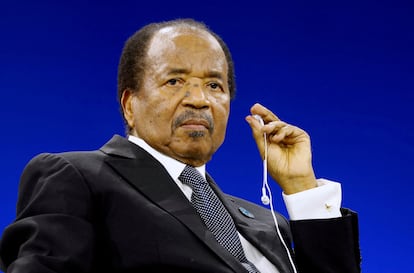

On July 13, 92-year-old Cameroonian President Paul Biya announced on social media that he would be a candidate in next October’s elections. After nearly 43 years of uninterrupted power, Biya has become a true champion of political longevity, surpassed in Africa (by just one month) only by Equatorial Guinea’s Teodoro Obiang. But they are not alone. In Uganda, Yoweri Museveni, head of state since 1986, is also preparing to run for his sixth re-election in January, while Ivorian President Alassane Ouattara has announced that he will seek his fourth term, after removing the constitutional limit that prevented him from doing so. Presidents for life flourish in Africa.
Some thought Biya was on the verge of retirement. The nonagenarian Cameroonian president spends almost all his time locked away in his residence in his birthplace Mvomeka’a — almost 100 miles from the capital, Yaoundé, but with a small airport nearby — and chooses his rare public appearances carefully. Sometimes he falls off the radar for months at a time, almost always for health reasons that require him to travel to Europe, but his silence is complete, and rumors are rife.
A year ago, he was considered dead. His lieutenants and party members were already sharpening their knives in a hypothetical race for succession, but Biya stopped them in their tracks with a new candidacy.
Let us remain faithful to our ideal of unity and look ahead with confidence.#Biya2025#PaulBiya#Cameroon pic.twitter.com/EQLl3UNWkX
— President Paul BIYA (@PR_Paul_BIYA) August 6, 2025
Doubts loom over his real ability not only to campaign, but also to lead a country. All eyes are on his entourage, who truly pulls the strings. There’s Samuel Mvondo, chief of staff; Jean Nkuete, coordinator of the governing party; and Ferdinand Ngoh, secretary to the presidency. But above all, there’s Chantal Biya, 56, the president’s second wife. She wields considerable influence over her husband and has become increasingly prominent as his physical and mental decline worsens.
The four of them will coordinate the campaign for the elections scheduled for October 12, from which Maurice Kamto, the main opposition leader, has been excluded by a court decision.
But the inexorable passage of time, which not even Biya can escape, is accelerating the fractures. Two of his main allies in the north of the country, former ministers Issa Tchiroma Bakary and Bello Bouba Maïgari, have now decided to fight him at the polls, as has a member of his own party. They have little hope of winning, but the monolithic power built by Biya is cracking, and the military is already looking for someone who will step forward to succeed him at some point.
“Paul Biya’s new candidacy only further increases the possibility of a scenario that has been foreseeable for years: an unconstitutional succession at the end of his presidency, whenever that may be,” says Gilles Yabi, director of the Wathi think tank.
Neutralized rivals
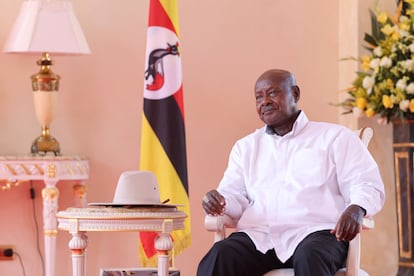
In Uganda, 80-year-old Yoweri Museveni appears to be following the same pattern. After overthrowing dictators Idi Amin, Milton Obote, and Tito Okello and seizing power in 1986, he has won election after election in which he has deployed the entire state apparatus to eliminate his most serious competitors from the presidential race, as happened with opposition leader Bobi Wine in the last election. The day after unveiling his candidacy, the popular singer and opposition leader who embodies hopes for change in Uganda was arrested for allegedly violating Covid-19 health regulations, which prevented him from campaigning. Following violent demonstrations with dozens of deaths, two days before the elections, the government shut down the internet.
Ahead of 2026, everything is set again: Museveni has re-applied for another term, and Wine refuses to back down, even though he knows what potentially awaits him: “I’ll be a candidate if I’m still alive and not in prison,” he said recently.
“It’s not something that’s part of African political culture, but rather part of undemocratic culture around the world. It also happens in North Korea or Russia. These are politicians who believe themselves above the law, who have a savior complex. They come to believe that if they’re not there, the country will collapse,” says Ivorian Dagauh Komenan, a doctor in contemporary history and specialist in international relations. “They organize elections because they know that without them, they lack international legitimacy, but they take it upon themselves to neutralize their rivals through imprisonment, repression, or the use of the justice system. We’re facing very presidentialist regimes, where countervailing powers are weak or can be manipulated. It’s a structural flaw in African political systems. When someone becomes president, it depends on their goodwill whether they respect the rules or violate them.”
Regardless of how they come to power, many of these presidents who remain in office for decades repeat the same pattern: they maintain a façade of free elections, but repress opponents who can actually challenge them, to the point that many end up in jail. Others dedicate themselves to recruiting these potential rivals and winning them over to their cause in exchange for positions or favors. With control of the public media and the ability to stifle their rivals, the gubernatorial candidate’s campaigns, in which money, power, or influence are distributed as a way to win votes, draw crowds, and the elections are usually triumphant parades.
On July 29, it was the turn of Alassane Ouattara, 83, president of the Ivory Coast. “I am a candidate because our country is facing unprecedented economic, monetary, and security challenges, the management of which requires experience,” he said in his address to the nation. In power since 2010, he is seeking a fourth term in a country whose Constitution provides for a two-term limit. To overcome this obstacle, he implemented a reform of the Constitution in 2020, resetting the counter, as did Alpha Condé in Guinea and Abdoulaye Wade in Senegal. The elections will be held on October 25.
Although there have been recent healthy alternations, such as in Ghana and Senegal, the attempt by rulers to remain in office well beyond what is legal or reasonable is a growing trend that is taking on new guises. The military leaders who have seized power in the last five years in countries such as Guinea-Conakry, Mali, Burkina Faso, and Niger have taken over the presidential palaces and stayed there. Not only have they extended the transition period they promised, but most have also hinted that they will be candidates in a future electoral process, as has happened in Gabon. “There is little hope that military leaders in power will be democrats. The usual thing is for them to remain as long as they want or be overthrown by another coup d’état,” Komenan notes.
Sign up for our weekly newsletter to get more English-language news coverage from EL PAÍS USA Edition









































