
NASA scientists find possible traces of life on Mars
A study analyzes biosignatures in samples that would need to be brought back to Earth for confirmation, a mission Donald Trump wants to cancel
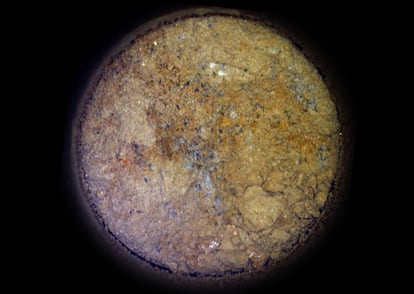

Scientists from the U.S. space agency NASA announced Wednesday the discovery of chemical and geological traces on the surface of Mars that could indicate the presence of life, although they acknowledge that they cannot confirm this until these samples are returned to Earth on a future mission as yet undated.
The discovery was made by the Perseverance rover in Jezero Crater, where a large lake and river system existed billions of years ago. During its exploration of the Neretva Valley, the vehicle examined outcrops of the Bright Angel Formation, composed of clayey rocks and conglomerates formed by sediments deposited by water.
Scientists have identified organic matter — carbon — in several samples, especially in the objectives the team named Chevaya Falls, Temple of Apollo, and Walhalla Glades. This organic matter could have reacted with minerals present in the rocks, giving rise to some “striking” nodule-shaped and greenish leopard-skin-like patches that NASA had previously highlighted as interesting samples in the search for past life.
Perseverance has collected a sample of these rocks — called Sapphire Canyon — which it has placed in a sealed capsule that will be left on the surface of the crater until the arrival of a new robotic mission that can collect it and bring it back to Earth for more detailed analysis.
The chances that this discovery is due to the presence of life, scientists argue, are slightly higher than the likelihood it was caused by an inert chemical phenomenon. But for now, it is impossible to rule out either hypothesis, researchers from NASA acknowledge in a study published Wednesday in the journal Nature. Analysis in terrestrial laboratories would make it possible to determine precisely whether the minerals and organic matter found are indeed signs of past life.
“The discovery of a possible biosignature on Mars [geochemical signs of a possible biological origin] has profound implications for the search for Martian life, but it also requires caution and a great deal of additional research before we can affirm that life has existed on the planet at some point,” Alberto González Fairén, co-author of the study, explains to this newspaper. “It is imperative to continue the sample return program to Earth, where these samples can be analyzed and characterized with much more comprehensive and advanced instruments than those available on Mars.”
The discovery’s publication will also be presented at a press conference Wednesday with acting NASA Administrator Sean Duffy, the agency’s chief scientist, Nicola Fox, and other researchers responsible for the discovery.
According to the researchers, the nodules and spots known as reaction fronts — where biochemical processes would take place — could have been formed by biological processes similar to those that generate vivianite and iron sulfides on Earth from microorganisms that consume iron and sulfate. Non-biological chemical processes could explain the formation of these minerals, although they are less likely given the conditions observed in the Martian crater.
The environment where these rocks formed was watery and relatively mild, which would have allowed chemical reactions to occur and organic matter to be preserved.
“We suggest that further in situ laboratory investigations, modeling, and terrestrial analog studies, focusing on both abiotic and biological processes that give rise to the array of mineral and organic phases observed in the Bright Angel Formation, will improve our understanding of the conditions under which they formed,” write the paper’s authors, including Spaniards Alberto González Fairén and Felipe Gómez. “Ultimately, returning samples from Mars for study on Earth, including the Sapphire Canyon sample, would offer the best opportunity to understand the processes that gave rise to the unique features described,” they add.
Since landing on Mars in 2021, Perseverance has explored the diverse landscapes of Jezero Crater in search of sediments and rocks that could prove whether Mars once hosted life. It has accumulated 30 samples, depositing them on the surface, and still has six more containers reserved for new materials.
The big question is whether the United States will be able to retrieve these samples before its greatest rival in space, China, beats it to it. The Mars Sample Return mission, planned for years and on which billions of dollars have already been spent, was scheduled for sometime in the next decade, and would have the collaboration of the European Space Agency. Donald Trump’s arrival in power has disrupted the already shaky plans: the U.S. president wants to cut NASA’s scientific missions by half and cancel the sample collection mission. According to several external analyses, this mission cannot be carried out before 2040, which would mean arriving after China, which plans to launch its robotic round-trip mission to the Red Planet between 2028 and 2030. To avoid being left behind, the United States would have to clarify its plans and launch them before the end of next year, and even then, it might not win the race.
Ricardo Amils, a researcher at the Center for Astrobiology in Madrid (CAB), believes that the publication and press conference on these findings have a dual scientific and political purpose. These new data were eagerly awaited, he acknowledges. “They have found samples whose chemical and mineralogical analysis using Perseverance’s methodologies suggests that they are products of biological activity, what are known as biosignatures, mainly because there are indications that they formed under temperature conditions compatible with life as we know it.”
But to confirm this, the material must be brought back to Earth, which is a clear maneuver to “soften Trump,” explains Amils, and resurrect the Mars Sample Return (MSR) mission. This same year, hidden in his big, beautiful bill, Trump had to make significant concessions to keep some NASA missions alive, including one related to MSR.
Antonio Molina, a planetary geologist at the CAB, makes a key observation: “They have found traces that living beings could have left behind, but not direct evidence of them.” This means that even if they reach Earth one day, these samples would not be enough to claim the discovery of life on Mars. The researcher analyzes an important detail of the study. “Above all, they talk about the mineral called vivianite, whose abiotic formation is not entirely compatible with what we know about the area, as it requires hydrothermal activity, which did not exist in this part of Mars. I think these are the possible biosignatures of this type with the greatest potential that have been found. It is worth considering whether, if there was life on Mars, it was so long ago that the most unequivocal biomolecules, such as nucleic acids or lipid markers, have already degraded, and this is the only remaining clue to its existence. Or perhaps it is necessary to search beneath the surface where markers like those raised in this study may be better preserved and provide more unequivocal evidence,” he explains.
Sign up for our weekly newsletter to get more English-language news coverage from EL PAÍS USA Edition









































