
The Trump paradox: Boasting about the Artemis mission while demanding deep cuts to NASA’s budget
The White House is trying to cut investment in science, including 23% in funding for the space agency, which would have to cancel 40 missions


It may seem like a contradiction, but perhaps it isn’t. Just four days apart, the president of the United States has claimed credit for the success of the first manned mission to the Moon in over half a century and sent Congress a budget proposal requesting, for the second year in a row, cuts to science funding unprecedented since World War II. In Trump’s mind, shrinking the government to the bare minimum is not incompatible with boasting about its achievements.
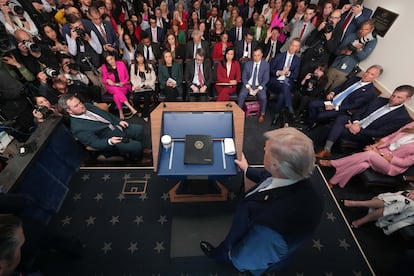
“You know, I had a decision to make in my first term, and the decision is: What are we going to do at Nasa? Are we going to have it be revived, or are we going to close it down?” Trump told the four astronauts of the Artemis 2 mission this week. They had just successfully completed their major milestones and were already on their way home. “And I had very little hesitation. We’ve spent what we had to do,” the president asserted as Commander Reid Wiseman, pilot Victor Glover, and mission specialists Christina Koch and Jeremy Hansen listened in silence, having been the first to view entire sections of the far side of the Moon for the first time and becoming the humans to have traveled farthest in space. Trump defended his decision to return to the Moon with the Artemis program, linking it to the creation of the U.S. Space Force, which he called his “baby.”
The first time humanity orbited the Moon was in 1968, with the Apollo 8 mission. The feat occurred during the deadliest year of the Vietnam War for the U.S., with more than 16,000 American soldiers killed. Half a century later, the country is once again embroiled in a war against Iran, alongside its regional ally Israel. The question is whether a return to the Moon can shift the world’s attention and inspire a message of universal reconciliation, as NASA hopes.
After arriving at the White House for the first time in 2017, Trump seized upon the return to the Moon as a political banner to wave as part of his victory over the Democrats. His predecessor, Barack Obama, had fought for precisely the opposite: not to return to the Moon — “we’ve already been there,” he said — but instead to land on an asteroid to learn how to save Earth from a potential catastrophic impact. It was in this way that the Artemis program, a revamped version of older lunar plans from previous administrations, took on name, form, and enjoyed a growing budget.

Trump wanted to land astronauts on the Moon in 2024, but the date has been pushed back to 2028. According to his current plans, that year, the last productive year of his second term, will see up to two astronaut landings on the lunar surface. This will mark the beginning of the colonization of the Moon, where Trump wants permanent bases by 2032, including a nuclear fission plant whose uranium would arrive by cargo ships from Earth. All of this is aimed at beating China, which plans to reach the Moon with its astronauts before 2030. “We will never be second,” Trump repeats time and again.
The White House’s proposed 2027 budget includes $8.5 billion for the Artemis program. The project provides all the necessary funding for lunar landers, spacesuits, lunar surface systems, and transportation to take astronauts to the Moon “safely” and “cost-effectively” to “increase America’s presence on the Moon,” the document states. The project includes objectives of uncertain significance, such as “eliminating unnecessary requirements and simplifying complex operational procedures to take a much more direct path” to the Moon.
A new $175 million package is also being created for robotic missions to support the establishment of the first lunar colonies. These bases “will establish U.S. dominance on the Moon, enable more intensive exploitation of lunar resources by NASA and U.S. companies, and serve as a testing ground for technologies” that will be used to travel to Mars.
The big unknown in this whole plan concerns American companies, specifically two: Elon Musk’s SpaceX and Jeff Bezos’s Blue Origin. Both are vying to be NASA’s preferred contractors to develop the future lunar landers that the U.S. space agency needs to reclaim the Moon. This Tuesday, NASA Administrator Jared Isaacman said that the next mission, Artemis 3, which is supposed to test the docking of the Orion spacecraft with these landers next year, is still on track. But he didn’t provide any further details. And both SpaceX and Blue Origin still seem far from achieving their goal, judging by their latest tests. During that press conference, a journalist asked Isaacman about the savage cuts to NASA being pursued by the Trump administration. The event’s moderator quickly withdrew the question, because they weren’t there to talk about anything other than Artemis 2.
For the second year in a row, the Trump administration wants to slash NASA’s budget. This time, they’re seeking a 23% cut to the agency’s total budget. Artemis is spared, but $3.4 billion is being cut from the agency’s science budget, reducing it by half, and more than 40 “low-priority” missions are being canceled.
The U.S. Congress rejected a nearly identical proposal earlier this year, which would have fully funded NASA’s science program, including Earth sciences. As with last year’s proposal, Trump’s science policy has been met with protests from major lobbying groups. “This proposal resurrects an existential threat to America’s leadership in science and space exploration,” said The Planetary Society, a non-governmental organization founded in 1980 by scientist and science communicator Carl Sagan, in a statement. The organization has called on all members of Congress to reject Trump’s new cuts and has launched a fundraising campaign to “save science” at NASA. The agency has lost one in five employees since Trump took office and implemented the cuts promoted by Musk’s 2025 plan at the helm of the Department of Government Efficiency.
Trump’s plan seeks cuts to federal agencies that fund or conduct research on health, space, and the environment. Some of the steepest reductions would be made to the National Science Foundation (NSF) and the Environmental Protection Agency (EPA): their budgets would fall by more than 50% by 2027 compared to current levels. The budget of the National Institutes of Health, the world’s largest biomedical research organization, would be reduced by 13%.
By contrast, the budget increases defense spending by 40%, while spending on civilian programs falls by 10%.
Ultimately, it is Congress, not the president, that decides how the federal budget is spent. Congress rejected the administration’s requests for deep cuts in 2026, restoring funding to many of the programs the White House sought to eliminate. Trump’s proposal is a starting point for congressional negotiations, which could extend into the beginning of fiscal year 2027 on October 1.
Sign up for our weekly newsletter to get more English-language news coverage from EL PAÍS USA Edition









































