
U.S. astronaut Christina Koch wins Princess of Asturias Award for Concord
The prestigious Spanish prize goes to the ‘first woman to travel to the Moon, holder of numerous records, honored for her role in space exploration,’ including the Artemis 2 mission
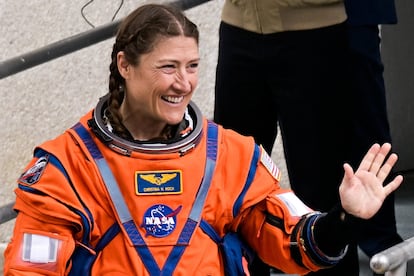
Christina Koch, the first woman to travel to the Moon, has been awarded the 2026 Princess of Asturias Award for Concord. The jury of the prestigious Spanish prize announced its decision on Wednesday, citing the U.S. astronaut’s scientific career and work in space exploration. Koch, one of the four crew members of Artemis 2, the first crewed mission to the Moon in over half a century. Koch holds the longest continuous female record for time spent in space.
In an interview with this newspaper, she emphasized how important it is to share the milestones of human exploration. “They serve as inspiration to people who may have to face their own challenges,” she said.
Inaugurated in 1981, the eight-category awards — which are tied to the Spanish royal family and named after the heir to the throne — have grown in international scope, and its awards ceremony has been attended by winners ranging from writer Paul Auster to actress Meryl Streep to former European Central Bank chief Mario Draghi. This year’s winners include the musician Patti Smith and the soccer star Leo Messi.
A historic mission
Artemis 2 marked humanity’s return to the Moon after the 1972 mission. The mission flew over the satellite and allowed the Orion spacecraft’s systems to be tested under real flight conditions. Koch was the mission’s most visible face, but the crew also included the first Black astronaut and the first Canadian one, symbolizing a shift in space exploration toward more inclusive and representative missions in the future. The 47-year-old Koch described the Moon then as “a silent witness to human history,” a symbol shared by all cultures and generations.
Trained as an electrical engineer and awarded an honorary doctorate by the NC State University, she began her career at Goddard Space Flight Center, where she worked on instrument development for high-profile scientific missions. She later continued her work at the Johns Hopkins Applied Physics Laboratory, contributing to projects such as Juno and the Van Allen probes, establishing herself as a specialist in instrumentation for space science.
Before becoming an astronaut she accumulated years of experience on scientific missions in some of the planet’s most inhospitable places, including Greenland, Alaska and Antarctica, where she spent an entire polar winter. She joined NASA in 2013 and her career has grown steadily since. Between 2019 and 2020 she spent 328 consecutive days on the International Space Station (ISS) and set the world record for the longest continuous stay in orbit by a woman. During that mission she and Jessica Meir also carried out the first all-female spacewalk, a seven-hour operation to replace a faulty power unit.
Sign up for our weekly newsletter to get more English-language news coverage from EL PAÍS USA Edition









































