
Sean Hepburn Ferrer, son of Audrey Hepburn: ‘My mother gave her life for the dream of an inclusive society… and it is being dismantled’
The actress’s eldest son and the guardian of her legacy has released a definitive biography of his mother’s life. It recounts painful episodes, ranging from her father’s abandonment, to her second husband’s infidelities: ‘If Hepburn, a symbol of beauty, kindness, humility and love, could be cheated on, then no one is safe’

The words that Sean Hepburn Ferrer, 65, repeats to anyone who will listen actually make a lot of sense. So much so that he has now put them down on paper: “[My mother] never made me feel like the son of a movie star.”
His mother was none other than Audrey Hepburn, the star of Hollywood’s golden age. She was a style icon, a beloved princess of cinema and the queen of popular culture. But the actress’s eldest son, who was born in Lucerne, Switzerland, is far removed from the glitz and glamor of the film industry. And yet, during his long video call with EL PAÍS, from the attic of his home in Florence, Italy, Ferrer reminisces and savors a bit of the life that he lived in proximity to the world of cinema, from the streets to his favorite restaurants in Los Angeles. “[Like] that Thai place crossing Cahuenga [Boulevard],” he sighs. The son of the Oscar-winning actress and Mel Ferrer, an actor and director, spent 25 years in the Californian city, managing his mother’s legacy and working as a screenwriter and script supervisor. He now lives in Italy, with no intention of returning to a country that he currently despises politically. He says his beloved mother wouldn’t like it either — not in the slightest. “She’d say, ‘Enough, I’ve seen enough.’ It’s unacceptable.”
Hepburn Ferrer is the author of what could be considered the definitive account of the actress’s life, titled Intimate Audrey: An Authorized Biography (2026). He assures EL PAÍS that it will be the last book he writes about her. Shortly after the actress died on January 20, 1993, he jotted down some 30 pages of fresh memories about her, which eventually became Audrey Hepburn, An Elegant Spirit: A Son Remembers (2003), one of his best-selling biographies, with up to two million copies sold worldwide. Since then, his agent has been asked for more material at every book fair, which he has released over the years. Just before the pandemic, he says, he even wrote a children’s book: Little Audrey’s Daydream (2020). But his latest publication is the grand finale: there will be no more. He has told everything there is to tell, including stories about her illness and death, or about the painful infidelities that her mother’s second husband, Andrea Dotti, put her through. He believes that it’s enough.
The writer and screenwriter recounts, chronologically — along with fellow writer Wendy Holden, a former war correspondent, whom he describes as his “filter, like a liver” — the life of his mother, as ordinary as it was extraordinary. A European girl, she was the daughter of divorced parents, with a cold mother and a father who abandoned her. She was nearly starved to death by World War II. She pursued a failed ballet career that first led her to become a chorus girl… and then one of the world’s greatest actresses. She was a woman with whom many could identify. “The girl next door who goes out into the world in a little black dress,” her son says with a smile. Her love life — from her British fiancé to her first husband, Mel Ferrer, as well as her second, painful marriage to Dotti and the relationship with her last partner, Rob Wolders — is recounted in the book, as are her numerous miscarriages and her unending desire to be a mother.
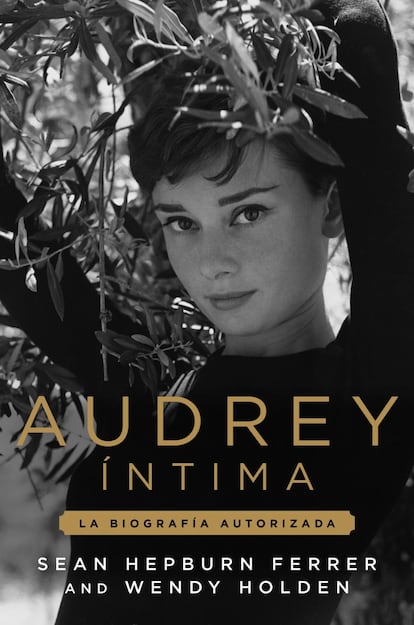
These are also sensitive topics for Hepburn Ferrer, which aren’t easy to put into words. “If Hepburn — who’s a symbol of beauty, kindness, humility and love — could be cheated on, then no one is safe,” he reflects. “And that’s where you have to take responsibility: you have to make choices not only with your eyes, not only with your heart, not only with your stomach, but with your head. [You have to] grow internally to attract the right person. Because until those antennas are sending out the right signal, you’re not going to find the person who will be good for you,” he affirms, in perfect Spanish. For him, it was important to address these issues in the book, in order to “bring her down to earth, to humanize her.”
“That’s really how she was,” he emphasizes. “It wasn’t a constructed persona. Behind it all was a woman who had to go through everything that we all go through.”
He doesn’t want to “get into the sordid or absurd details — because there aren’t any — but rather to describe the essence [of the person].” That’s why he particularly focuses on what he calls “the third act of her life, her humanitarian work,” which deeply moved the star of Sabrina (1954) and made her a pioneer in the use of fame to draw attention to humanitarian crises. She would stand in a refugee camp in Somalia surrounded by 30,000 starving children, eschewing private flights and five-star hotels. She would pay for her own plane tickets, seeking to experience life alongside the other aid workers. She might have seemed fragile, but there was a lot of strength in her. “You don’t become that kind of symbol, icon, legend, without having cojones.” Hepburn Ferrer pauses to apologize for the word before continuing. “She had the strength to protect that fragility… to keep it alive, like a little bird in her hand. But her hand, the one that held it, was strong.”
According to him, the star decided to leave her humanitarian work “for health reasons, at the peak of her success, at the height of her powers, like an opera.”
“Great humanitarian tragedies aren’t earthquakes, tsunamis, or pandemics: they’re the horrors that people inflict on one another,” he explains, referring to the causes his mother championed as a UNICEF ambassador, traveling everywhere from Ecuador to Somalia.
In writing the book, he wants to emphasize that Audrey Hepburn left behind a legacy in film, but also in humanitarianism: today, he points out, no self-respecting celebrity fails to contribute to a cause. “She’s a real woman,” he says of his mother, unintentionally using the present tense. “She had a real life. She had hardships, she had pain, she had great joy… and she left this incredible legacy that still survives; [it’s] so powerful.”

The legacy is also physical. The Hepburns have preserved thousands of objects, which they take around the world in a large exhibition (which is currently touring China). They also decided to hold a major auction a decade ago, with 500 lots of Audrey’s belongings. It wasn’t about money; in fact, they raised $5.3 million on the first day… a high figure, but not that impressive. “Compared to Elizabeth Taylor’s [possessions] — which fetched over $100 million — I think we made six, seven [million], or something like that, but it was the auction with the highest [number of bidders] in Christie’s history,” he recounts. “There were a lot of things stored in dark, air-conditioned [rooms] in the desert. And that [didn’t] make any sense,” he acknowledges. “The dream of that auction wasn’t to sell things of great value; rather, it was so that a little girl who loved her could buy one of her silk flowers and put it in her hair. That was the spirit [of the event].”
Even so, naturally, he still keeps “many things” that belonged to his mother: photos, letters, papers. Hepburn didn’t keep diaries, but she still left behind a wealth of material. “When we’re setting up an exhibition and we open a box that contained one of her dresses, it’s like you’re struck by Audrey. And it’s 50 years old now, but that scent is still there. At that moment, I don’t know which era I’m in,” he recalls, with a wry smile. He remains “the guardian of that legacy, of that work.” Through the books he’s written, he’s tried to give back, in part, some of these memories to the very public that created Hepburn’s iconic image.
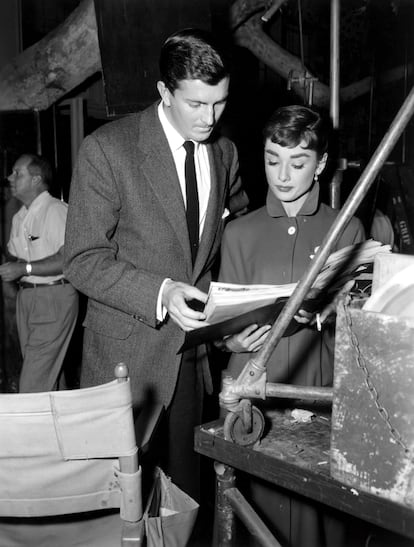
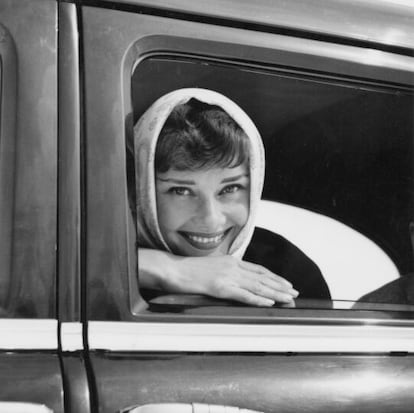
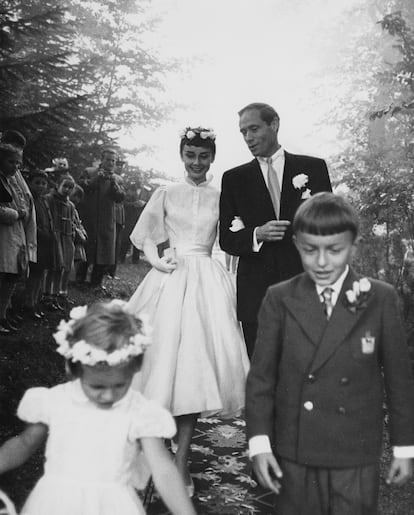
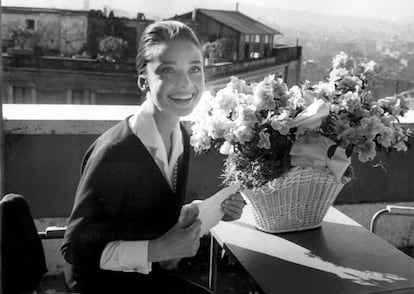
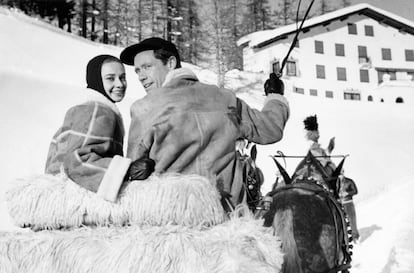
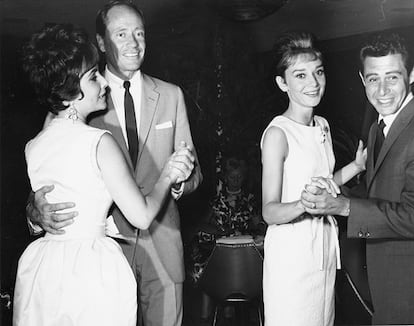
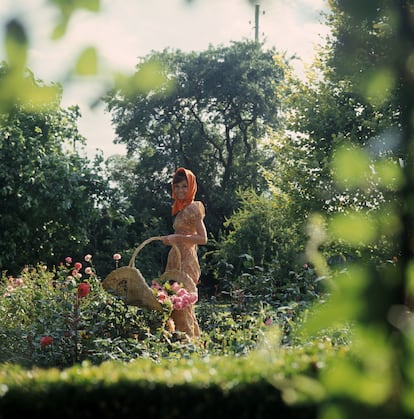
But what Hepburn Ferrer treasures most are their moments together. He acknowledges that, during his mother’s final days, they would chat together in her bed, “sitting in the dark, talking about everything and nothing.” That’s something he’ll carry with him until the end. There, she was Audrey Hepburn, but above all, she was his mother. He’s especially grateful to her for three things: not raising him and his brother, Luca Dotti, in the Hollywood environment; allowing them to grow up in “a house without ideologies”; and being a full-time mother, something that was, after all, the actress’s passion.
Incidentally, his brother hasn’t yet read Intimate Audrey. They work on her legacy daily, communicating by email. He says that they have a cordial relationship. “Obviously, it’s going to be difficult for him to reread and relive everything related to his father. It’s going to be hard. I don’t think he’s going to send me flowers for that. But I also speak very directly and very truthfully about my own father,” Hepburn Ferrer notes.
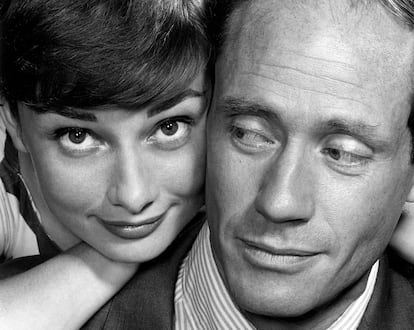
“People sometimes ask me, ‘What was it like being the son of a superstar?’ I love the question because I love the answer: I have no idea,” he says, amused. For him, she was the woman who picked him up from school, welcomed his friends and helped him do his homework. “We’d walk or take a taxi downtown to buy socks and books. She’d get up with her hair flattened to make me breakfast. She’d bake me cakes for my birthdays. And that’s it,” he admits. It wasn’t until he was 14 that he discovered all her films and, with a screen and a projector, watched them all in one sitting at her home in Switzerland. That’s when he realized she was a great actress.
It took him even longer to truly understand who this immense star really was. “I think it wasn’t until she passed away… our little town of 500 [residents] swelled up like some kind of Coachella, with thousands of cars and 25,000 people in the streets waiting for us to pass by with her coffin. That’s when you realize it wasn’t just her acting, not just her inner elegance — which later manifests as the elegance we see in photos — but also her humanitarian work [that had an impact]. She touched people deeply.”
That’s why it’s so hard for him to see the state of the planet. He believes that Hepburn — who was part of “20th-century royalty, as [Italian director Bernardo] Bertolucci said” — would suffer greatly in this world. “I’m very bitter to see how my mother gave her life for the dream of an inclusive society. We’ve been working toward that for 33 years, following in her footsteps… and, to tell you the truth, it’s being dismantled,” he laments. He recalls how the actress always advocated for peace. She even championed the creation of a university of peace, where it could be studied and strengthened.
Hepburn would now be about to turn 97. She’d be a venerable old woman. But if she were still alive and active, where would she be? Perhaps in Gaza? “Probably,” her son replies. “[She’d be] seeing who has the courage to shoot her. Because it’s one thing to shoot a stranger and another thing entirely to shoot Audrey Hepburn.”
In 2029, the centenary of her birth will be celebrated. Hepburn Ferrer hopes to be able to return to the United States by then.
What tributes will be paid to his mother? Perhaps there’ll be a permanent museum? He explains that no, they sold the family house in Switzerland years ago — it was too big — and that they tried to create a museum in Amsterdam or Brussels, but it didn’t work out. But he has a lovely project in mind: to restore My Fair Lady (1964), with her original voice. He notes that this is “a little dream.”
Would Hepburn — the actress and mother — be proud of her legacy three decades later? “She wasn’t someone who easily felt pride. And, if she did, she hid it,” he reflects. “But I think she would be satisfied because what she saw, what she [labored over] and what she gave away has been put to good use.”
Translated by Avik Jain Chatlani.
Sign up for our weekly newsletter to get more English-language news coverage from EL PAÍS USA Edition









































