
NASA tasks Jeff Bezos with taking the first step to build its lunar base
The US plans to launch three robotic missions to the Moon, run by private companies, starting with Blue Origin’s first lunar flight in fall 2026
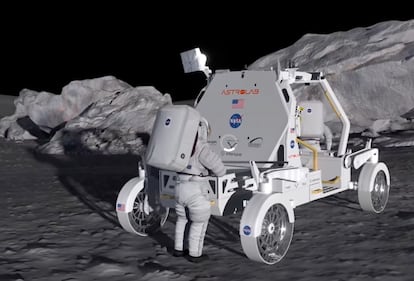

Two months after NASA promised what seems impossible — to build the first human colony on the Moon within the next decade — officials at the U.S. space agency have outlined the first steps toward making that dream a reality. On Tuesday, NASA administrator Jared Isaacman announced that by the end of 2026, three robotic missions to the lunar surface will be launched, carried out by private companies.
The first of these, scheduled for fall 2026, will be the Moon Base 1 mission, which NASA has contracted to Blue Origin, Jeff Bezos’ space company. Its destination will be the Moon’s south pole, where the U.S. plans to build its base. This mission will mark the debut of Bezos’ lunar lander, Blue Moon, whose second version will also compete with Elon Musk’s Starship to carry the first astronauts to set foot on the Moon in the 21st century during the Artemis 4 and Artemis 5 missions.
The Moon Base 2 mission, also scheduled for this year, will be operated by Astrobotics, which will have a second chance to land its Griffin lander on the Moon after failing in January 2024. And the third mission of the new U.S. program to build its lunar base will also be entrusted to another commercial provider, Intuitive Machines, which had a rough landing with its Athena robotic probe in 2025, following another failed attempt in 2024.
Spanish engineer Carlos García Galán is in charge of developing Isaacman’s ambitious plans to establish the first human colony on the Moon. García Galán is the director of NASA’s Moon Base program, and during Tuesday’s press conference, he outlined the three phases the space agency is planning: the first, which begins this year with the first announced missions, will be dedicated to conducting tests and learning how astronauts can survive long stays in an environment more hostile than the one encountered by the astronauts of the Apollo missions between 1969 and 1972.
The goal is to colonize the lunar south pole, where temperatures can drop to 200ºC below zero during nights that last two weeks and where there are craters bathed in perpetual darkness. And to thoroughly study that area — where a permanent colony will eventually be established — NASA plans to send vehicles there that will allow astronauts to travel across the Moon, along with multiple drones and scientific instruments. That will be the objective of the 21 lunar surface missions the agency has planned between 2026 and 2029 to complete the initial reconnaissance phase of the Moon Base program, which is set to reach its full potential over the next decade and become a staging ground for the next leap: sending astronauts to Mars.
Ambitions that depend on Bezos and Musk
After the launch of the Artemis 2 mission had been delayed twice, NASA announced a much grander ambition last March: that first crewed lunar mission in more than half a century would be just the first step toward establishing the first human colony on the Moon.
During his tenure, Isaacman has set out to restore NASA’s original spirit of “making the seemingly impossible possible.” This is his approach to meeting the goals set by Donald Trump, who, in his executive order to ensure American superiority in space, committed to establishing permanent bases on the lunar surface and powering them with nuclear energy. Such goals are hardly feasible in the short term, given that NASA does not yet have a spacecraft capable of landing astronauts on the Moon and that its recent commercial missions to land robots on Earth’s natural satellite have yielded very modest results.
If that situation changes and NASA manages to secure a lunar lander in the near future — a task it has entrusted to Blue Origin and SpaceX — the plan is to test that spacecraft in low Earth orbit in 2027 during the Artemis 3 mission. And if that test proves successful, the U.S. intends to attempt two lunar landings in 2028, with the Artemis 4 and Artemis 5 missions.
Assuming those plans come to fruition, the second phase of lunar colonization would begin in 2029, with the creation of the first habitable bases, which will be temporary and powered by solar and nuclear facilities. Starting in 2032, the bases could become permanent, built with the help of construction robots. The first human colony on another world would have pressurized transport vehicles to cover long distances, a telecommunications system — both on the surface and in lunar orbit — and nuclear power plants capable of providing constant energy to the base during the long, freezing lunar nights.
Sign up for our weekly newsletter to get more English-language news coverage from EL PAÍS USA Edition









































