
Artemis 3 and beyond: To set foot on the Moon, NASA needs Elon Musk and Jeff Bezos, but their spacecraft aren’t ready
The US space agency is already assembling an SLS rocket and an Orion capsule to launch the next mission in 2027. The lunar landers from SpaceX and Blue Origin are prototypes that are years behind schedule

Following the complete success of the Artemis 2 lunar test flight, NASA has been quick to declare that it was just a first step toward a lunar landing far more ambitious than that of Apollo 11 in 1969: “This time we’re coming back to stay,” was the motto at mission control in Houston, as soon as the four astronauts, who broke records and changed the tough-guy image of space cowboys, splashed down safely. This Monday, Jared Isaacman, the head of the U.S. space agency, announced that preparations for the 2027 launch of the Artemis 3 mission have already begun at the Kennedy Space Center in Florida.
According to Isaacman, the same mobile launch platform used for the April 2 launch will arrive at the assembly building in the coming days. Once repaired, it will be used to assemble the components of a new SLS rocket that will launch the next test flight of the Artemis program. Next month, the core stage — the largest part of this colossal spacecraft — is expected to leave the Louisiana plant where Boeing is finalizing its construction. Other smaller components are en route or have already arrived at the launch site. However, beyond that, nothing is clear; there is no concrete plan yet for how the test flight will be conducted, nor are there any known timelines for when all the spacecraft involved will be ready to fly and carry astronauts.
Developed by NASA itself, the Orion spacecraft has passed its first crewed test with flying colors. It has demonstrated its ability to fly to the vicinity of the Moon and return to Earth, but the capsule cannot land on the lunar surface. For that task, the Artemis program relies on a different type of spacecraft: lunar landers. The development and manufacturing of these landers has been entrusted to the space companies of magnates Elon Musk and Jeff Bezos. Both SpaceX and Blue Origin are years behind schedule on this project and, for the moment, only have prototypes of these spacecraft, which, unlike Orion, have not yet proven capable of flying to the Moon.
No spacecraft for Moon landing
The most striking case is SpaceX’s Starship, which has still not reached low Earth orbit — the first step in any space voyage — even though Musk had promised that by the end of 2026 he would be sending a fleet of them to Mars. The world’s richest man made those declarations in the summer of 2024, exultant, after several test flights in which Starship achieved various new milestones.
Since then, in almost two years, the most powerful and largest space launch vehicle in history has made no progress; and in early 2025, it suffered three consecutive explosions in mid-flight. So far in 2026, SpaceX still hasn’t flown the third-generation Starship, with which it will attempt to reach Earth orbit. Musk has promised that the next test flight — the 12th — of his giant rocket will be in May, after having started the year saying it would be in March, and then delaying expectations until April.

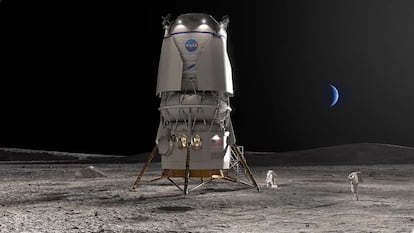
Starship was the spacecraft initially selected for the third Artemis mission, which aimed to return astronauts to the Moon in 2028. A few weeks ago, NASA definitively abandoned that plan. Now, Artemis 3 is no longer focused on the lunar surface, but rather on testing, near Earth, the docking process between the Orion spacecraft — which will transport astronauts to the Moon on the Artemis 4 and 5 missions — and a lunar lander. Once there, the astronauts will transfer to the lander to descend to and ascend from the lunar surface. The space agency is no longer referring specifically to Starship for Artemis 3, but rather generically to “lunar landers,” which also includes Bezos’s Blue Moon lander.
Bezos’s company is two decades behind Musk’s in their unique space race between tech magnates. However, in 2025, Blue Origin achieved two major victories over SpaceX: first, it successfully launched its giant New Glenn rocket into orbit on its maiden test flight — something Starship has yet to accomplish after 11 attempts; and then, it successfully sent twin probes to Mars.
Bezos and Musk in space race
Following those two successes, Blue Origin announced that its next milestone would be landing on the Moon in early 2026 with a first version of its Blue Moon lander, designed to carry robots and scientific instruments. But in January, the company decided that the third flight of its brand-new rocket would be to launch a massive telecommunications satellite in February, although that mission has yet to take off. So far, Bezos has not given a date for the launch of his first attempt to reach the Moon with a robotic mission, nor has he revealed a timeline for when a second version of the Blue Moon lunar lander, which is designed to carry astronauts, might be ready.
Given this history of delays and lack of concrete progress, which jeopardizes Trump’s goal of returning to the lunar surface before China, both magnates have stated they will refocus their space companies to ensure the U.S. wins the race. Each has done so in their own way. First, Bezos announced he is “pausing” his space tourism program to concentrate on putting humans on the Moon. And then, Musk promised that, in the coming years, he will build a “self-growing city” on the Moon.
For now, NASA is waiting for both SpaceX and Blue Origin to do something much more modest: test their lunar landers in Earth orbit. Isaacman has stated that he is confident SpaceX and Blue Origin will have those spacecraft ready for the Artemis 3 crew to conduct the test in 2027. Within the space agency itself, there’s another — much more realistic but also difficult — hot potato: getting a new Orion spacecraft ready within a year, when it was initially scheduled for completion in 2028. Furthermore, it will now need to incorporate the improvements determined by a thorough analysis of the Artemis 2 flight data.
Isaacman has made it clear that his strategy is to accelerate the Artemis program to make it more reliable by flying much more frequently. What he lacks now are concrete plans and timelines to make that idea viable.
Sign up for our weekly newsletter to get more English-language news coverage from EL PAÍS USA Edition









































