
Ukraine’s biggest defense gap: More than 92% of Russian ballistic missiles hit their targets
The Kremlin’s recent offensive on the Ukrainian capital, which on Monday claimed about 20 lives, has laid bare one of Kyiv’s most pressing military vulnerabilities
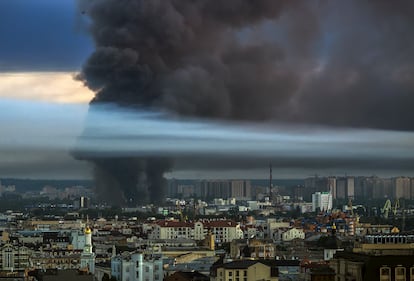

The data provide stark evidence. The major arms revolution taking place in Ukraine is not enough to counter Russia’s full potential. Kyiv’s defense industry has made an extraordinary leap forward, mass-producing modern, effective, and inexpensive weapons at speed, especially drones of all kinds. At the same time, however, it suffers from a significant shortcoming when it comes to defending against the ballistic missiles that Kremlin forces frequently launch.
In just the last two major attacks on the Ukrainian capital, on July 2 and 6, 49 of the 53 ballistic missiles used managed to hit their targets, according to figures from Kyiv’s own authorities. This represents a success rate of more than 92%.
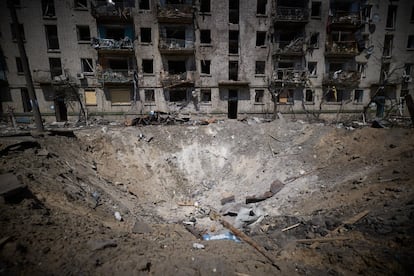
Ukraine has had to contend with around 2,200 attack drones, more than 1,730 aerial bombs, and 106 missiles over the past week, according to official figures. Its air-defense systems have become highly effective at intercepting drones — shooting down around 90% of them — but this does not diminish the pressing need for anti-ballistic missile capabilities.
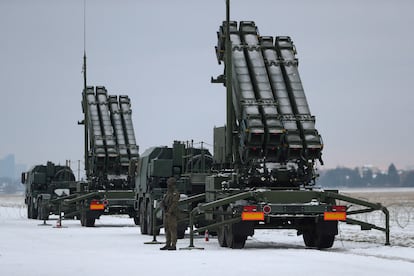
Experts consulted believe that this shortcoming cannot be overcome in the short term, particularly because of the difficulty of obtaining the U.S.-made Patriot air-defense system, the primary tool for countering ballistic missiles.
Kyiv is seeking above all the PAC-2 and PAC-3 variants. Each PAC-3 interceptor costs around $4 million, while a complete launcher battery is valued at roughly $1 billion. Beyond the cost, strong global demand for these systems makes it harder to incorporate them into Kyiv’s defenses amid the pressure being exerted by Russian President Vladimir Putin.
“The biggest problem right now is the war with Iran, for which a large number of these Patriot missiles are being used,” warns Oleksiy Melnyk, a former Ukrainian military officer and director of the Razumkov Center. He explains in a phone interview that the world in general — and Kyiv’s allies in particular — are facing a shortage of Patriots, especially PAC-3s, which are considered best suited to intercept ballistic missiles.
“The U.S. industry is not able to produce enough to replenish those stocks and, moreover, Ukraine is not among its priorities,” he acknowledges. The progress made by the domestic defense industry is significant, but according to Melnyk, even in the best-case scenario, his country could have a similar weapon within six months if the necessary technology were transferred to Kyiv.
In any case, he believes that the “real solution” lies not only in providing such interceptors, but also in supplying long-range missiles such as the Tomahawk, which has a range of up to 1,550 miles, or similar weapons capable of eliminating Russia’s ability to carry out attacks like those seen in recent days.
The Ukrainian government and military, which have surprised the Russians with the rapid development of a significant portion of their arsenal, acknowledge that the weapons currently at their disposal are not capable of countering the attack missiles Moscow is using. Ukrainian President Volodymyr Zelenskiy reiterates this almost daily to both Ukraine’s allies and the United States. Last Monday, on the eve of the NATO summit and coinciding with the latest Russian bombardment of Kyiv, the president once again voiced his frustration over the situation.
“Our warriors performed well today in intercepting drones and cruise missiles, but unfortunately not Russian ballistic missiles. And the reason lies in the insufficient supply of interceptor missiles,” he wrote on his social networks. “ It is critically important that the world — first and foremost the United States and our European partners — come out of the NATO Summit in Ankara with strong decisions in support of our air defense, and thus the protection of ordinary people’s lives.”
He concluded: “As long as Patriot missiles remain in our allies’ stockpiles, Russia is only encouraged to keep ‘vanquishing’ residential buildings.”
Last night, Kyiv came under a massive Russian attack. Russia launched 68 missiles and 351 attack drones. Response efforts are still underway. Damage has been recorded at more than 10 locations across the city, including residential buildings. All necessary services are on the… pic.twitter.com/101XvDDYs1
— Volodymyr Zelenskyy / Володимир Зеленський (@ZelenskyyUa) July 6, 2026
The statistics back the president’s complaints. “The success rate is low, to put it mildly. To shoot down ballistic missiles, you need the assets to do so,” Air Force spokesman Yurii Ihnat said on local television on Monday morning.
At that time, emergency teams were still trying to locate bodies after the latest wave of ballistic missiles, launched that dawn, left about 20 dead in Kyiv. Of the 29 ballistic missiles fired, none were intercepted. This came after the previous attack, when 20 of the 24 ballistic missiles launched by the Russians reached their targets.
“Russia is exploiting the fact that Ukraine, and indeed the world, is facing a serious shortage of PAC-2 and PAC-3 interceptor missiles. That is why it is increasingly focusing on ballistic missile strikes,” Ihnat added, echoing Zelenskiy’s complaints and Melnyk’s assessment. Melnyk also emphasized that not a single ballistic missile was intercepted on Monday.
Patriot, a defensive crown jewel
The Patriot missile is the crown jewel of the air-defense system that Kyiv needs most. However, according to Christian D. Villanueva, editor of the military affairs magazine Ejércitos, it is being produced in quantities far below current wartime demand. The return of Donald Trump to the U.S. presidency in January of last year was accompanied by new restrictions on the transfer of weapons to Kyiv.
At the same time, the armed conflict dominating the Middle East has intensified, prompting Washington to reserve the quantities it considers necessary for its own military to address the threats arising from its involvement, particularly in operations against Iran.
“No matter how much Europe wants to put money in through the PURL [Priority Ukraine Requirements List], Patriots are produced at the rate they are produced,” Villanueva explains. He also stresses that the issue is not only the missile itself and current demand for it, but the entire system that supports it: radars, vehicles, launch batteries, licenses, production lines, and so on. Ultimately, despite pressure from Brussels or NATO, everything depends on Trump’s approval, meaning that “Europe can do very little,” he concludes.
In any case, the editor of Ejércitos adds, the process depends on factors such as U.S. export regulations and licensing requirements, and even the presence of Ukrainian specialists on American soil. In short, it is something that would take “many months.” Spain has five Patriot batteries on order, but their delivery has repeatedly been delayed and, for now, they are not expected before 2031. Nevertheless, aware of Kyiv’s needs, Madrid announced during Zelenskiy’s latest visit to Spain in March that it would provide Ukraine with five PAC-2 Patriot missiles.
Ukraine’s air defenses are, however, largely capable of intercepting other types of weapons, including cruise missiles, as well as Iranian-designed Shahed drones and the various versions that have been developed since Russia launched its full-scale invasion of Ukraine in February 2022. According to the government in Kyiv, that is still not enough amid an international environment that is increasingly unfavorable to securing additional weapons from its allies.
Sign up for our weekly newsletter to get more English-language news coverage from EL PAÍS USA Edition









































