
‘Don’t go near the mountains’: Cartel violence spreads to Mazatlán as the war in Sinaloa fragments
The city, Sinaloa’s main tourist destination, is in the grip of a wave of violence that left 14 homicides in the first week of August
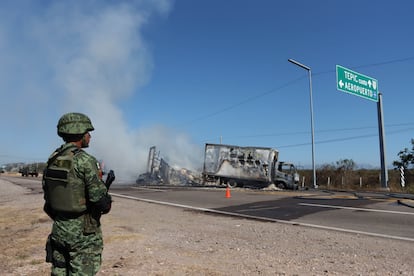
“Don’t even go near the mountains; it’s full of armed men, and it’s dangerous because the fighting is still going on in the towns below,” reads a message sent by a resident of the highlands of Concordia, in southern Sinaloa, to relatives who had fled to Mazatlán.
Southern Sinaloa has become an area of constant danger. Official reports increasingly point to this part of the state, home to its flagship tourist destination: Mazatlán. Known as the Pearl of the Pacific, the port city earned its reputation as one of Mexico’s fastest-growing tourist destinations over the past three decades. Today, however, it is grappling with a serious outbreak of violence.
In just the first week of August, up to 32 violent events were officially recorded. Of those, 14 people — almost all men — were confirmed murdered, and eight were injured. Among the injured were three state police officers attacked by drones on the Mazatlán-Culiacán bypass near the town of El Chilillo.
This is only the violence that becomes public through press reports, statements from the state prosecutor’s office, the Navy and the Army, and independently verified incidents. Other episodes never make it into the statistics, such as the situation described by the man warning his displaced relatives in Mazatlán. Over the past month, southern Sinaloa has become the area of greatest concern in Mexico. The violence that had previously ravaged other municipalities, especially Culiacán, has shifted southward.
Violence shifts to the south
“Since they detained ‘El Texas’ it’s been calmer,” says Teresa Navia, a reporter who covers crime, referring to the drop in violence in Culiacán, the capital of Sinaloa. “There are days I don’t have to go out to cover incidents, and that never used to happen.”
On July 8, Mexico’s security cabinet announced that Cristhian Guadalupe Pérez Pérez, alias “El Texas” or “El 01,” identified as the Los Chapitos plaza boss in Culiacán, had been killed in an unusual operation. Members of the Mexican Army and the state Public Security Secretariat surrounded the Paralela apartment towers in the Humaya neighborhood. Authorities first reported arrests and later disclosed that one person had also been killed. Images circulated on WhatsApp and Telegram groups. There were no visible gunshot wounds, no blood, no signs of a shootout, only a man lying dead inside the apartment.
The following day, Sinaloa Public Security Secretary General Sinuhé Téllez López said something his two predecessors had avoided saying: “We expect homicides to go down with this event.” The security cabinet identified Pérez Pérez as Los Chapitos’ main enforcer in Culiacán, where a conflict continues between La Chapiza and La Mayiza, the security arms of the two rival factions battling for control.
Culiacán has been the scene of eight out of every 10 murders and disappearances recorded in the state over the past two years. Recent data from Mexico’s National Institute of Statistics and Geography (INEGI) show that Sinaloa recorded 1,805 homicides in 2025 alone, as many as 150 more than were reported by the state prosecutor’s office. It was the Mexican state with the sharpest increase in killings that year: while homicides nationwide fell by 18%, Sinaloa experienced a 75% increase compared with the previous year.
And Culiacán continues to see outbreaks of violence, including the murder of influencer César Gastelum, who was shot and killed while livestreaming outside a fast-food restaurant just 200 meters from the state prosecutor’s headquarters. The case drew attention both inside and outside the state. But on that very same day, four bodies were discovered in Mazatlán, including those of a man and a woman found by a volunteer search group looking for missing persons in the city.
“Both had their hands handcuffed,” said one of the searchers while showing photographs of the bodies, which she said had been left there at least a week earlier, “they were already decomposing.”
There is no official report or government assessment describing exactly what is happening in Sinaloa nearly two years after the conflict began. But the testimony of residents and victims helps reconstruct how the geography of violence has shifted and how criminal groups have repositioned themselves.
After El Texas was killed, murders declined in Culiacán. But a couple of months earlier, residents had begun reporting displacement from Tepuche, north of the city, which had been attacked since February with drones and bombs dropped on houses and their occupants.
“They even threw bombs at the gas station and one day they dropped a head in the town square with a drone,” says a young man displaced from the town. According to him, the attackers were looking for people who supported one of the factions. “They were asking about El Chapo’s people and that’s why everyone switched sides.”
It has become increasingly common to hear residents and victims talk about “los volteados.” In local parlance, the term refers to people who switch allegiance from one criminal group to another. For many, it is a matter of survival and a way of remaining in their communities rather than fleeing.
Shifting alliances
The same thing happened in San Ignacio, a municipality farther south. For more than a year it was contested territory, with drone attacks, arson, land seizures, shootouts and disappearances in villages such as La Caña, Contra Estaca, Pueblo Viejo, Las Azoteas, Casa de Tejas, El Candelero, Rincón del Guayabito, La Lechuguilla, Las Sabilas, Los Brasiles, Tenchoquelite, Tepehuajes, Los Plátanos, Las Mulas, Las Lajas, El Cantón, Tolosa, El Chaco, Vado Hondo, San Juan, Los Humayes, Tacuitapa and El Capule. They have now become ghost towns.
But something unexplained by authorities has changed there. Reports of violence decreased, even though armed men patrol the towns, some on ATVs and others in four-wheel-drive trucks.
“They switched to La Mayiza,” residents explain. They even name alleged leaders, such as René Bastidas, who is also known as “El 00.” “El René was the one who switched; he was the one behind all the violence here and reached an agreement. Now they’re all on the same side,” they say.
That pattern, however, has not been repeated everywhere.
In Concordia, violence intensified after the arrest of Gabriel Nicolás Martínez Larios, known as “El Gabito,” who authorities accused of driving high levels of violence in Escuinapa, Rosario, Concordia and Mazatlán on behalf of Los Chapitos. The allegations included involvement in disappearances, clandestine graves, roadblocks, murders, forced displacement, illegal control of mines and drug trafficking.
He and his brother, Óscar Luciano Martínez Larios, known as “El Casco,” were also linked to the disappearance and murder of 10 employees of the mining company Vizsla Silver. The workers were abducted on February 23 from La Clementina, a residential complex that housed a camp for employees.
Following El Gabito’s arrest on June 2, the towns of Concordia entered a particularly volatile period.
“We’re literally being watched by armed men; they’ve already set up camp in four towns, in houses that were standing empty. It seems as though there’s an agreement with the people who have taken over the mountains. Because they’re going about their business very calmly — they used to hide, but not anymore. They’ve even taken over some of the best houses and are living there very peacefully,” say residents of the Concordia highlands, from towns such as Potrerillos, Chirimoyos, El Palmito, La Guayabera, and Pánuco.
In Escuinapa, the situation is different. There has been something of a lull since the arrest of Misael Guerrero Pérez, alias “El Güero Pin,” the alleged Los Chapitos boss in southern Sinaloa. He was arrested on June 25 together with Hilario Javier Martínez Gómez, a former municipal police chief who was serving as his bodyguard at the time.
Escuinapa had been a hotspot for drone attacks and displacement in Isla del Bosque, El Palmito, Tecualilla and El Camarón. Later, the violence reached the municipal seat itself, which from October 2025 to June 2026 endured repeated drone attacks, including strikes on the municipal police headquarters and the Army camp located in the town gymnasium. Evidence of an attack carried out on February 9 is still visible in the form of a hole in the gym roof that has yet to be repaired.
“Since they detained El Güero, there have been killings, but they are very isolated,” says a resident who agreed to an interview.
“They’ve stayed in Tecualilla; from there they are watching and waiting for the Army to leave,” adds another Escuinapa resident.
Locals are trying to make sense of the situation. Many believe the group that once dominated the area has been weakened and that the Army has succeeded in containing Los Cabrera, a criminal organization believed to have entered from the neighboring state of Durango.
“As long as the Army is here, they don’t come in,” says one resident, referring to military checkpoints at Escuinapa’s entrances and exits, patrols through the town center, fishing areas and mango orchards, which are the region’s main economic activities.
Mazatlán, a special case
State and federal authorities view Mazatlán as a place that must be protected at all costs. The port is Sinaloa’s leading tourist destination and the second most important in northwestern Mexico. It has experienced a massive real estate boom, with high-rise towers rising along the Malecón waterfront and new developments expanding northward. The boom dates back to 2017 and has been fueled by growth in domestic tourism as well as retirees from Canada and the United States choosing to settle there. That economic engine is what authorities are trying to safeguard.
More than 6,000 members of the Army, National Guard, Navy and the Secretariat of Security and Citizen Protection have been deployed to position themselves around the tourist zone. Soldiers can be seen patrolling the waterfront promenade, stationed with military vehicles in the Golden Zone, Mazatlán’s main tourist district, and manning checkpoints in strategic areas such as Cerritos.
Over the past month, that strategy has met with only partial success. Within the tourist district itself, where visitors crowd the beaches, restaurants, nightclubs and the historic center, four people have been murdered.
Outside that zone are the working-class neighborhoods, the areas that are home to the hotel and apartment workers, restaurant staff and nightlife employees. That is where the bodies are being found.
Sign up for our weekly newsletter to get more English-language news coverage from EL PAÍS USA Edition









































